Strategy vault / Trend following
A Trend Following Strategy Based on Keltner Channels
This strategy is designed based on the Keltner Channel indicator of candlestick charts to track trends by judging price breakouts of channel bands. The strategy is suitable for medium-term holding positions and can…
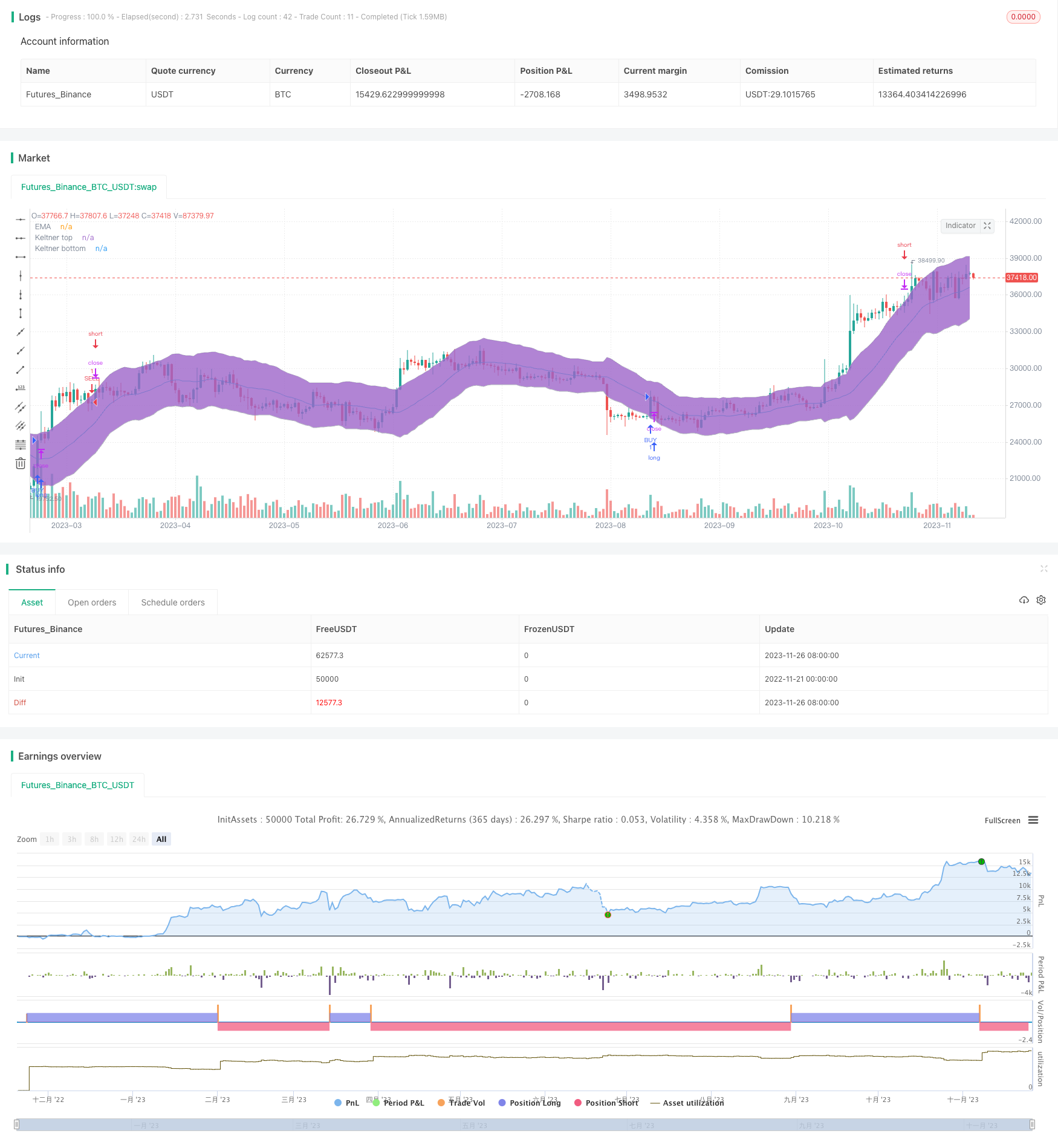
Overview
This strategy is designed based on the Keltner Channel indicator of candlestick charts to track trends by judging price breakouts of channel bands. The strategy is suitable for medium-term holding positions and can effectively follow trends with high profit potential.
Strategy Logic
The core of this strategy lies in constructing a Keltner Channel to judge price trends and potential support/resistance levels. Specifically, it first calculates the EMA line of candlesticks, then adds upper and lower bands at a distance of keltnerDeviation times ATR volatility to build the Keltner Channel. When the price breaks above the lower band, a long position is opened. When the price breaks below the upper band, a short position is opened to follow trends. In addition, the strategy also provides a closeOnEMATouch parameter to control whether to take profit when the price touches the EMA line.
The key logic focuses on three parts:
Construct the Keltner Channel indicator, including calculating the EMA, ATR volatility, upper and lower bands.
Judge entry signals based on breakouts of the channel bands, including going long when the price breaks above the lower band and going short when the price breaks below the upper band.
Provide the closeOnEMATouch parameter to control whether to take profit when the price touches the EMA line.
By combining these three parts, a trend following trading strategy based on channel indicators is implemented.
Advantage Analysis
Compared with traditional moving stop loss strategies, this strategy has the following main advantages:
Can effectively follow market trends and general direction.
Relatively long medium-term holding periods avoid over-frequent trading.
By considering volatility, it has a certain filtering effect against abnormal market conditions.
Provides risk control mechanisms through stop loss.
Therefore, this strategy is very suitable for quantitative traders who have accurate judgments on market trends and pursue high capital utilization.
Risk Analysis
Despite its advantages, the strategy also faces some key risks in actual trading:
Sudden and violent trend reversal poses the biggest risk, which may penetrate the stop loss point and cause huge losses.
Price may oscillate within the channel and trigger stop loss repeatedly.
High trading frequency may lead to severe impact on profits from trading costs and slippage.
To control these risks, we can adjust parameters to make the channel range more reasonable, choose products with smaller price fluctuations, or properly widen the stop loss distance. But most importantly, we need to keep prudent enough judgments on the markets.
Optimization Directions
Considering the potential risks, we can further optimize the strategy in the following aspects:
Increase diversity of stop loss methods. Currently only the closeOnEMATouch method is provided. We can introduce more auxiliary stop loss indicators for more comprehensive and multidimensional risk control.
Optimize parameter settings. More automated methods can be introduced to optimize parameters to make the Keltner Channel settings more intelligent and adaptive.
Add position sizing control. By introducing capital management modules, we can dynamically adjust positions based on drawdowns or market volatility.
Add filtering conditions. More auxiliary filters can be set on both entry and stop loss to avoid unnecessary losses due to wrong signals.
Summary
In summary, this is a typical medium-term trend following strategy based on channel indicators. Compared to simple moving stop loss strategies, it provides a certain risk adjustment function through volatility factors and can effectively follow trends to make profits. However, risks of reversal and oscillation still need to be watched out for in live trading. Parameter optimization, expanding stop loss methods and adding filtering conditions can help further improve the strategy.
Parameters
| Name | Default | What it controls |
|---|---|---|
| v_input_1 | 20 | Keltner EMA Period Length |
| v_input_2 | 2 | Keltner band width (in ATRs) |
| v_input_3 | false | Close trade on EMA touch? (less drawdown, but less profit and higher commissions impact) |
Source Pine Script
/*backtest
start: 2022-11-21 00:00:00
end: 2023-11-27 00:00:00
period: 1d
basePeriod: 1h
exchanges: [{"eid":"Futures_Binance","currency":"BTC_USDT"}]
*/

//@version=2
strategy("Keltner bounce from border. No repaint. (by Zelibobla)", shorttitle="Keltner border bounce", overlay=true)

price = open

// build Keltner
keltnerLength = input(defval=20, minval=1, title="Keltner EMA Period Length")
keltnerDeviation = input(defval=2, minval=1, maxval=5, title="Keltner band width (in ATRs)")
closeOnEMATouch = input(type=bool, defval=false, title="Close trade on EMA touch? (less drawdown, but less profit and higher commissions impact)")
EMA = sma(price, keltnerLength)
ATR = atr(keltnerLength)
top = EMA + ATR * keltnerDeviation
bottom = EMA - ATR * keltnerDeviation

buyEntry = crossover(price, bottom)
sellEntry = crossunder(price, top)
plot(EMA, color=aqua,title="EMA")
p1 = plot(top, color=silver,title="Keltner top")
p2 = plot(bottom, color=silver,title="Keltner bottom")
fill(p1, p2)

if ( crossover(price, bottom))
    strategy.entry("BUY", strategy.long, stop=bottom,  comment="BUY")

if( crossover(price,EMA) and closeOnEMATouch )
    strategy.close("BUY")

if ( crossunder(price, top))
    strategy.entry("SELL", strategy.short, stop=top,  comment="SELL")
if( crossunder(price, EMA) and  closeOnEMATouch )
    strategy.close("SELL")
Published by ChaoZhang on the FMZ strategy square · last modified 2023-11-28. Collected in the Quant Trading Vault. Unvalidated research: re-test with your own data and costs before trusting it.
Build this with AgenKit
A spec is not a trading system. Paste this into your coding agent and AgenKit runs a specialist team — architecture, test-first build, risk gates, review — with paper trading on by default.
/agenkit build a production-grade trading bot with a backtest engine, risk controls and paper trading by default from strategies/A-Trend-Following-Strategy-Based-on-Keltner-Channels.md- npx agenkit install engineering-kit in your project
- Paste the command into your agent and approve each phase
- Get tests, backtest, risk controls and a paper-trading switch
Understand it first
Before you run this, read the lesson behind the idea and how to backtest it honestly. Specs like this one are the survivors of an unknown number of trials; deflate their results accordingly.
Related specs
- Fixed Range Volume Profile And Anchored VWAP Trend Identification Strategy With Dynamic Stop LossPine Script · Trend following · 1h
- Multi Factor Trend Price Action Strategy with Dynamic Risk Management SystemPine Script · Trend following · 2h
- Multi Indicator Dynamic Trend Following Strategy Based on EMA and SMAPine Script · Trend following · 1d
- Trend Following Strategy Based on PMax IndicatorPine Script · Trend following · 5m
- Trend Tracking and Short term Trading Strategy Based on ADX IndicatorPine Script · Trend following · 1d
- Triple Supertrend Ichimoku Cloud Quantitative Trading StrategyPine Script · Trend following · 1d