Strategy vault / Mean reversion
Adaptive Moving Average Trading Strategy
This strategy is a trend-following strategy based on adaptive moving averages. It uses two DEMA moving averages with different periods to generate trading signals. The strategy will automatically adapt the timeframe…
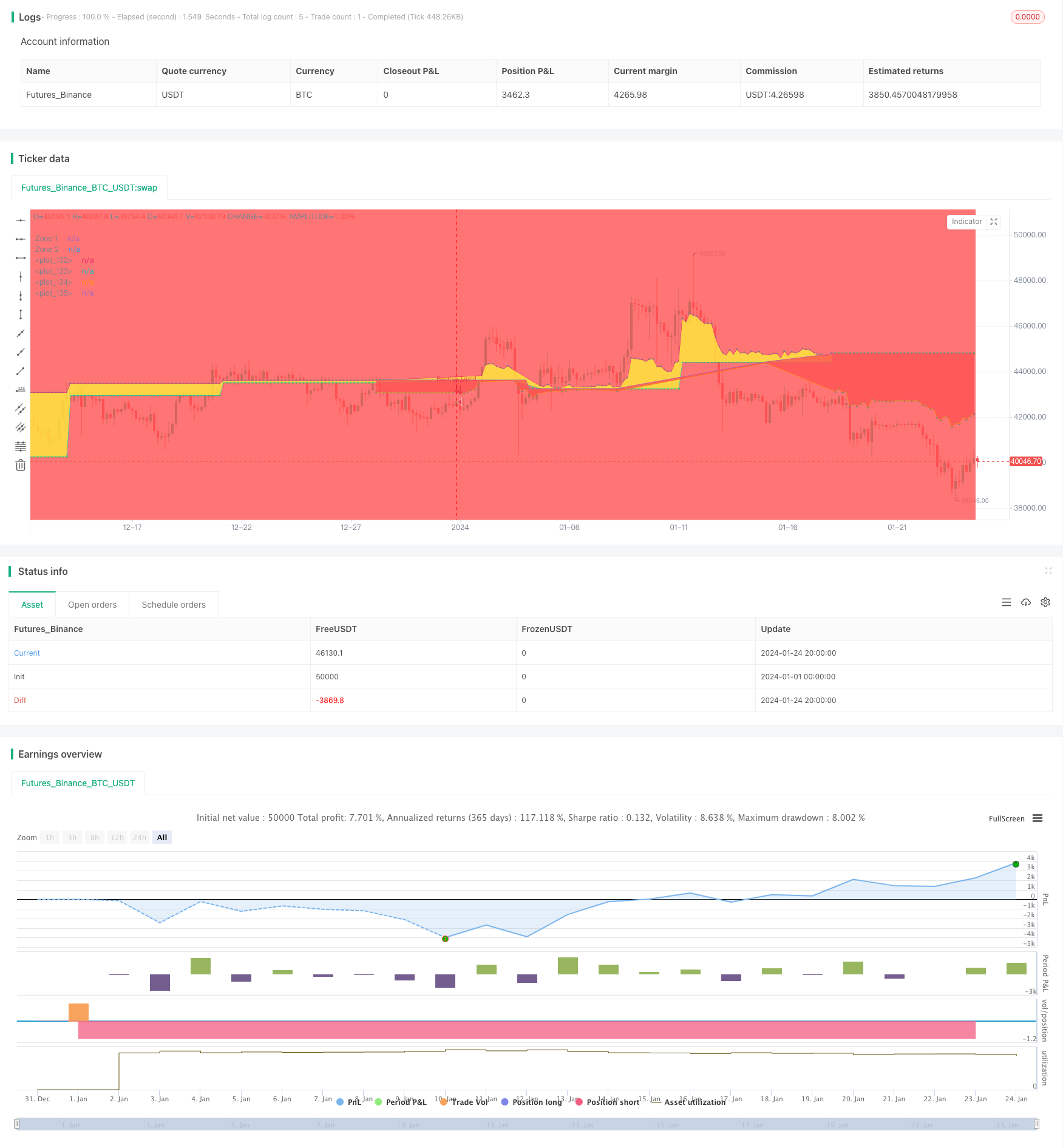
Overview
This strategy is a trend-following strategy based on adaptive moving averages. It uses two DEMA moving averages with different periods to generate trading signals. The strategy will automatically adapt the timeframe for analysis based on the current period, allowing multi-timeframe tracking.
Strategy Logic
The strategy uses a fast DEMA line and a slow DEMA line to construct trading signals. The fast line has a period of tf and the slow line has a period of tf*2. A buy signal is generated when the fast line crosses above the slow line. A sell signal is generated when the fast line crosses below the slow line. This allows the strategy to track mid-to-long term trends. In addition, the strategy also uses a Hull double moving average filter to reduce noisy trades. Signals are only generated when the Hull filter agrees on directionality.
Advantage Analysis
The biggest advantage of this strategy is that it can adapt to different periods automatically. It will choose the analysis timeframe from daily to weekly based on the current period. This makes the strategy suitable for a variety of market environments. In addition, the dual moving average structure can track trends effectively, and the dual filter increases signal quality. As a result, this strategy is very suitable for tracking mid-to-long term trends.
Risk Analysis
The main risk of this strategy comes from trend reversals. When the market transitions from a bull market to a bear market, the fast and slow lines may cross sharply downward, resulting in huge floating losses. In addition, the line filter may also miss out on some profitable opportunities. If the filter disagrees with the price directionality, those otherwise profitable signals will be skipped. As a result, this strategy mainly targets stable mid-to-long term trending markets.
Optimization Directions
The strategy can be optimized by adjusting the filter parameters or using other indicators as replacements. For example, MACD can be tested instead of HullMA, or the HullMA period parameters can be adjusted. Different parameter combinations can also be tested to find better fitted trading rules. In addition, volatility indicators can also be incorporated to control position sizing. Smaller positions can be taken when market volatility rises.
Conclusion
In conclusion, this is a very practical adaptive trend following strategy. It can automatically adjust the analysis timeframe for different periods and is suitable for trading across different time horizons. The dual moving average structure can steadily track trends, and the filter also improves signal quality. Overall, it is suitable for investors looking for steady mid-to-long term returns.
Parameters
| Name | Default | What it controls |
|---|---|---|
| v_input_1 | false | Delay Open/Close MA (Forces Non-Repainting) |
Source Pine Script
/*backtest
start: 2024-01-01 00:00:00
end: 2024-01-24 23:59:59
period: 4h
basePeriod: 15m
exchanges: [{"eid":"Futures_Binance","currency":"BTC_USDT"}]
*/

//@version=2

//
//---------------------------------------------
//* Author - PPSingnal
//* http://ppsignal.com
//---------------------------------------------
//
//

strategy (title="PPSignal V4 (Auto Adaptive Times)", shorttitle="PPSignal V4", overlay=true)
delayOffset = input(defval = 0, title = "Delay Open/Close MA (Forces Non-Repainting)", minval = 0, step = 1)

//----------------------------------------    INICIO PPI     ----------------------------------------

// - PARÁMETROS DE ENTRADA
// SE DEFINE LA RESOLUCIÓN
useRes1 = true
setRes1 = true


tf = timeframe.period == "60" ? 4 : timeframe.period == "240" ? 4 : timeframe.period == "D" ? 4 : timeframe.period == "W" ?4 : 4


// PRIMER DEMA
type   = "DEMA"
src   = close
len    = tf
off   = 0
lsma   = 0
// SEGUNDA DEMA
type2   = "DEMA"
src2    = open
len2    = tf
off2    = 0
lsma2   = 0

// - INPUTS END

//----------------------------------------    INICIO FUNCIONES     ----------------------------------------

// RETORNA UNA MEDIA MOVIL (TYPE=TIPO / SRC = TIPO DE PRECIO / LEN=LONGITUD / LSMA=0)
variant(type, src, len, lsma) =>
    v1 = sma(src, len)                                                  // Simple
    v2 = ema(src, len)                                                  // Exponential
    v3 = wma(src, len)                                                  // Weighted
    v4 = vwma(src, len)                                                 // Volume Weighted
    v5 = na(v5[1]) ? sma(src, len) : (v5[1] * (len - 1) + src) / len    // Smoothed
    v6 = 2 * v2 - ema(v2, len)                                          // Double Exponential
    v7 = 3 * (v2 - ema(v2, len)) + ema(ema(v2, len), len)               // Triple Exponential
    v8 = wma(2 * wma(src, len / 2) - wma(src, len), round(sqrt(len)))   // Hull
    v9 = linreg(src, len, lsma)                                         // Least Squares
    // return variant, defaults to SMA if input invalid.
    type=="EMA"?v2 : type=="WMA"?v3 : type=="VWMA"?v4 : type=="SMMA"?v5 : type=="DEMA"?v6 : type=="TEMA"?v7 : type=="HullMA"?v8 : type=="LSMA"?v9 : v1

// SuperSmoother filter
    // © 2013  John F. Ehlers
    a1 = exp(-1.414*3.14159 / len)
    b1 = 2*a1*cos(1.414*3.14159 / len)
    c2 = b1
    c3 = (-a1)*a1
    c1 = 1 - c2 - c3
    v12 = 0.0
    v12 := c1*(src + nz(src[1])) / 2 + c2*nz(v12[1]) + c3*nz(v12[2])


// RETORNA LA RESOLUCIÓN SETEADA Y SINO LA DEFAULT
// 3H:      1min - 3min - 5min - 15min
// DIARIO:  30 - 45 - 60
// SEMANAL: 120 - 180 - 240 - D


reso(exp, use, res) => use ? request.security(syminfo.tickerid, timeframe.period=="1" ? "D" : timeframe.period=="3" ? "D" : timeframe.period=="5" ? "D" : timeframe.period=="15" ? "D" : timeframe.period=="30" ? "D" : timeframe.period=="45" ? "W" : timeframe.period=="60" ? "W" : timeframe.period=="120" ? "W" : timeframe.period=="180" ? "W" : timeframe.period=="240" ? "W" : timeframe.period=="D" ? "W" : "W", exp) : exp


//----------------------------------------    FIN FUNCIONES     ----------------------------------------

//----------------------------------------    INICIO VARIABLES     ----------------------------------------

// DEMAS
ma_short    = reso(variant(type, src[off], len, lsma), useRes1, setRes1)
ma_long     = reso(variant(type2, src2[off2], len2, lsma2), useRes1, setRes1)


//----------------------------------------    FIN VARIABLES     ----------------------------------------


//----------------------------------------    FIN PPI     ----------------------------------------

//----------------------------------------    PRIMER FILTRO      ----------------------------------------
// Double HullMA
scolor      = false

n=1
n2ma=2*wma(close,round(n/2))
nma=wma(close,n)
diff=n2ma-nma
sqn=round(sqrt(n))

n2ma1=2*wma(close[1],round(n/2))
nma1=wma(close[1],n)
diff1=n2ma1-nma1
sqn1=round(sqrt(n))

n1=wma(diff,sqn)
n2=wma(diff1,sqn)

//----------------------------------------    FIN PRIMER FILTRO     ----------------------------------------

//----------------------------------------    INICIO CONDICIONES      ----------------------------------------

// CONDICION CON FILTRO
cruce= (ma_short > ma_long) and n1>n2 ? true : ma_short < ma_long ? false : cruce[1]
// Condition

// FONDO DE COLOR
bground = cruce ? white : red
bgcolor(bground, transp=90)


// BARRAS COLOREADAS
barcol = cruce ? yellow : red
barcolor(barcol, transp=0)

closePlot   = plot(ma_short, title = "Zone 1", color = gray, circles = 0, style = circles, transp = 100)
openPlot   = plot(ma_long, title = "Zone 2", color = green, circles = 0, style = circles, transp = 100)
trendState  = ma_short > ma_long ? true : ma_short < ma_long ? false : trendState[1]

// channel fill
closePlotU  = plot(trendState ? ma_short : na, transp = 100, editable = false)
openPlotU   = plot(trendState ? ma_long : na, transp = 100, editable = false)
closePlotD  = plot(trendState ? na : ma_short, transp = 100, editable = false)
openPlotD   = plot(trendState ? na : ma_long, transp = 100, editable = false)

fill(openPlotU, closePlotU, title = "Up Trend Fill", color = yellow, transp = 70)
fill(openPlotD, closePlotD, title = "Down Trend Fill", color = red, transp = 70)


//----------------------------------------    FIN CONDICIONES     ----------------------------------------

//----------------------------------------    INICIO ESTRATEGIA      ----------------------------------------

//CONDICION COMPRA
longCond    = (ma_short > ma_long) and n1>=n2

//CONDICION VENTA

shortCond    = (ma_short < ma_long)

//ABRO COMPRA A
strategy.entry("Bull Trend", strategy.long, when = longCond)

//ABRO VENTA A
strategy.entry("Bearish Trend", strategy.short, when = shortCond)

//CIERRO VENTA A
strategy.exit("Exit Short", from_entry = "Bull Trend", when = shortCond)

//CIERRO COMPRA A
strategy.exit("Exit Long", from_entry = "Bearish Trend", when = longCond)

//----------------------------------------    FIN ESTRATEGIA     ----------------------------------------
Published by ChaoZhang on the FMZ strategy square · last modified 2024-02-22. Collected in the Quant Trading Vault. Unvalidated research: re-test with your own data and costs before trusting it.
Build this with AgenKit
A spec is not a trading system. Paste this into your coding agent and AgenKit runs a specialist team — architecture, test-first build, risk gates, review — with paper trading on by default.
/agenkit build a production-grade trading bot with a backtest engine, risk controls and paper trading by default from strategies/Adaptive-Moving-Average-Trading-Strategy.md- npx agenkit install engineering-kit in your project
- Paste the command into your agent and approve each phase
- Get tests, backtest, risk controls and a paper-trading switch
Understand it first
Before you run this, read the lesson behind the idea and how to backtest it honestly. Specs like this one are the survivors of an unknown number of trials; deflate their results accordingly.
Related specs
- Advanced 15 Minute Chart Trading Signal StrategyPine Script · Mean reversion · 3h
- BONK Multi Factor Trading StrategyPine Script · Mean reversion · 1d
- Customizable Non Repainting HTF MACD MFI Scalable Bot StrategyPine Script · Mean reversion · 1d
- Dynamic Adaptive Multi Timeframe Trend Following and Range Reversal Hybrid StrategyPine Script · Mean reversion · 2d
- MACD Cross Period Trading StrategyPine Script · Mean reversion · 1d
- MACD Double Optimization Trading StrategyPine Script · Mean reversion · 1d