Adaptive Regularized Moving Average Cross Market Arbitrage Strategy
This strategy implements arbitrage trading between different markets by calculating an adaptive regularized moving average line. The strategy features cross-market arbitrage, dynamic parameter adjustment, risk…
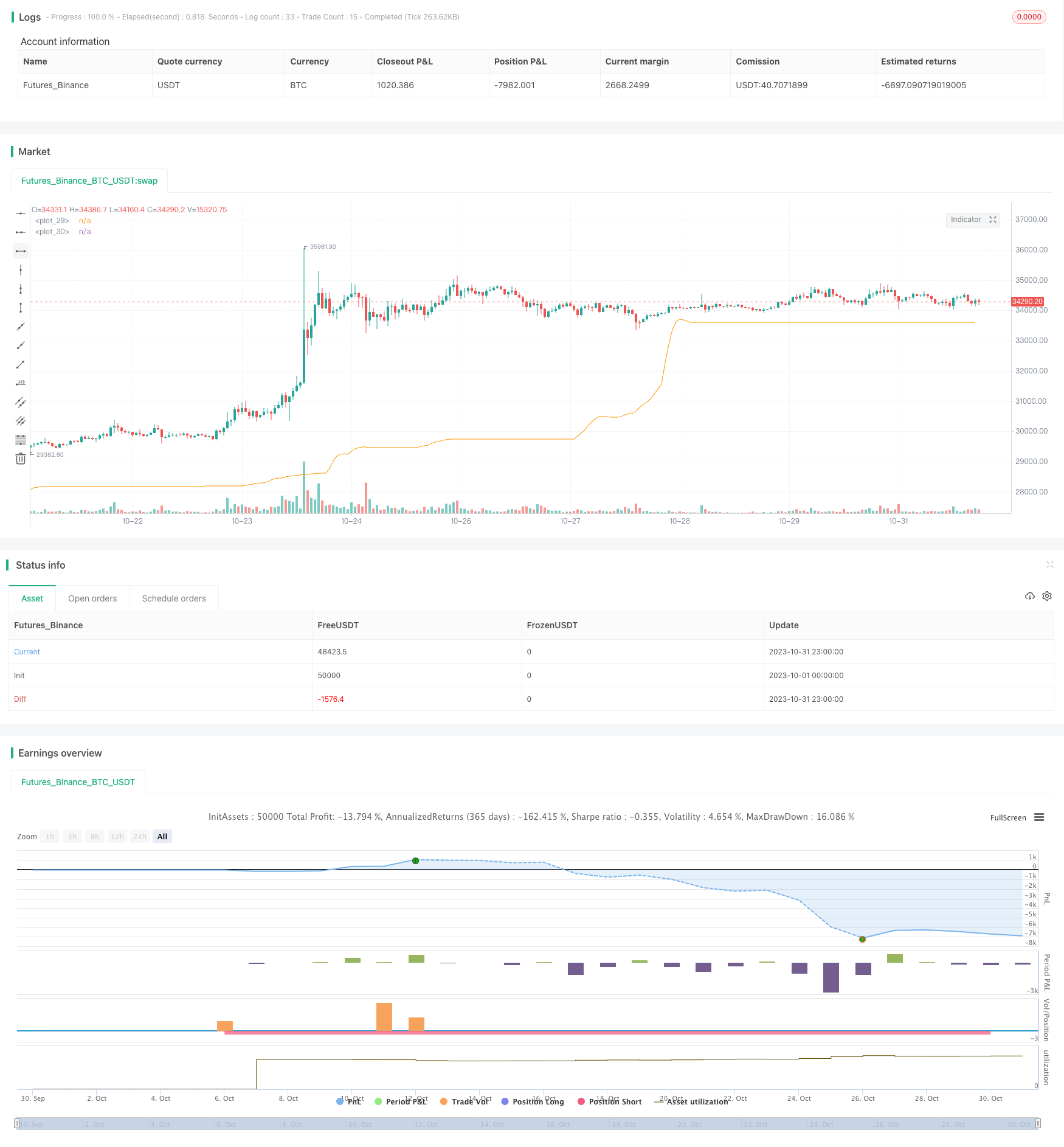
Overview
This strategy implements arbitrage trading between different markets by calculating an adaptive regularized moving average line. The strategy features cross-market arbitrage, dynamic parameter adjustment, risk control, etc.
Strategy Principle
The strategy first defines a scaleMinimax function to standardize the time series to a specified range. Then it defines an adaptive regularized moving average function rema to calculate the smoothed signal line sig. The calculation of the signal line is:
Define a sliding window, default length 5 days.
The sig value for each day is the weighted average of the previous sig value and the current closing price. The weighting uses an adaptive weighting mechanism, where values closer to the current price are weighted higher.
Add a λ parameter as a regularizer to make the sig transition smoother.
After obtaining the signal line, the strategy determines long/short based on the golden/dead cross of the signal line and price. Specifically:
When sig crosses above price, go long.
When sig crosses below price, go short.
In addition, the strategy adds the smooth factor and show_line as adjustable parameters to increase flexibility.
Advantage Analysis
Compared with traditional moving average strategies, this strategy has the following advantages:
The adaptive weighting mechanism can respond faster to price changes.
The added regularizer makes the signal line smoother, avoiding wrong signals from drastic price fluctuations.
Cross-market arbitrage can profit from price differences between markets.
Flexible adjustable parameters can be optimized according to market conditions.
Risks and Solutions
The strategy also has some risks:
The probability of wrong signals from double crossovers is higher. The solution is to properly adjust the smooth parameter to avoid oscillation of the signal line.
Cross-market arbitrage requires that the two markets have price correlation and consistent trends. The solution is to select highly correlated markets for arbitrage.
Parameter optimization requires sufficient historical data for backtesting. The solution is to cautiously adjust parameters in live trading.
Optimization Directions
The strategy can also be optimized in the following aspects:
In parameter selection, machine learning algorithms can be introduced to automatically optimize parameter combinations.
In signal generation, more indicators can be introduced to construct more stable trading signals.
In risk control, stop loss can be set to limit the loss per trade.
In cross-market arbitrage, it can be extended to more highly correlated trading assets.
Summary
This strategy implements arbitrage trading between markets by adaptively calculating moving averages. Compared with traditional moving average strategies, it has the advantages of adaptive parameters, smoothed processing, cross-market arbitrage, etc. Next steps are to further optimize the strategy through machine learning, combined signals, risk management, etc.
Parameters
| Name | Default | What it controls |
|---|---|---|
| v_input_1_close | 0 | Data source: close | high | low | open | hl2 | hlc3 | hlcc4 | ohlc4 |
| v_input_2 | 2 | REMA smooth factor |
| v_input_3 | true | Show signal line |
Source Pine Script
/*backtest
start: 2023-10-01 00:00:00
end: 2023-10-31 23:59:59
period: 1h
basePeriod: 15m
exchanges: [{"eid":"Futures_Binance","currency":"BTC_USDT"}]
*/

//@version=3
strategy("Crossover82%", overlay=true)

//
// Functions
//
scaleMinimax(X, p, min, max) =>
    hi = highest(X, p), lo = lowest(X, p)
    (max - min) * (X - lo)/(hi - lo) + min

rema(ts, p) => // regularized ma
    rm = 0.0, lambda = .5, a = 2 / (p + 1)
    rm := (nz(rm[1]) + a * (ts - nz(rm[1])) + lambda * (2 * nz(rm[1]) - nz(rm[2]))) / (lambda + 1)
    rm

//
// Inputs
//
X = input(close, title="Data source")
smooth = input(2, title="REMA smooth factor")
show_line = input(true, title="Show signal line")

//
// Main
//
p = 5
sig = rema(scaleMinimax(pow(X*p,-X) - 0.1, 100, lowest(X, 100), highest(X, 100)), smooth)

plot(show_line ? sig : na, linewidth=1)
plot(cross(sig, X) ? ohlc4 : na, style=circles, linewidth=8, color=blue, transp=50)

longCondition = crossover(sig, X)
if (longCondition)
    strategy.entry("LE", strategy.long)

shortCondition = crossunder(sig, X)
if (shortCondition)
    strategy.entry("SE", strategy.short)
Published by ChaoZhang on the FMZ strategy square · last modified 2023-11-16. Collected in the Quant Trading Vault. Unvalidated research: re-test with your own data and costs before trusting it.
Build this with AgenKit
A spec is not a trading system. Paste this into your coding agent and AgenKit runs a specialist team — architecture, test-first build, risk gates, review — with paper trading on by default.
/agenkit build a spread arbitrage engine with WebSocket order routing and leg-risk controls from strategies/Adaptive-Regularized-Moving-Average-Cross-Market-Arbitrage-Strategy.md- npx agenkit install engineering-kit in your project
- Paste the command into your agent and approve each phase
- Get tests, backtest, risk controls and a paper-trading switch
Understand it first
Before you run this, read the lesson behind the idea and how to backtest it honestly. Specs like this one are the survivors of an unknown number of trials; deflate their results accordingly.
Related specs
- Bitcoin Trading Strategy Based on Ichimoku CloudPine Script · Arbitrage · 1h
- multiple auxiliary RSI indicator strategyPine Script · Arbitrage · 1d
- Time based Strategy with ATR Take ProfitPine Script · Arbitrage · 1h
- Dual Reversal Arbitrage StrategyPine Script · Arbitrage · 1h
- High Performance Algorithmic Trading Strategy Based on Quantitative ModelsPine Script · Arbitrage · 1d
- Oscillating Market Long StrategyPine Script · Arbitrage · 1d