Adaptive Volatility Breakout Trading Strategy
This strategy identifies market trends based on price breakthrough points and uses adaptive indicators to determine the overall trend in order to capture short-term price reversal opportunities. It generates buy/sell…
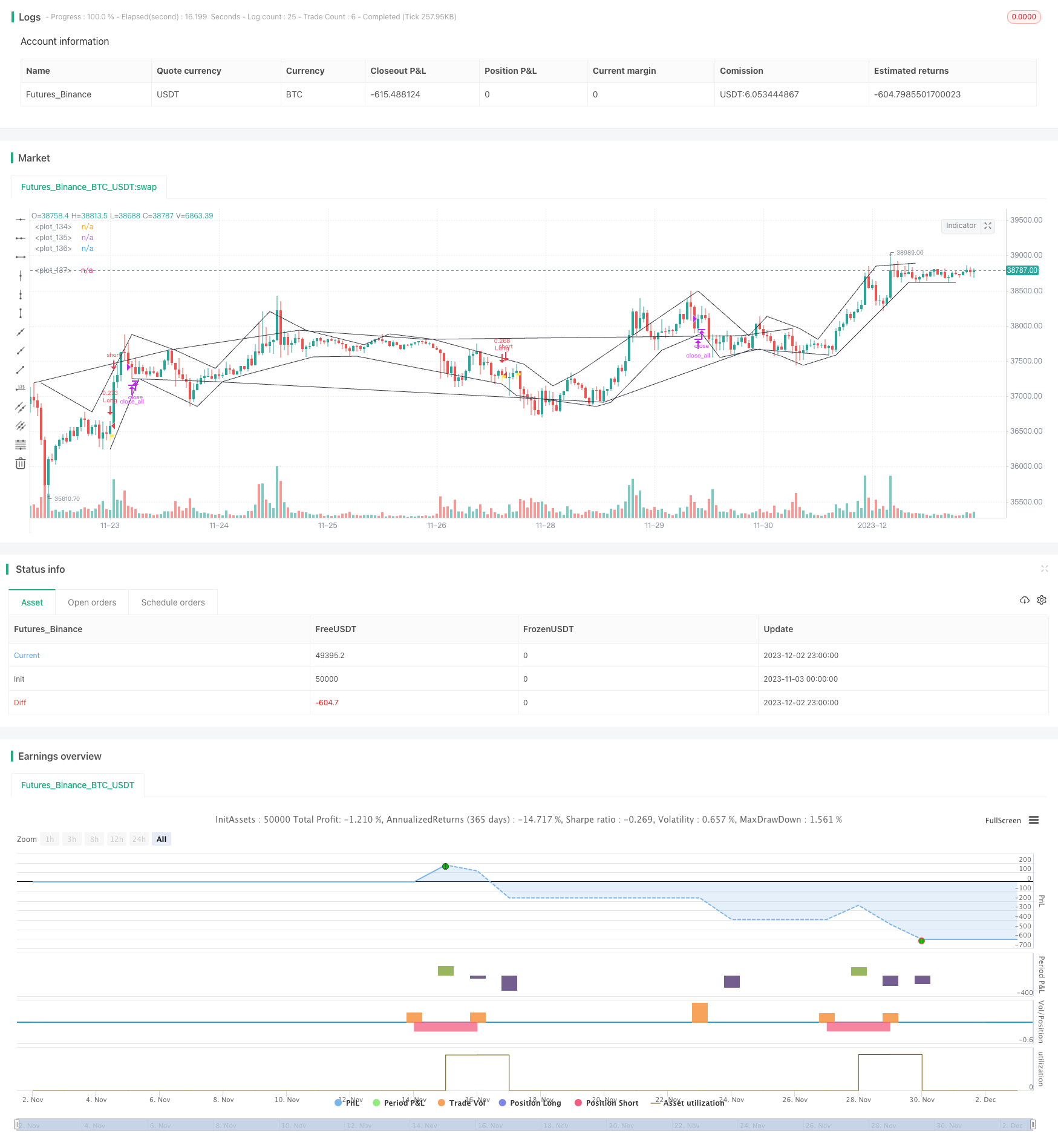
Overview
This strategy identifies market trends based on price breakthrough points and uses adaptive indicators to determine the overall trend in order to capture short-term price reversal opportunities. It generates buy/sell signals when prices break out of the baseline channel. The strategy is suitable for trading highly volatile cryptocurrencies.
Strategy Logic
- Identify extreme price points as channel boundaries. When prices hit new highs or lows, set those points as channel boundaries.
- Calculate the adaptive volatility MA indicator to determine the overall trend direction. Larger MA values indicate the market is currently in a volatile stage.
- Generate buy signals when prices break above the channel top, and sell signals when prices break below the channel bottom.
- Set stop loss points. Long position stop loss points are set at 1% below the entry price.
Advantage Analysis
- The price channel is adaptive and can accurately determine trend reversal points.
- The volatility indicator judges the overall trend and avoids missing the big picture in volatile markets.
- As a reversal strategy, it is suitable to capture short-term price bounces.
Risk Analysis
- In a sustained downtrend, multiple stop loss points may be triggered resulting in large losses.
- Frequent buy and sell trades in ranging markets increase transaction costs.
- Requires manual determination of entry times. Fully automated trading has overfitting risks.
Optimization Directions
- Optimize MA parameters to better determine overall trends.
- Incorporate volume indicators to avoid reversal signals in volume exhaustion scenarios.
- Add machine learning models to enable dynamic parameter optimization.
Summary
The overall logic of this strategy is clear and has some practical value. However, trading risks should still be controlled to prevent large losses in certain market conditions. Next steps include optimizing multiple dimensions such as the overall framework, indicator parameters, and risk control to make the strategy parameters and trading signals more reliable.
Parameters
| Name | Default | What it controls |
|---|---|---|
| v_input_1 | 13 | Start Date |
| v_input_2 | 9 | Start Month |
| v_input_3 | 2021 | Start Year |
| v_input_4 | true | filter Bill Williams Fractals: |
| v_input_5 | true | Filter fractals using extreme method: |
| v_input_6 | 2 | Extreme Window: |
| v_input_7 | true | ShowSwingsHL |
| v_input_8 | true | showchannel |
| v_input_9 | true | showZigZag |
| v_input_10 | 2 | VolumeMA |
| v_input_11 | 0.01 | Long Stop Loss (%) |
Source Pine Script
/*backtest
start: 2023-11-03 00:00:00
end: 2023-12-03 00:00:00
period: 1h
basePeriod: 15m
exchanges: [{"eid":"Futures_Binance","currency":"BTC_USDT"}]
*/

// @version = 4
// This source code is subject to the terms of the Mozilla Public License 2.0 at https://mozilla.org/MPL/2.0/
// © TradingGroundhog


//  ||---   Cash & Date:
cash_amout = 10000
pyramid_val = 1
cash_given_per_lot = cash_amout/pyramid_val
startDate = input(title="Start Date",defval=13)
startMonth = input(title="Start Month",defval=9)
startYear = input(title="Start Year",defval=2021)
afterStartDate = (time >= timestamp(syminfo.timezone,startYear, startMonth, startDate, 0, 0))
//  ||------------------------------------------------------------------------------------------------------


//  ||---   Strategy:
strategy(title="TradingGroundhog - Strategy & Fractal V1 - Short term", overlay=true, max_bars_back = 4000, max_labels_count=500, commission_type=strategy.commission.percent, commission_value=0.00,default_qty_type=strategy.cash, default_qty_value= cash_given_per_lot, pyramiding=pyramid_val)
//  ||------------------------------------------------------------------------------------------------------


//  ||---   Fractal Recognition:
filterBW = input(true, title="filter Bill Williams Fractals:")
filterFractals = input(true, title="Filter fractals using extreme method:")
length = input(2, title="Extreme Window:")
regulartopfractal = high[4] < high[3] and high[3] < high[2] and high[2] > high[1] and high[1] > high[0]
regularbotfractal = low[4] > low[3] and low[3] > low[2] and low[2] < low[1] and low[1] < low[0]
billwtopfractal = filterBW ? false : (high[4] < high[2] and high[3] < high[2] and high[2] > high[1] and high[2] > high[0] ? true : false)
billwbotfractal = filterBW ? false : (low[4] > low[2] and low[3] > low[2] and low[2] < low[1] and low[2] < low[0] ? true : false)
ftop = filterBW ? regulartopfractal : regulartopfractal or billwtopfractal
fbot = filterBW ? regularbotfractal : regularbotfractal or billwbotfractal
topf = ftop ? high[2] >= highest(high, length) ? true : false : false
botf = fbot ? low[2] <= lowest(low, length) ? true : false : false
filteredtopf = filterFractals ? topf : ftop
filteredbotf = filterFractals ? botf : fbot
//  ||------------------------------------------------------------------------------------------------------


//  ||---   V1 : Added Swing High/Low Option
ShowSwingsHL = input(true)
highswings = filteredtopf == false ? na : valuewhen(filteredtopf == true, high[2], 2) < valuewhen(filteredtopf == true, high[2], 1) and valuewhen(filteredtopf == true, high[2], 1) > valuewhen(filteredtopf == true, high[2], 0)
lowswings = filteredbotf == false ? na : valuewhen(filteredbotf == true, low[2], 2) > valuewhen(filteredbotf == true, low[2], 1) and valuewhen(filteredbotf == true, low[2], 1) < valuewhen(filteredbotf == true, low[2], 0)
//---------------------------------------------------------------------------------------------------------


//  ||---   V2 : Plot Lines based on the fractals.
showchannel = input(true)
//---------------------------------------------------------------------------------------------------------


//  ||---   ZigZag:
showZigZag = input(true)
//----------------------------------------------------------------------------------------------------------


//  ||---   Fractal computation:
istop = filteredtopf ? true : false
isbot = filteredbotf ? true : false
topcount = barssince(istop)
botcount = barssince(isbot)
vamp = input(title="VolumeMA",  defval=2)
vam = sma(volume, vamp)
fractalup = 0.0
fractaldown = 0.0
up = high[3]>high[4] and high[4]>high[5] and high[2]<high[3] and high[1]<high[2] and volume[3]>vam[3]
down = low[3]<low[4] and low[4]<low[5] and low[2]>low[3] and low[1]>low[2] and volume[3]>vam[3]
fractalup :=  up ? high[3] : fractalup[1]
fractaldown := down ? low[3] : fractaldown[1]
//----------------------------------------------------------------------------------------------------------


//  ||---   Fractal save:
fractaldown_save = array.new_float(0)
for i = 0 to 4000
    if array.size(fractaldown_save) < 3
        if array.size(fractaldown_save) == 0
            array.push(fractaldown_save, fractaldown[i])
        else
            if fractaldown[i] != array.get(fractaldown_save, array.size(fractaldown_save)-1)
                array.push(fractaldown_save, fractaldown[i])
if array.size(fractaldown_save) < 3
    array.push(fractaldown_save, fractaldown)
    array.push(fractaldown_save, fractaldown)
fractalup_save = array.new_float(0)
for i = 0 to 4000
    if array.size(fractalup_save) < 3
        if array.size(fractalup_save) == 0
            array.push(fractalup_save, fractalup[i])
        else
            if fractalup[i] != array.get(fractalup_save, array.size(fractalup_save)-1)
                array.push(fractalup_save, fractalup[i])
if array.size(fractalup_save) < 3
    array.push(fractalup_save, fractalup)
    array.push(fractalup_save, fractalup)
Bottom_1 = array.get(fractaldown_save,  0)
Bottom_2 = array.get(fractaldown_save,  1)
Bottom_3 = array.get(fractaldown_save,  2)
Top_1 = array.get(fractalup_save, 0)
Top_2 = array.get(fractalup_save, 1)
Top_3 = array.get(fractalup_save, 2)
//----------------------------------------------------------------------------------------------------------


//  ||---   Fractal Buy Sell Signal:
bool Signal_Test = false
bool Signal_Test_OUT_TEMP = false
var Signal_Test_TEMP = false
longLossPerc = input(title="Long Stop Loss (%)", minval=0.0, step=0.1, defval=0.01) * 0.01
if filteredbotf and open < Bottom_1 and (Bottom_1 - open) / Bottom_1 >= longLossPerc
    Signal_Test := true
if filteredtopf and open > Top_1
    Signal_Test_TEMP := true
if filteredtopf and Signal_Test_TEMP
    Signal_Test_TEMP := false
    Signal_Test_OUT_TEMP := true
//----------------------------------------------------------------------------------------------------------


//  ||---   Plotting:
//plotshape(filteredtopf, style=shape.triangledown, location=location.abovebar, color=color.red, text="•", offset=0)
//plotshape(filteredbotf, style=shape.triangleup, location=location.belowbar, color=color.lime, text="•", offset=0)
//plotshape(ShowSwingsHL ? highswings : na, style=shape.triangledown, location=location.abovebar, color=color.maroon, text="H", offset=0)
//plotshape(ShowSwingsHL ? lowswings : na, style=shape.triangleup, location=location.belowbar, color=color.green, text="L", offset=0)
plot(showchannel ? (filteredtopf ? high[2] : na) : na, color=color.black, offset=0)
plot(showchannel ? (filteredbotf ? low[2] : na) : na, color=color.black, offset=0)
plot(showchannel ? (highswings ? high[2] : na) : na, color=color.black, offset=-2)
plot(showchannel ? (lowswings ? low[2] : na) : na, color=color.black, offset=-2)
plotshape(Signal_Test, style=shape.flag, location=location.belowbar, color=color.yellow, offset=0)
plotshape(Signal_Test_OUT_TEMP, style=shape.flag, location=location.abovebar, color=color.white, offset=0)
//----------------------------------------------------------------------------------------------------------


//  ||---   Buy And Sell:
strategy.entry(id="Long", long=true, when = Signal_Test and afterStartDate)
strategy.close_all(when = Signal_Test_OUT_TEMP and afterStartDate)
//----------------------------------------------------------------------------------------------------------
Published by ChaoZhang on the FMZ strategy square · last modified 2023-12-04. Collected in the Quant Trading Vault. Unvalidated research: re-test with your own data and costs before trusting it.
Build this with AgenKit
A spec is not a trading system. Paste this into your coding agent and AgenKit runs a specialist team — architecture, test-first build, risk gates, review — with paper trading on by default.
/agenkit build a production-grade trading bot with a backtest engine, risk controls and paper trading by default from strategies/Adaptive-Volatility-Breakout-Trading-Strategy.md- npx agenkit install engineering-kit in your project
- Paste the command into your agent and approve each phase
- Get tests, backtest, risk controls and a paper-trading switch
Understand it first
Before you run this, read the lesson behind the idea and how to backtest it honestly. Specs like this one are the survivors of an unknown number of trials; deflate their results accordingly.
Related specs
- 5 Day Moving Average Channel Breakout Strategy Combined With Mileage ConceptPine Script · Breakout · 1d
- Adaptive Bollinger Breakout with Moving Average Quantitative Strategy SystemPine Script · Breakout · 1h
- Adaptive Multi Period Trading Strategy Based on Wave Trend Momentum BreakoutPine Script · Breakout · 2h
- Adaptive Trading Strategy Based on ADX IndicatorPine Script · Breakout · 1d
- Average Line Breakthrough StrategyPine Script · Breakout · 1d
- BB Breakout StrategyPine Script · Breakout · 1d