Adaptive VWAP Bands with Garman Klass Volatility Dynamic Tracking Strategy
This is an adaptive trading strategy based on Volume Weighted Average Price (VWAP) and Garman-Klass Volatility (GKV). The strategy dynamically adjusts the standard deviation bands of VWAP through volatility to…
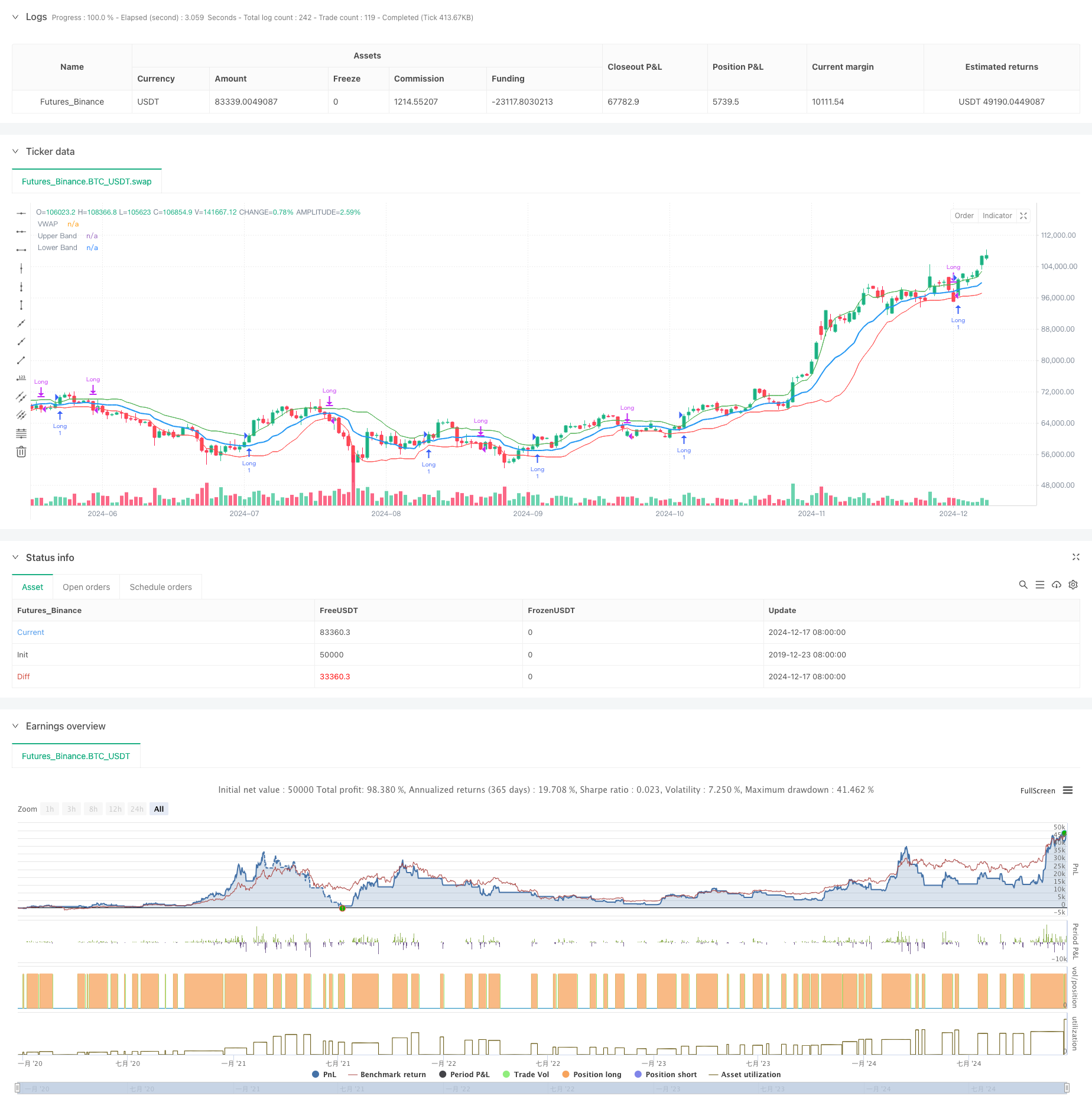
Overview
This is an adaptive trading strategy based on Volume Weighted Average Price (VWAP) and Garman-Klass Volatility (GKV). The strategy dynamically adjusts the standard deviation bands of VWAP through volatility to achieve intelligent market trend tracking. It opens long positions when price breaks above the upper band and closes positions when breaking below the lower band, with higher volatility leading to higher breakout thresholds and lower volatility leading to lower thresholds.
Strategy Principle
The core of the strategy combines VWAP with GKV volatility. It first calculates VWAP as the price pivot, then builds bands using the standard deviation of closing prices. The key is using the GKV formula for volatility calculation, which considers four price points (open, high, low, close) and is more accurate than traditional volatility measures. Volatility dynamically adjusts band width - when volatility increases, bands widen, raising breakout thresholds; when volatility decreases, bands narrow, lowering breakout thresholds. This adaptive mechanism effectively avoids false breakouts.
Strategy Advantages
- Combines volume-price relationship and volatility characteristics for more reliable signals
- Adaptive adjustment of band width reduces noise interference
- Uses GKV volatility for more accurate market microstructure capture
- Simple and clear calculation logic, easy to implement and maintain
- Suitable for different market environments with strong universality
Strategy Risks
- May trade frequently in ranging markets, increasing costs
- Sensitive to VWAP length and volatility period
- May respond slowly to rapid trend reversals
- Requires real-time market data with high quality requirements Risk control suggestions:
- Set reasonable stop-loss levels
- Optimize parameters for different markets
- Add trend confirmation indicators
- Control position sizing
Strategy Optimization Directions
- Introduce multi-timeframe analysis to improve signal reliability
- Add volume analysis dimension to confirm breakout validity
- Optimize volatility calculation method, consider introducing EWMA
- Add trend strength filters
- Consider adding dynamic stop-loss mechanisms These optimizations can improve strategy stability and return quality.
Summary
The strategy achieves dynamic market tracking through innovative combination of VWAP and GKV volatility. Its adaptive nature enables stable performance across different market environments. While there are some potential risks, the strategy shows good application prospects through proper risk control and continuous optimization.
Source Pine Script
/*backtest
start: 2019-12-23 08:00:00
end: 2024-12-18 08:00:00
period: 1d
basePeriod: 1d
exchanges: [{"eid":"Futures_Binance","currency":"BTC_USDT"}]
*/

//@version=5
strategy("Adaptive VWAP Bands with Garman Klass Volatility", overlay=true)

// Inputs
length = input.int(25, title="Volatility Length")
vwapLength = input.int(14, title="VWAP Length")
vol_multiplier = input.float(1,title="Volatility Multiplier")

// Function to calculate Garman-Klass Volatility
var float sum_gkv = na
if na(sum_gkv)
    sum_gkv := 0.0

sum_gkv := 0.0
for i = 0 to length - 1
    sum_gkv := sum_gkv + 0.5 * math.pow(math.log(high[i]/low[i]), 2) - (2*math.log(2)-1) * math.pow(math.log(close[i]/open[i]), 2)

gcv = math.sqrt(sum_gkv / length)

// VWAP calculation
vwap = ta.vwma(close, vwapLength)

// Standard deviation for VWAP bands
vwapStdDev = ta.stdev(close, vwapLength)

// Adaptive multiplier based on GCV
multiplier = (gcv / ta.sma(gcv, length)) * vol_multiplier

// Upper and lower bands
upperBand = vwap + (vwapStdDev * multiplier)
lowerBand = vwap - (vwapStdDev * multiplier)

// Plotting VWAP and bands
plot(vwap, title="VWAP", color=color.blue, linewidth=2)
plot(upperBand, title="Upper Band", color=color.green, linewidth=1)
plot(lowerBand, title="Lower Band", color=color.red, linewidth=1)

var barColor = color.black

// Strategy: Enter long above upper band, go to cash below lower band
if (close > upperBand)
    barColor := color.green
    strategy.entry("Long", strategy.long)
else if (close < lowerBand)
    barColor := color.fuchsia
    strategy.close("Long")

barcolor(barColor)
Published by ChaoZhang on the FMZ strategy square · last modified 2024-12-20. Collected in the Quant Trading Vault. Unvalidated research: re-test with your own data and costs before trusting it.
Build this with AgenKit
A spec is not a trading system. Paste this into your coding agent and AgenKit runs a specialist team — architecture, test-first build, risk gates, review — with paper trading on by default.
/agenkit build a production-grade trading bot with a backtest engine, risk controls and paper trading by default from strategies/Adaptive-VWAP-Bands-with-Garman-Klass-Volatility-Dynamic-Tracking-Strategy.md- npx agenkit install engineering-kit in your project
- Paste the command into your agent and approve each phase
- Get tests, backtest, risk controls and a paper-trading switch
Understand it first
Before you run this, read the lesson behind the idea and how to backtest it honestly. Specs like this one are the survivors of an unknown number of trials; deflate their results accordingly.
Related specs
- Dual Moving Average Volatility Tracking StrategyPine Script · Volatility · 1h
- Multi Indicator Dynamic Position Size Volatility Adaptive Quantitative Trading StrategyPine Script · Volatility · 1d
- Dynamic Volatility Trading Strategy Based on Bollinger Bands and Candlestick PatternsPine Script · Volatility · 1d
- Dual Bollinger Band Volatility Tracking StrategyPine Script · Volatility · 1d
- Multi Indicator Dynamic Volatility Alert Trading SystemPine Script · Volatility · 1m
- Multi Indicator Volatility Trading RSI EMA ATR StrategyPine Script · Volatility · 3m