Strategy vault / Trend following
Adaptive Weighted Trend Following Strategy VIDYA Multi Indicator System
This strategy is a trend following trading system based on the VIDYA (Variable Index Dynamic Average) indicator. The strategy adapts to market volatility by dynamically adjusting weights, combining Chande's Momentum…
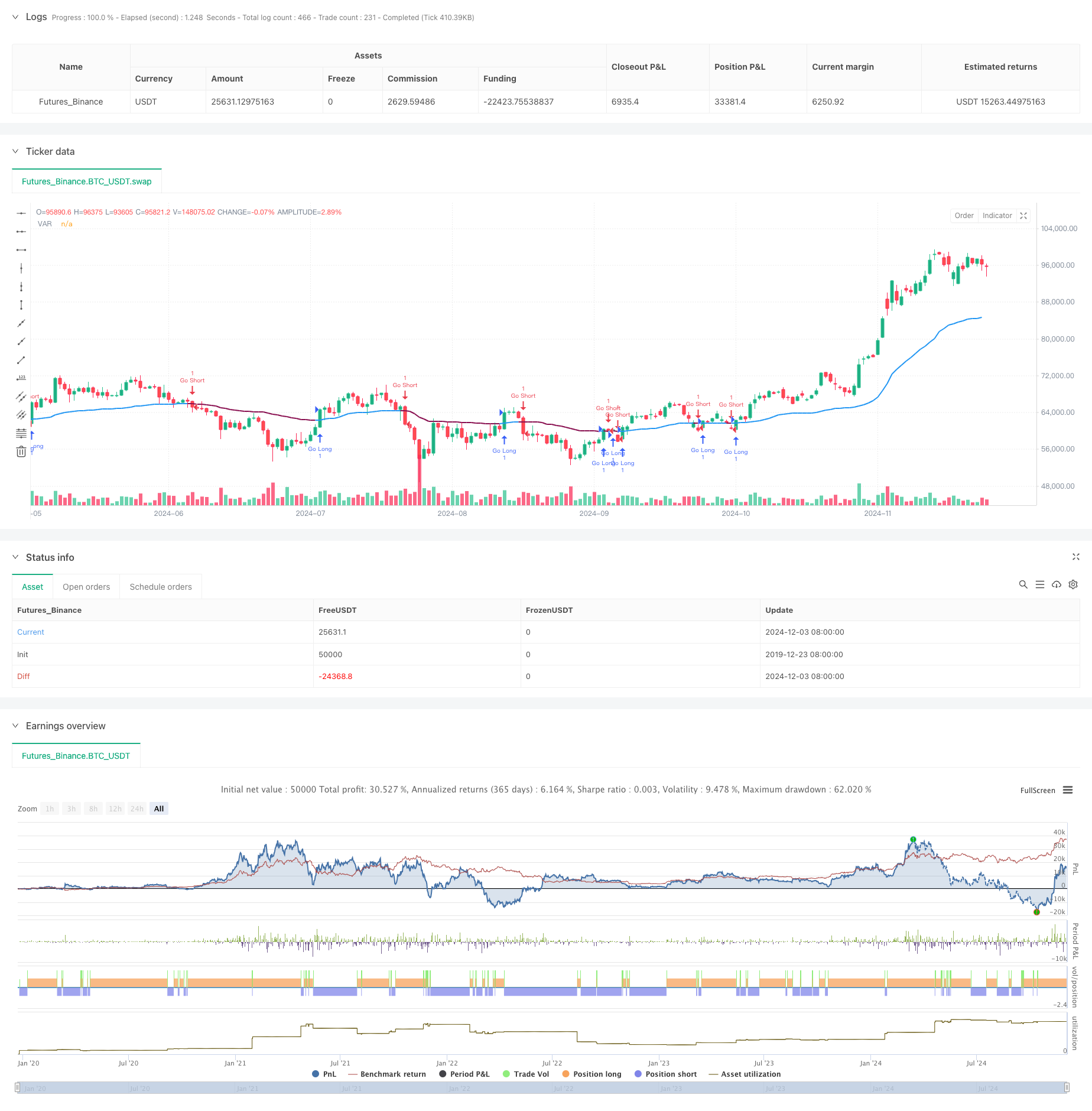
Overview
This strategy is a trend following trading system based on the VIDYA (Variable Index Dynamic Average) indicator. The strategy adapts to market volatility by dynamically adjusting weights, combining Chande's Momentum Oscillator (CMO) and Standard Deviation (StDev) calculation methods to achieve more accurate trend identification and trading signal generation. The system introduces an adaptive mechanism on top of traditional moving averages, automatically adjusting sensitivity based on market conditions.
Strategy Principles
The core of the strategy is the VIDYA indicator, with calculation process including these key steps:
- Setting basic period (default 21) and smoothing coefficient alpha
- Incorporating CMO or StDev as volatility calculation methods
- Using dynamic weight k to adjust VIDYA's sensitivity to price changes
- Generating long signals when VIDYA crosses upward and short signals when crossing downward
The strategy allows users to choose between CMO or standard deviation for volatility coefficient calculation, increasing flexibility. CMO mode uses a fixed 9-period cycle, while StDev mode maintains consistency with the base period.
Strategy Advantages
- Strong Adaptability: Maintains good performance in different market environments through dynamic weight adjustment
- Stable Signals: Better filters false signals compared to traditional moving averages
- Adjustable Parameters: Provides multiple tunable parameters for optimization based on different market characteristics
- Dual Calculation Methods: Supports both CMO and StDev volatility calculations, increasing strategy adaptability
- User-Friendly: Clear strategy logic and definitive signals, convenient for practical operation
Strategy Risks
- Trend Dependency: May generate frequent false signals in oscillating markets
- Parameter Sensitivity: Different parameter combinations significantly affect strategy performance
- Lag: Inherent delay exists as a moving average type indicator
- Market Adaptability: May underperform in certain specific market environments
- Money Management: Lack of stop-loss mechanism may lead to significant drawdowns
Strategy Optimization Directions
- Introduce Volatility Filter: Adjust signal generation rules in high volatility environments
- Add Trend Confirmation Indicators: Combine with other technical indicators to improve signal reliability
- Improve Money Management: Design dynamic stop-loss and position management mechanisms
- Optimize Parameter Selection: Develop automatic parameter optimization methods for different market cycles
- Enhance Market Environment Assessment: Dynamically adjust strategy parameters based on market conditions
Summary
The VIDYA strategy provides a relatively reliable trend following solution through innovative adaptive weight mechanisms. While maintaining simplicity and ease of use, the strategy improves adaptability to market changes through dynamic adjustments. Although some inherent limitations exist, the provided optimization directions can further enhance strategy stability and reliability. The dual calculation methods offer greater flexibility for application in different market environments.
Source Pine Script
/*backtest
start: 2019-12-23 08:00:00
end: 2024-12-04 00:00:00
period: 1d
basePeriod: 1d
exchanges: [{"eid":"Futures_Binance","currency":"BTC_USDT"}]
*/

// This Pine Script™ code is subject to the terms of the Mozilla Public License 2.0 at https://mozilla.org/MPL/2.0/
// © GriffinJames


//@version=5
strategy("VIDYA Strategy", overlay=true, initial_capital=25000)

// Inputs
src = input(close, title="Source")
pds = input.int(21, title="Length")
fixCMO = input.bool(true, title="Fixed CMO Length (9)?")
select = input.bool(true, title="Calculation Method: CMO/StDev?")
alpha = 2 / (pds + 1)
momm = ta.change(src)

// Functions to calculate MOM
f1(m) => m >= 0.0 ? m : 0.0
f2(m) => m >= 0.0 ? 0.0 : -m

m1 = f1(momm)
m2 = f2(momm)
sm1 = fixCMO ? math.sum(m1, 9) : math.sum(m1, pds)
sm2 = fixCMO ? math.sum(m2, 9) : math.sum(m2, pds)

percent(nom, div) => 100 * nom / div
chandeMO = na(percent(sm1 - sm2, sm1 + sm2)) ? 0 : percent(sm1 - sm2, sm1 + sm2)

// Select calculation method
k = select ? math.abs(chandeMO) / 100 : ta.stdev(src, pds)

// Calculate VIDYA
var float VIDYA = na
VIDYA := na(VIDYA[1]) ? src : alpha * k * src + (1 - alpha * k) * VIDYA[1]

// Conditions for long and short
col12 = VIDYA > VIDYA[1]
col32 = VIDYA < VIDYA[1]

// Plot VIDYA with dynamic colors
color2 = col12 ? color.new(color.blue, 0) : col32 ? color.new(color.maroon, 0) : color.new(color.blue, 0)
plot(VIDYA, "VAR", color=color2, linewidth=2)

// Long and Short Strategy
if (col12)
    strategy.entry("Go Long", strategy.long)
if (col32)
    strategy.entry("Go Short", strategy.short)

// Alert for VIDYA color change
alertcondition(ta.cross(VIDYA, VIDYA[1]), title="Color ALARM!", message="VIDYA has changed color!")
Published by ChaoZhang on the FMZ strategy square · last modified 2024-12-05. Collected in the Quant Trading Vault. Unvalidated research: re-test with your own data and costs before trusting it.
Build this with AgenKit
A spec is not a trading system. Paste this into your coding agent and AgenKit runs a specialist team — architecture, test-first build, risk gates, review — with paper trading on by default.
/agenkit build a production-grade trading bot with a backtest engine, risk controls and paper trading by default from strategies/Adaptive-Weighted-Trend-Following-Strategy-VIDYA-Multi-Indicator-System.md- npx agenkit install engineering-kit in your project
- Paste the command into your agent and approve each phase
- Get tests, backtest, risk controls and a paper-trading switch
Understand it first
Before you run this, read the lesson behind the idea and how to backtest it honestly. Specs like this one are the survivors of an unknown number of trials; deflate their results accordingly.
Related specs
- 200 EMA VWAP MFI Trend Following StrategyPine Script · Trend following · 1d
- 4 EMA Trend StrategyPine Script · Trend following · 1d
- ADX MA and EMA Long Only Trend Tracking StrategyPine Script · Trend following · 1d
- ATR Dynamic Profit Target and Stop Loss StrategyPine Script · Trend following · 1d
- ATR Dynamic Trend Following and EMA Crossover Trading StrategyPine Script · Trend following · 1d
- ATR and Moving Average Crossover Hybrid StrategyPine Script · Trend following · 1h