Strategy vault / Trend following
Advanced Opportunity Space Oscillator Strategy A Quantitative Trading System Based on Fair Value Gaps
This strategy is an innovative trading system based on Fair Value Gaps (FVG), designed to capture potential trading opportunities by identifying price gaps and volume anomalies in the market. The strategy combines…
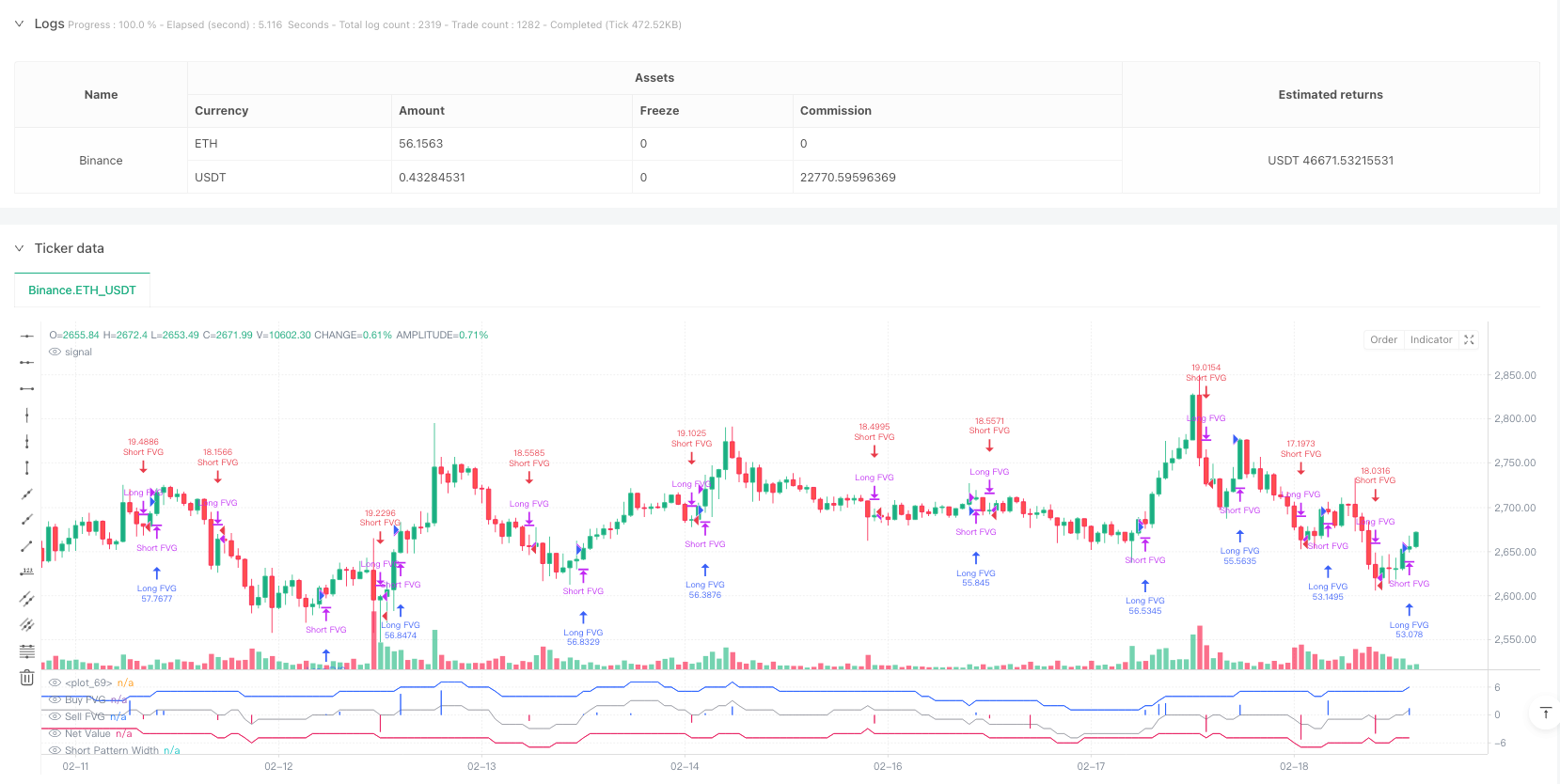
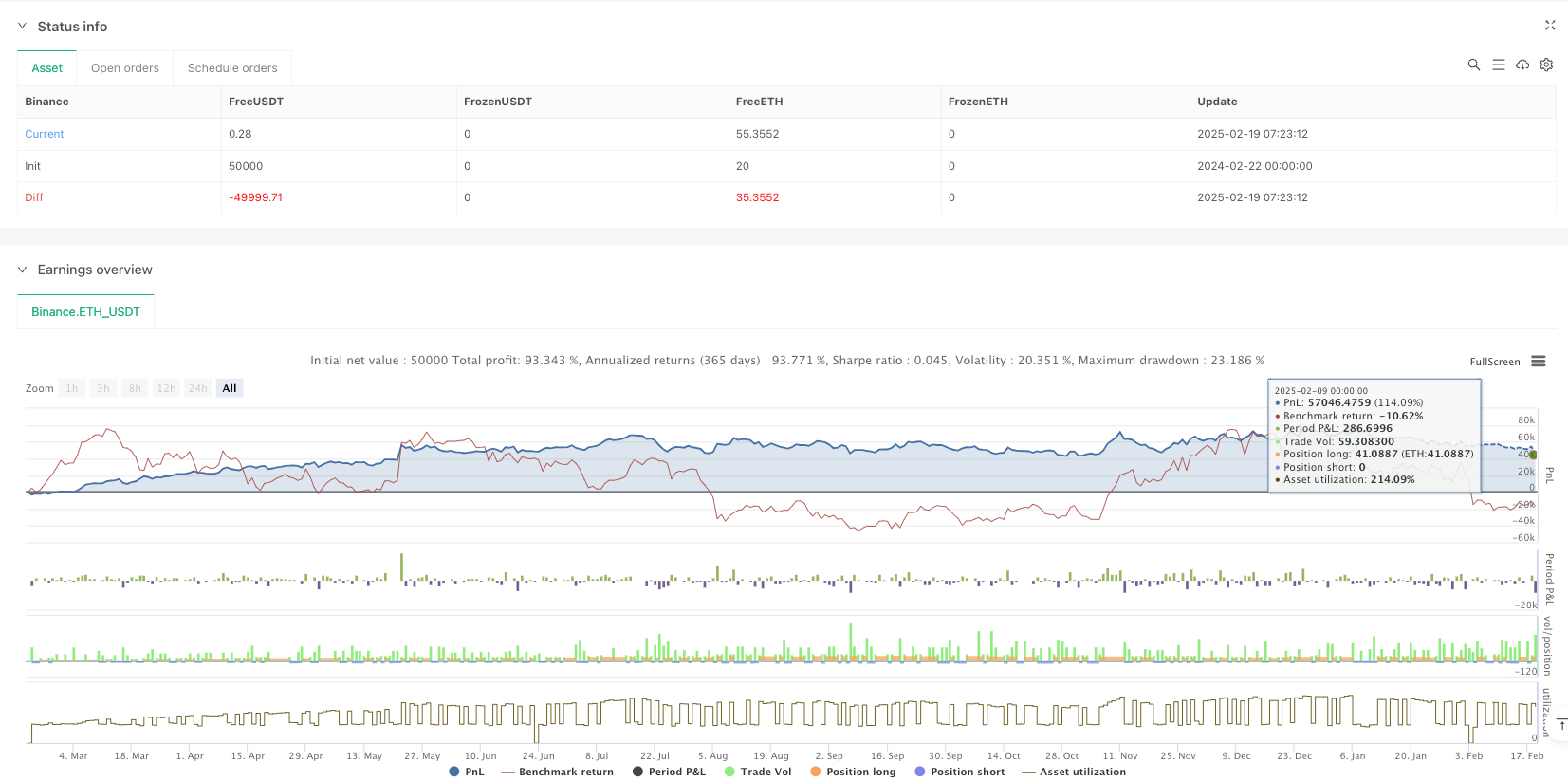
Overview
This strategy is an innovative trading system based on Fair Value Gaps (FVG), designed to capture potential trading opportunities by identifying price gaps and volume anomalies in the market. The strategy combines dynamic counting mechanisms and normalization processing, not only accurately identifying buy and sell signals but also helping traders better understand market structure through visualization.
Strategy Principles
The core of the strategy is to identify potential trading opportunities by monitoring price gaps between consecutive candles. Specifically:
- Bullish FVG (BFVG) forms when the current candle's low is higher than the high of two candles ago
- Bearish FVG (SFVG) forms when the current candle's high is lower than the low of two candles ago
- The strategy incorporates a verification mechanism based on volume and gap size, where only FVGs meeting verification conditions trigger trading signals
- Uses a 50-period dynamic counting window to accumulate the number of bullish and bearish FVGs
- Through normalization processing, gap widths are transformed into more intuitive indicator values
Strategy Advantages
- The system has a comprehensive signal verification mechanism, improving signal quality through dual confirmation of volume and gap magnitude
- Dynamic counting window effectively captures market trend changes
- Normalization processing makes signals comparable across different periods
- Strategy includes automatic position management, closing reverse positions before opening new ones
- Excellent visualization effects, making it easier for traders to understand market conditions
Strategy Risks
- FVG signals may generate false signals in highly volatile markets
- Fixed verification parameters may not be suitable for all market environments
- Lack of stop-loss and take-profit mechanisms may lead to significant drawdowns
- Frequent trading may result in high transaction costs It is recommended to manage these risks by setting appropriate stop-loss levels and introducing market environment filters.
Optimization Directions
- Introduce adaptive parameter adjustment mechanisms to better adapt to different market environments
- Add trend filters to trade only in the direction of strong trends
- Design more sophisticated position management systems, including staged position building and dynamic stop-loss
- Consider transaction costs and optimize trading frequency
- Combine with other technical indicators to improve signal reliability
Summary
This is an innovative trading strategy based on price structure, capturing market opportunities through intelligent identification and verification of fair value gaps. The strategy's design concept is clear, implementation is professional, and it has good scalability. Through the suggested optimization directions, the strategy's stability and profitability can be further enhanced.
Source Pine Script
/*backtest
start: 2024-02-22 00:00:00
end: 2025-02-19 08:00:00
period: 1h
basePeriod: 1h
exchanges: [{"eid":"Binance","currency":"ETH_USDT"}]
*/

// ----------------------------------------------------------------------------
// This Pine Script™ code is subject to the terms of the Mozilla Public License
// 2.0 at https://mozilla.org/MPL/2.0/
// © OmegaTools
// ----------------------------------------------------------------------------

//@version=5
strategy("FVG Oscillator Strategy",
     shorttitle="FVG Osc v5 [Strategy]",
     overlay=false,
     initial_capital=100000,
     default_qty_type=strategy.percent_of_equity,
     default_qty_value=100)

//------------------------------------------------------------------------------
// 1) Input Parameters
//------------------------------------------------------------------------------
lnt   = input.int(50, "Bars Back")
area  = input.bool(true, "Show Areas")
upcol = input.color(#2962ff, "Positive Color")
dncol = input.color(#e91e63, "Negative Color")

//------------------------------------------------------------------------------
// 2) FVG Detection
//    bfvg = bullish FVG, sfvg = bearish FVG
//------------------------------------------------------------------------------
bfvg = low > high[2]
sfvg = high < low[2]

//------------------------------------------------------------------------------
// 3) Additional Conditions - FVG Verification (Volume, Gap Size)
//------------------------------------------------------------------------------
vol  = volume > ta.sma(volume, 10)
batr = (low - high[2]) > ta.sma(low - high[2], lnt) * 1.5
satr = (high - low[2]) > ta.sma(high - low[2], lnt) * 1.5

//------------------------------------------------------------------------------
// 4) Sum of Bullish / Bearish FVG within the Last lnt Bars
//------------------------------------------------------------------------------
countup   = math.sum(bfvg ? 1 : 0, lnt)      // +1 for each BFVG
countdown = math.sum(sfvg ? -1 : 0, lnt)     // -1 for each SFVG

//------------------------------------------------------------------------------
// 5) Verification (e.g., Require Higher Volume or Large Gap)
//------------------------------------------------------------------------------
verifyb = (bfvg and vol[1]) or (bfvg and batr)
verifys = (sfvg and vol[1]) or (sfvg and satr)

//------------------------------------------------------------------------------
// 6) Normalized Gap Values
//------------------------------------------------------------------------------
normb = ((low - high[2]) * countup * 0.75) / ta.highest(low - high[2], lnt)
norms = ((high - low[2]) * countdown * 0.75) / ta.lowest(high - low[2], lnt)

//------------------------------------------------------------------------------
// 7) Total Net FVG Count + Calculation of Maximum for fill()
//------------------------------------------------------------------------------
totcount = countup + countdown
max      = math.max(
               ta.highest(countup, 200),
               ta.highest(math.abs(countdown), 200)
           )

//------------------------------------------------------------------------------
// 8) Plotting Values (as in an indicator – can be kept for visualization)
//------------------------------------------------------------------------------
up   = plot(countup,     "Buy FVG",  color=upcol,  display=display.none)
down = plot(countdown,   "Sell FVG", color=dncol,  display=display.none)
zero = plot(0, "", color.new(color.gray, 100), display=display.none, editable=false)

// Net Value (sum of FVG)
plot(totcount, "Net Value", color=color.new(color.gray, 50))

// Filling areas above/below zero

plot(verifyb ? normb : na, "Long Pattern Width",  color=upcol,  linewidth=1, style=plot.style_histogram)
plot(verifys ? norms : na, "Short Pattern Width", color=dncol, linewidth=1, style=plot.style_histogram)

//------------------------------------------------------------------------------
// 9) Simple Trading Logic (STRATEGY)
//------------------------------------------------------------------------------
// - If "verifyb" is detected, go long.
// - If "verifys" is detected, go short.
//
// You can extend this with Stop Loss, Take Profit,
// closing old positions, etc.
//------------------------------------------------------------------------------
bool goLong  = verifyb
bool goShort = verifys

// Basic example: Open Long if verifyb, Open Short if verifys.
if goLong
    // First close any short position if it exists
    if strategy.position_size < 0
        strategy.close("Short FVG")
    // Then open Long
    strategy.entry("Long FVG", strategy.long)

if goShort
    // First close any long position if it exists
    if strategy.position_size > 0
        strategy.close("Long FVG")
    // Then open Short
    strategy.entry("Short FVG", strategy.short)
Published by ianzeng123 on the FMZ strategy square · last modified 2025-02-24. Collected in the Quant Trading Vault. Unvalidated research: re-test with your own data and costs before trusting it.
Build this with AgenKit
A spec is not a trading system. Paste this into your coding agent and AgenKit runs a specialist team — architecture, test-first build, risk gates, review — with paper trading on by default.
/agenkit build a production-grade trading bot with a backtest engine, risk controls and paper trading by default from strategies/Advanced-Opportunity-Space-Oscillator-Strategy-A-Quantitative-Trading-System-Based-on-Fair-Value-Gaps.md- npx agenkit install engineering-kit in your project
- Paste the command into your agent and approve each phase
- Get tests, backtest, risk controls and a paper-trading switch
Understand it first
Before you run this, read the lesson behind the idea and how to backtest it honestly. Specs like this one are the survivors of an unknown number of trials; deflate their results accordingly.
Related specs
- ADX MA and EMA Long Only Trend Tracking StrategyPine Script · Trend following · 1d
- ATR and Moving Average Crossover Hybrid StrategyPine Script · Trend following · 1h
- Adaptive FVG Detection and MA Trend Trading Strategy with Dynamic ResistancePine Script · Trend following · 1d
- Adaptive Risk Management Strategy Based on Dynamic ATR and Moving Average CrossoverPine Script · Trend following · 2h
- Adaptive Trading Strategy Based on Stochastic RSI Dual Line CrossoverPine Script · Trend following · 4h
- Adaptive Volatility Based Trend Following Short Strategy with Time Delay and Stop Loss ProtectionPine Script · Trend following · 2m