Strategy vault / Mean reversion
Baseline Cross Qualifier ATR Volatility HMA Trend Bias Mean Reversion Strategy
This strategy integrates the baseline mean reversion signal, ATR volatility filter, and HMA trend filter to generate robust trading signals for quantitative trading strategies. It uses two moving averages with…
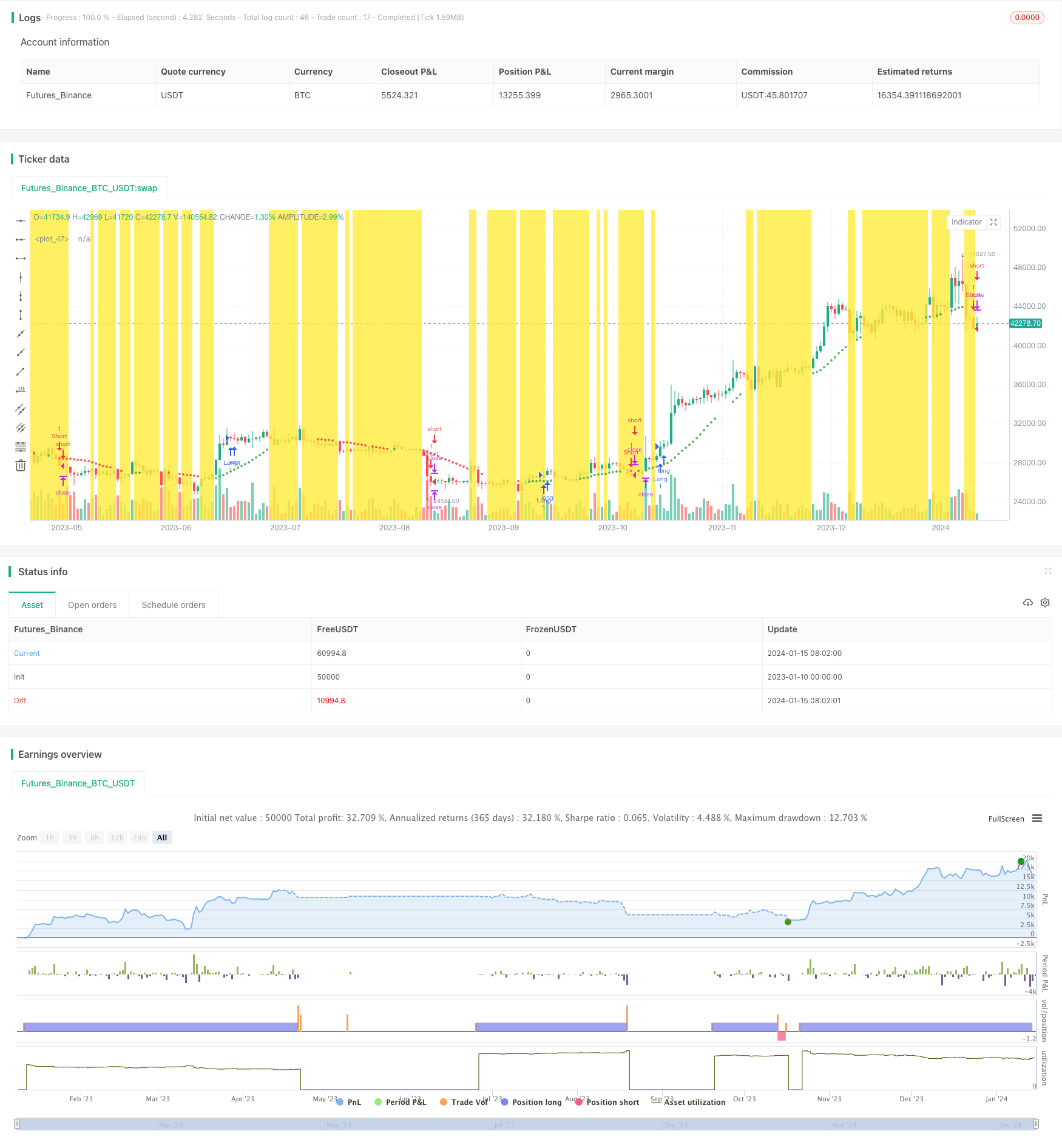
Overview
This strategy integrates the baseline mean reversion signal, ATR volatility filter, and HMA trend filter to generate robust trading signals for quantitative trading strategies. It uses two moving averages with different periods to construct trading signals, combines the ATR volatility indicator to filter out some invalid signals, and utilizes HMA to determine the major trend direction to avoid adverse selection.
Strategy Logic
The strategy uses a 37-period moving average as the baseline. When the price breaks out upward from this baseline, it generates a buy signal, and when it breaks down from above, it generates a sell signal. To avoid false signals, the strategy requires the price to move beyond 2xATR volatility after penetrating the baseline to confirm the validity of signals. Also, the strategy uses an 11-period HMA to judge the major trend. It only confirms valid signals when price penetrating baseline is aligned with HMA direction to prevent adverse selection.
For profit taking, the strategy supports using one or multiple (two or three) take profit levels. For stop loss, it simply takes the upper and lower band lines as SL for long and short positions.
Advantage Analysis
Compared with simple moving average breakout strategies, this strategy adds the ATR volatility filter that removes a lot of invalid signals. This aligns very well with visual pattern breakout techniques, thus leading to higher win rates. Also, the HMA trend bias prevents adverse selection and significantly reduces unnecessary losses. The multiple take-profit scheme also allows more profits to be locked in.
Risks & Solutions
The major risk is the ATR volatility filter may remove some valid signals, causing failure to open positions timely. Also, the HMA trend judgment is not very significant sometimes when price is just having a short-term retracement, not reversal. This may lead to unnecessary stop loss. To reduce the risks, we can lower the ATR volatility filter parameter to allow more signals. We can also adjust the HMA period parameter to use longer-term HMA for judging major trends, preventing interference from short-term fluctuations.
Optimization Directions
The strategy can be optimized in the following aspects:
Test more parameter combinations to find the optimum set of values, e.g., baseline period, ATR period, volatility coefficient etc.
Add more filters or oscillators to judge market conditions to enhance model robustness.
Optimize parameters for profit taking mechanisms, test more price levels and allocation schemes.
Incorporate machine learning models to generate more effective trading signals.
Conclusion
This strategy integrates dual moving average baseline signal, ATR volatility filter and HMA trend bias filter into a very practical quantitative trading system. Although it still has space to enhance performance through parameter tuning, it already serves well for disciplined rule-based trading.
Parameters
| Name | Default | What it controls |
|---|---|---|
| v_input_int_1 | 20 | Baseline Length |
| v_input_bool_1 | true | Post Baseline Cross Qualifier Enabled |
| v_input_int_2 | 3 | Post Baseline Cross Qualifier Bars Ago |
| v_input_int_3 | 14 | ATR Length |
| v_input_float_1 | 2 | Volatility Multiplier |
| v_input_float_2 | true | Volatility Range Multiplier |
| v_input_float_3 | 0.5 | Volatility Qualifier Multiplier |
| v_input_string_1 | 0 | Take Profit Type: 1 Take Profit | 2 Take Profits | 3 Take Profits |
| v_input_int_4 | 50 | HMA Length |
Source Pine Script
/*backtest
start: 2023-01-10 00:00:00
end: 2024-01-16 00:00:00
period: 1d
basePeriod: 1h
exchanges: [{"eid":"Futures_Binance","currency":"BTC_USDT"}]
*/

// This source code is subject to the terms of the Mozilla Public License 2.0 at https://mozilla.org/MPL/2.0/
// © sevencampbell

//@version=5
strategy(title="Baseline Cross Qualifier Volatility Strategy with HMA Trend Bias", overlay=true)

// --- User Inputs ---

// Baseline Inputs
baselineLength = input.int(title="Baseline Length", defval=20)
baseline = ta.sma(close, baselineLength)

// PBCQ Inputs
pbcqEnabled = input.bool(title="Post Baseline Cross Qualifier Enabled", defval=true)
pbcqBarsAgo = input.int(title="Post Baseline Cross Qualifier Bars Ago", defval=3)

// Volatility Inputs
atrLength = input.int(title="ATR Length", defval=14)
multiplier = input.float(title="Volatility Multiplier", defval=2.0)
rangeMultiplier = input.float(title="Volatility Range Multiplier", defval=1.0)
qualifierMultiplier = input.float(title="Volatility Qualifier Multiplier", defval=0.5)

// Take Profit Inputs
takeProfitType = input.string(title="Take Profit Type", options=["1 Take Profit", "2 Take Profits", "3 Take Profits"], defval="1 Take Profit")

// HMA Inputs
hmaLength = input.int(title="HMA Length", defval=50)

// --- Calculations ---

// ATR
atr = ta.atr(atrLength)

// Range Calculation
rangeHigh = baseline + rangeMultiplier * atr
rangeLow = baseline - rangeMultiplier * atr
rangeColor = rangeLow <= close and close <= rangeHigh ? color.yellow : na
bgcolor(rangeColor, transp=90)

// Qualifier Calculation
qualifier = qualifierMultiplier * atr

// Dot Calculation
isLong = close > baseline and (close - baseline) >= qualifier and close > ta.hma(close, hmaLength)
isShort = close < baseline and (baseline - close) >= qualifier and close < ta.hma(close, hmaLength)
colorDot = isLong ? color.green : isShort ? color.red : na
plot(isLong or isShort ? baseline : na, color=colorDot, style=plot.style_circles, linewidth=3)

// --- Strategy Logic ---

// PBCQ
pbcqValid = not pbcqEnabled or low[pbcqBarsAgo] > baseline

// Entry Logic
longCondition = isLong and pbcqValid
shortCondition = isShort and pbcqValid
if (longCondition)
    strategy.entry("Long", strategy.long)
if (shortCondition)
    strategy.entry("Short", strategy.short)

// Exit Logic
if (takeProfitType == "1 Take Profit")
    strategy.exit("TP/SL", "Long", limit=rangeHigh, stop=rangeLow)
    strategy.exit("TP/SL", "Short", limit=rangeLow, stop=rangeHigh)
else if (takeProfitType == "2 Take Profits")
    strategy.exit("TP1", "Long", qty=strategy.position_size * 0.5, limit=rangeHigh / 2)
    strategy.exit("TP2", "Long", qty=strategy.position_size * 0.5, limit=rangeHigh)
    strategy.exit("TP1", "Short", qty=strategy.position_size * 0.5, limit=rangeLow / 2)
    strategy.exit("TP2", "Short", qty=strategy.position_size * 0.5, limit=rangeLow)
else if (takeProfitType == "3 Take Profits")
    strategy.exit("TP1", "Long", qty=strategy.position_size * 0.5, limit=rangeHigh / 2)
    strategy.exit("TP2", "Long", qty=strategy.position_size * 0.25, limit=rangeHigh * 0.75)
    strategy.exit("TP3", "Long", qty=strategy.position_size * 0.25, limit=rangeHigh * 1.5)
Published by ChaoZhang on the FMZ strategy square · last modified 2024-01-17. Collected in the Quant Trading Vault. Unvalidated research: re-test with your own data and costs before trusting it.
Build this with AgenKit
A spec is not a trading system. Paste this into your coding agent and AgenKit runs a specialist team — architecture, test-first build, risk gates, review — with paper trading on by default.
/agenkit build a production-grade trading bot with a backtest engine, risk controls and paper trading by default from strategies/Baseline-Cross-Qualifier-ATR-Volatility-HMA-Trend-Bias-Mean-Reversion-Strategy.md- npx agenkit install engineering-kit in your project
- Paste the command into your agent and approve each phase
- Get tests, backtest, risk controls and a paper-trading switch
Understand it first
Before you run this, read the lesson behind the idea and how to backtest it honestly. Specs like this one are the survivors of an unknown number of trials; deflate their results accordingly.
Related specs
- Adaptive Trading Strategy Combining Dynamic Trend Reversal and Stochastic IndicatorPine Script · Mean reversion · 1d
- Advanced Momentum EMA Trend Following with RSI Overbought Oversold Trading StrategyPine Script · Mean reversion · 1d
- Advanced Quantitative Trend Following and Cloud Reversal Composite Trading StrategyPine Script · Mean reversion · 1d
- Advanced Strategy with Volume and Price Pullback Multiple Take ProfitPine Script · Mean reversion · 1h
- Bidirectional Moving Average Reversion Trading StrategyPine Script · Mean reversion · 1h
- Bollinger Bands ATR Risk Reward Trading StrategyPine Script · Mean reversion · 1d