Close Buying Next Open Profit Taking Strategy
The main idea of this strategy is to buy at the close on the current day and sell at open on the next day if the price is higher than the buying price, otherwise continue holding until stop loss or profit taking.
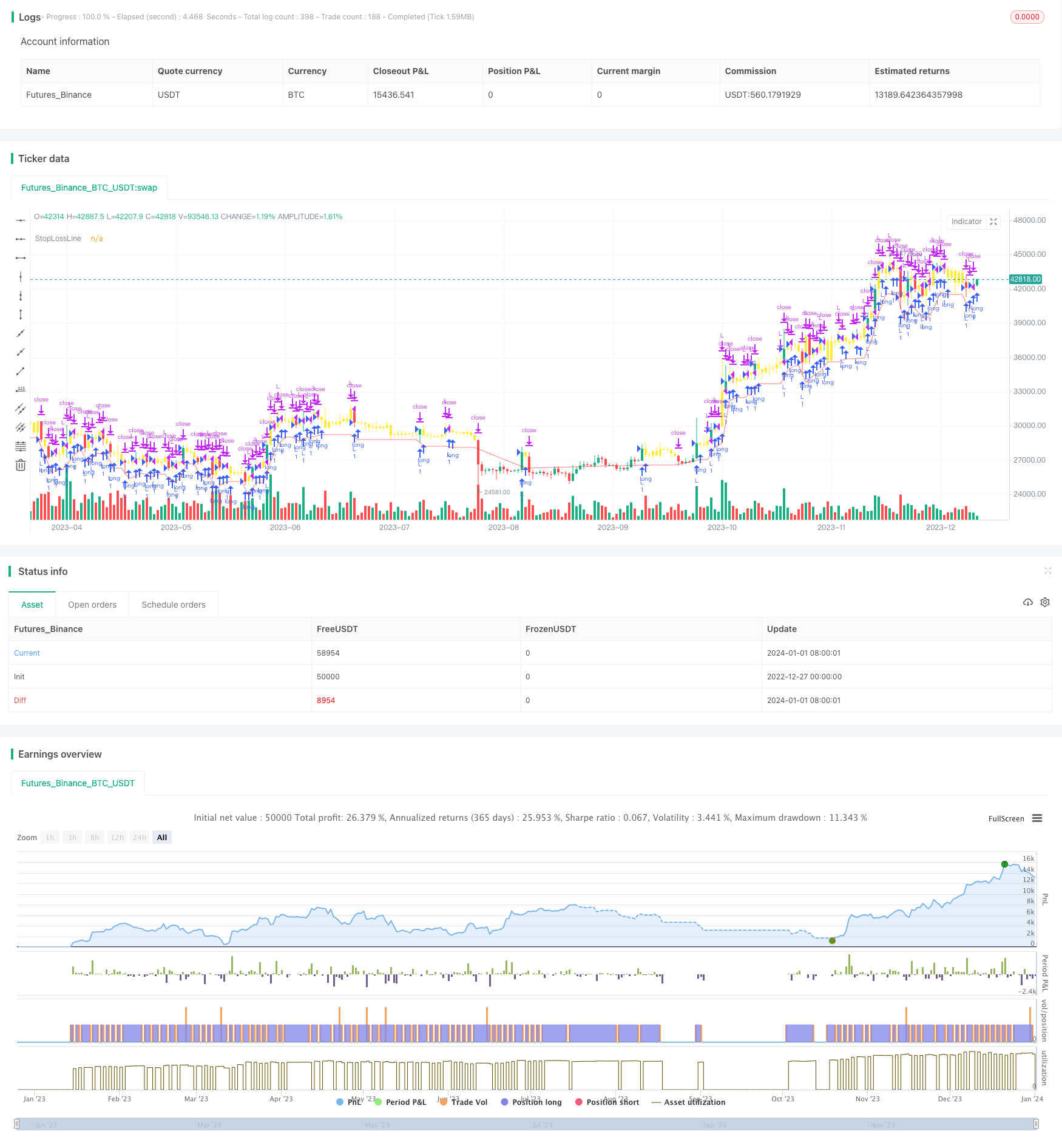
Overview
The main idea of this strategy is to buy at the close on the current day and sell at open on the next day if the price is higher than the buying price, otherwise continue holding until stop loss or profit taking.
Strategy Logic
The strategy first sets a 200-day simple moving average as the market state indicator, allowing trading only when the price is above the 200-day line. The buying time is set to the last half hour before the close every day, and the selling time is set to the first half hour after the next open. When the market state meets the requirement during buying time, it will place a market order to buy. During selling time, it will check if the price is higher than the buying price, if yes, it will place a market order to sell and take profit, otherwise, it continues holding until stop loss or profit taking tomorrow. It also sets a 5% stop loss line to limit losses.
Advantage Analysis
The strategy has the following advantages:
Utilize the closing effect where price fluctuation and gap are larger during closing. The next open price may have a large swing.
The short holding period allows quick stop loss and profit taking to reduce risks.
The logic is simple and easy to understand and implement.
Flexible configuration on stop loss line and market state indicator to control risks.
Risk Analysis
There are also some risks:
Buying at the closing price may take positions at high prices, increasing loss risk.
The short holding period makes it easy to be trapped. There may be no limit up or down the next day.
It relies on large gaps, which may not always form, leading to losses or trapped positions.
Choosing the wrong symbol, like index consolidation, may lead to multiple losses.
Solutions:
Combine technical indicators to ensure buying at a relative bottom at closing.
Extend holding period to 2-3 days.
Only buy at valid breakout moments.
Careful symbol selection, choose symbols with an uptrend.
Optimization Directions
The strategy can be optimized in the following aspects:
Add more technical indicators for buying signal to improve certainty.
Test different holding periods to find the optimal profit-taking time.
Optimize the stop loss line to find the optimal stop loss point.
Test performance across different symbols and market environments, adopt dynamic symbol and position management.
Summary
The strategy has clear logic, utilizing the closing gap effect for quick stop loss/profit trading. It is easy to implement and understand. But it also has high trap risks. Position sizing, stop loss management and stock picking are critical. It can be further optimized on improving buying certainty, optimal holding period and stop loss point, and dynamic position sizing to improve stability and profitability while controlling risk.
Parameters
| Name | Default | What it controls |
|---|---|---|
| v_input_1 | 200 | MarketFilterLen |
| v_input_2 | 0.95 | StopLossPerc |
Source Pine Script
/*backtest
start: 2022-12-27 00:00:00
end: 2024-01-02 00:00:00
period: 1d
basePeriod: 1h
exchanges: [{"eid":"Futures_Binance","currency":"BTC_USDT"}]
*/

//  @version=4
//  © HermanBrummer
//  This source code is subject to the terms of the Mozilla Public License 2.0 at https://mozilla.org/MPL/2.0/
strategy("M8 BUY @ END OF DAY", "", 1)

///         BUYS AT THE END OF THE DAY
///         SELLS THE NEXT MORNING IF PRICE IS HIGHER THEN THE ENTRY PRICE
///         IF PRICE IS NOT HIGHER THEN IT WILL KEEP THE POSITION AND WAIT FOR EITHER A STOP OUT OR FOR PRICE TO BE HIGHER THAN THE ENTRY
///         USES A 5% STOP LOSS ON THE REDLINE  -- SETTABLE IN SETTINGS
///         USES A 200 DAY MARKET FILTER        -- SETTABLE IN SETTINGS -- IMPORTS DATA FROM HIGHER TIMEFRAME, BUT USES CLOSE[2] << SO THIS IS FIXED, NON-REPAITING DATA


MarketFilterLen = input(200)
StopLossPerc    = input(.95, step=0.01)

buyTime         = time(timeframe.period, "1429-1500")
sellTime        = time(timeframe.period, "0925-0935")

F1              = close > sma(security(syminfo.tickerid, "D", close[2]), MarketFilterLen) // HIGH OF OLD DATA -- SO NO REPAINTING

enter           = buyTime and F1
exit            = sellTime


StopLossLine    = strategy.position_avg_price * StopLossPerc

plot(StopLossLine, "StopLossLine", color.new(#FF0000, 50))

strategy.entry("L", true, when=enter)
strategy.exit("StopLoss", stop=StopLossLine )
if  close > strategy.position_avg_price
    strategy.close("L", when=exit)

barcolor(strategy.opentrades != 0 ? color.new(color.yellow, 0) : na )
Published by ChaoZhang on the FMZ strategy square · last modified 2024-01-03. Collected in the Quant Trading Vault. Unvalidated research: re-test with your own data and costs before trusting it.
Build this with AgenKit
A spec is not a trading system. Paste this into your coding agent and AgenKit runs a specialist team — architecture, test-first build, risk gates, review — with paper trading on by default.
/agenkit build a production-grade trading bot with a backtest engine, risk controls and paper trading by default from strategies/Close-Buying-Next-Open-Profit-Taking-Strategy.md- npx agenkit install engineering-kit in your project
- Paste the command into your agent and approve each phase
- Get tests, backtest, risk controls and a paper-trading switch
Understand it first
Before you run this, read the lesson behind the idea and how to backtest it honestly. Specs like this one are the survivors of an unknown number of trials; deflate their results accordingly.
Related specs
- 5 Day Moving Average Channel Breakout Strategy Combined With Mileage ConceptPine Script · Breakout · 1d
- Adaptive Bollinger Breakout with Moving Average Quantitative Strategy SystemPine Script · Breakout · 1h
- Adaptive Multi Period Trading Strategy Based on Wave Trend Momentum BreakoutPine Script · Breakout · 2h
- Adaptive Trading Strategy Based on ADX IndicatorPine Script · Breakout · 1d
- Average Line Breakthrough StrategyPine Script · Breakout · 1d
- BB Breakout StrategyPine Script · Breakout · 1d