Coppock Curve Based Quantitative Trading Strategy
This strategy utilizes the lesser known Coppock Curve technical indicator to implement quantitative trading. The Coppock Curve is derived by taking a weighted moving average of the rate of change (ROC) of a market…
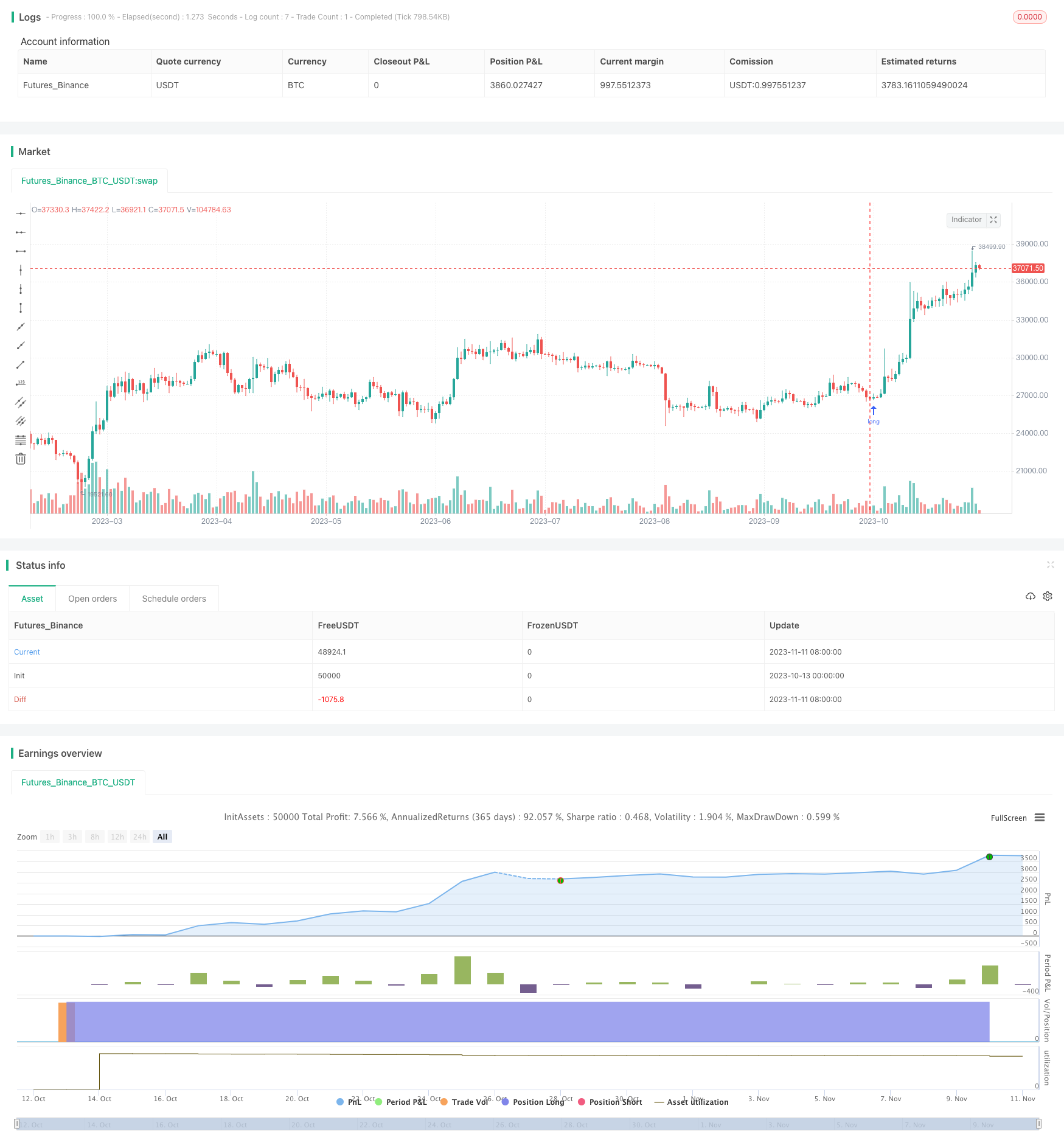
Overview
This strategy utilizes the lesser known Coppock Curve technical indicator to implement quantitative trading. The Coppock Curve is derived by taking a weighted moving average of the rate of change (ROC) of a market index like S&P 500 or a trading equivalent like SPY ETF. Buy signals are generated when the Coppock Curve crosses above zero and sell signals when it crosses below. An optional trailing stop loss is available to lock in profits. The strategy uses $SPY Coppock curve as a proxy to generate trade signals on other ETFs and stocks.
Principles
The strategy uses Coppock Curve as the technical indicator for generating trading signals. The Coppock Curve formula is:
Coppock Curve = 10-period WMA (14-period ROC + 11-period ROC)
Where ROC rate of change is calculated as: (Current Close - Close N periods ago) / Close N periods ago
The strategy calculates the Coppock Curve based on the closing price of $SPY. Buy signals are generated when the curve crosses above zero and sell signals when it crosses below.
Advantages
- Uses unique Coppock Curve indicator which has better predictive power than common indicators like moving averages
- Configurable parameters for optimization like WMA period, ROC period etc.
- Uses $SPY as signal source which has strong market representativeness
- Optional trailing stop loss to lock in profits and reduce drawdowns
Risks
- Coppock Curve is not a widely used indicator, its efficacy needs validation
- Signal lag may exist, parameters need to be optimized
- Overly wide stop loss may miss pullback opportunities
- Reliance on single indicator can produce false signals
Optimization Directions
- Test optimal parameter combinations across different markets and stocks
- Combine with other indicators to filter out false signals e.g. volume
- Dynamic optimization of stop loss percentage
- Consider other entry signals like number of bars or price breakthroughs
Conclusion
The strategy utilizes the unique curve shape characteristics of the Coppock Curve to generate trade signals. Compared to common indicators, the Coppock Curve has stronger predictive power. But as a standalone indicator, its reliability needs validation. It's recommended to combine it with other factors to filter false signals. Through parameter optimization, stop loss optimization and combining with other indicators, this strategy can become an effective quantitative trading system.
Parameters
| Name | Default | What it controls |
|---|---|---|
| v_input_1 | 100 | Trail Long Loss (%) |
| v_input_2 | SPY | security |
| v_input_3 | 10 | WMA Length |
| v_input_4 | 14 | Long RoC Length |
| v_input_5 | 11 | Short RoC Length |
Source Pine Script
/*backtest
start: 2023-10-13 00:00:00
end: 2023-11-12 00:00:00
period: 1d
basePeriod: 1h
exchanges: [{"eid":"Futures_Binance","currency":"BTC_USDT"}]
*/

// This source code is subject to the terms of the Mozilla Public License 2.0 at https://mozilla.org/MPL/2.0/
// © RolandoSantos

//@version=4
strategy(title = "Coppock Curve", shorttitle = "Copp Curve Strat", default_qty_type=strategy.cash, default_qty_value=10000, initial_capital=10000)

///trail stop
longTrailPerc = input(title="Trail Long Loss (%)", minval=0.0, step=0.1, defval=100) * 0.01

// Determine trail stop loss prices
longStopPrice = 0.0

longStopPrice := if (strategy.position_size > 0)
    stopValue = close * (1 - longTrailPerc)
    max(stopValue, longStopPrice[1])
else
    0
//Use SPY for Copp Curve entries and exits//
security = input("SPY")
ticker = security(security, "D", close)

///Copp Curve////
wmaLength = input(title="WMA Length", type=input.integer, defval=10)
longRoCLength = input(title="Long RoC Length", type=input.integer, defval=14)
shortRoCLength = input(title="Short RoC Length", type=input.integer, defval=11)
source = ticker
curve = wma(roc(source, longRoCLength) + roc(source, shortRoCLength), wmaLength)

///Lower Band Plot///
band1 = hline(0)
band0 = hline(100)
band2 = hline(-100)
fill(band1, band0, color=color.green, transp=90)
fill(band2, band1, color=color.red, transp=90)
plot(curve, color=color.white)

///Trade Conditions///
Bull = curve > 0
Bear = curve < 0

///Entries and Exits//
if (Bull)
    strategy.entry("Long", strategy.long, comment = "LE")


if (Bear)
    strategy.close("Long", qty_percent=100, comment="close")

// Submit exit orders for trail stop loss price
if (strategy.position_size > 0)
    strategy.exit(id="Long Trail Stop", stop=longStopPrice)
Published by ChaoZhang on the FMZ strategy square · last modified 2023-11-13. Collected in the Quant Trading Vault. Unvalidated research: re-test with your own data and costs before trusting it.
Build this with AgenKit
A spec is not a trading system. Paste this into your coding agent and AgenKit runs a specialist team — architecture, test-first build, risk gates, review — with paper trading on by default.
/agenkit build a production-grade trading bot with a backtest engine, risk controls and paper trading by default from strategies/Coppock-Curve-Based-Quantitative-Trading-Strategy.md- npx agenkit install engineering-kit in your project
- Paste the command into your agent and approve each phase
- Get tests, backtest, risk controls and a paper-trading switch
Understand it first
Before you run this, read the lesson behind the idea and how to backtest it honestly. Specs like this one are the survivors of an unknown number of trials; deflate their results accordingly.
Related specs
- 5 Day Moving Average Channel Breakout Strategy Combined With Mileage ConceptPine Script · Breakout · 1d
- ATR Trailing Stops StrategyPine Script · Breakout · 1h
- ATR Trend Breakout StrategyPine Script · Breakout · 1d
- Adaptive Bollinger Breakout with Moving Average Quantitative Strategy SystemPine Script · Breakout · 1h
- Adaptive Channel Breakout StrategyPine Script · Breakout · 1d
- Adaptive Multi Period Trading Strategy Based on Wave Trend Momentum BreakoutPine Script · Breakout · 2h