Donchian Channel Breakout Trading Strategy
The Donchian channel breakout trading strategy judges current price trends by calculating the channel of highest and lowest prices over a certain period and trades long and short based on channel breakouts. This…
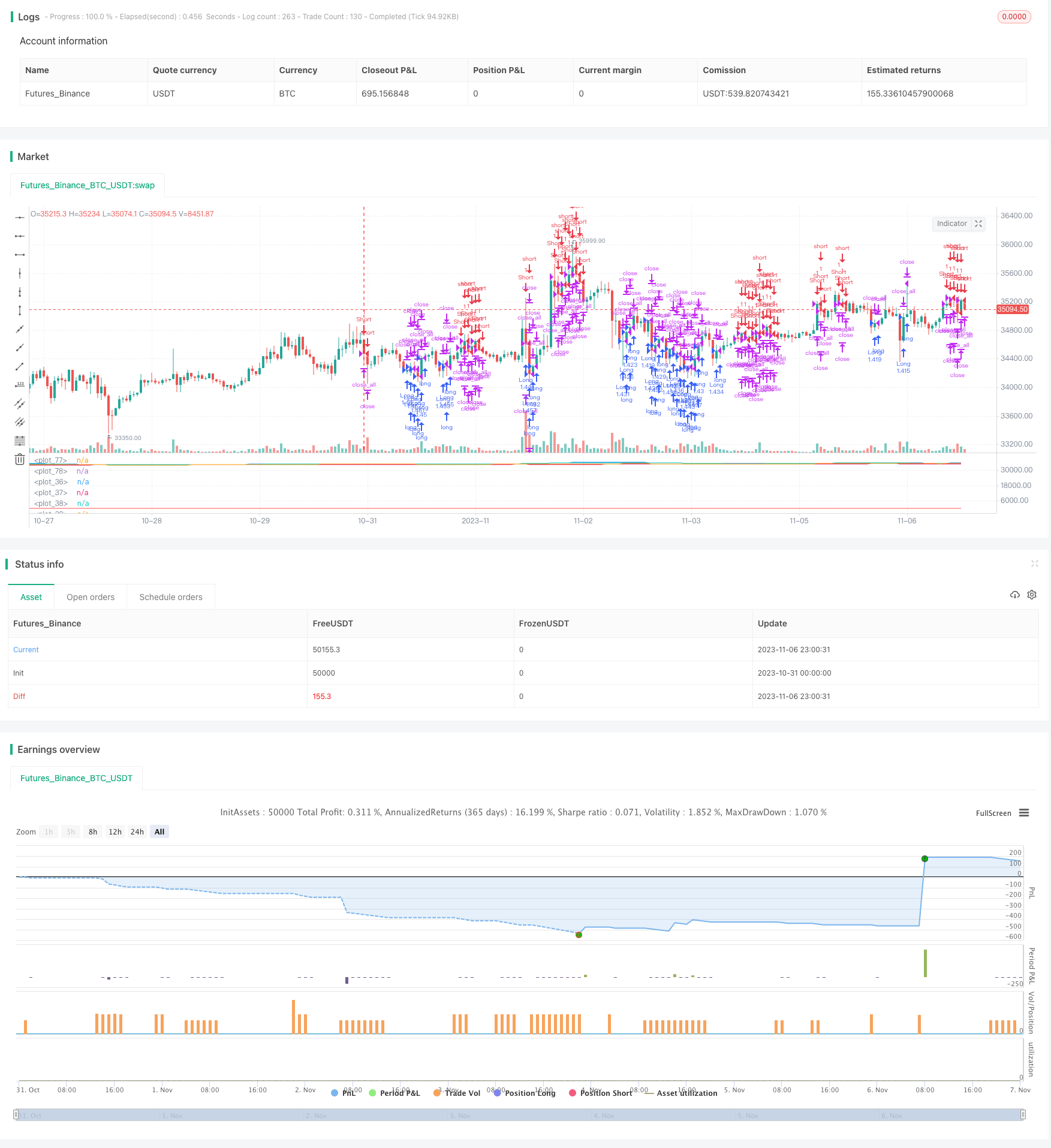
Overview
The Donchian channel breakout trading strategy judges current price trends by calculating the channel of highest and lowest prices over a certain period and trades long and short based on channel breakouts. This strategy is suitable for highly volatile stocks and cryptocurrencies.
Strategy Logic
This strategy constructs a channel by calculating the highest price pcmax and lowest price pcmin over the last history periods. The calculation methods for the upper and lower rail of the channel are:
Upper rail yh = pcmax - (pcmax - pcmin) * (100 - percentDev)/100
Lower rail yl = pcmin + (pcmax - pcmin) * percentDev/100
where percentDev defaults to 13.
A long signal is generated when the price breaks through the upper rail. A short signal is generated when the price breaks through the lower rail.
The specific logic to generate trading signals is:
boundup = high > yh to determine if the upper rail is broken
bounddn = low < yl to determine if the lower rail is broken
upsign = sma(bounddn, 2) == 1 uses sma of bounddn to determine persistent breakout of lower rail
dnsign = sma(boundup, 2) == 1 uses sma of boundup to determine persistent breakout of upper rail
exitup = dnsign breakout of upper rail generates exit signal
exitdn = upsign breakout of lower rail generates exit signal
if upsign breakout of lower rail generates long signal
if dnsign breakout of upper rail generates short signal
The strategy also sets start and end trading times to avoid unnecessary overnight positions.
Advantages of the Strategy
Uses Donchian channel to determine trends, good backtest results
Has both long and short signals, allows two-way trading
Uses SMA to filter signals and avoid bad trades
Optional stop loss to control risks
Sets start and end trading times to avoid overnight risks
Risks of the Strategy
Sensitive to history and percentDev parameters, needs optimization for different products
May generate false signals in range-bound markets
Does not consider order management, may impact profitability in live trading
Does not consider position sizing, risks of oversized positions
Does not consider money management, needs reasonable trading capital
Enhancement Ideas
Optimize history and percentDev parameters for different products
Add filters to avoid false signals in ranging markets
Add position sizing module to control single position size
Add money management module to limit total position size
Add order management for optimal order execution
Conclusion
The Donchian channel breakout strategy uses channel breakouts to determine trends and trading signals, with good backtest results and ability to trade both long and short. However, risks exist regarding parameter optimization, filters, position sizing, money management, order management etc. Proper enhancements in these areas are needed before stable live trading. Overall, it is a traditional trend following strategy, and with optimizations can become a reliable quantitative trading strategy.
Parameters
| Name | Default | What it controls |
|---|---|---|
| v_input_1 | 20 | history |
| v_input_2 | 13 | percentDev |
| v_input_3 | 100 | capital |
| v_input_4 | true | Long |
| v_input_5 | true | Short |
| v_input_6 | true | Stop Loss |
| v_input_7 | 3.8 | Stop loss multiplicator |
| v_input_8 | 2018 | From Year |
| v_input_9 | 2100 | To Year |
| v_input_10 | true | From Month |
| v_input_11 | 12 | To Month |
| v_input_12 | true | From day |
| v_input_13 | 31 | To day |
Source Pine Script
/*backtest
start: 2023-10-31 00:00:00
end: 2023-11-07 00:00:00
period: 1h
basePeriod: 15m
exchanges: [{"eid":"Futures_Binance","currency":"BTC_USDT"}]
*/

////////////////////////////////////////////////////////////
//  Copyright by AlexInc v1.0 02/07/2018  @aav_1980
// PriceChannel strategy
// If you find this script helpful, you can also help me by sending donation to
// BTC 16d9vgFvCmXpLf8FiKY6zsy6pauaCyFnzS
// LTC LQ5emyqNRjdRMqHPHEqREgryUJqmvYhffM
////////////////////////////////////////////////////////////
//@version=3
strategy("AlexInc PriceChannel Str", overlay=false)
history = input(20)
percentDev = input(13)
capital = input(100)

needlong = input(true, defval = true, title = "Long")
needshort = input(true, defval = true, title = "Short")
usestoploss = input(true, defval = true, title = "Stop Loss")
stoplossmult = input(3.8, defval = 3.8, minval = 1, maxval = 10, title = "Stop loss multiplicator")


fromyear = input(2018, defval = 2018, minval = 1900, maxval = 2100, title = "From Year")
toyear = input(2100, defval = 2100, minval = 1900, maxval = 2100, title = "To Year")
frommonth = input(01, defval = 01, minval = 01, maxval = 12, title = "From Month")
tomonth = input(12, defval = 12, minval = 01, maxval = 12, title = "To Month")
fromday = input(01, defval = 01, minval = 01, maxval = 31, title = "From day")
today = input(31, defval = 31, minval = 01, maxval = 31, title = "To day")

bodymin = min( open, close)
bodymax = max(open, close)

pcmax = highest(bodymax, history)
pcmin = lowest(bodymin, history)

yh = ((pcmax - pcmin) / 100 * (100 - percentDev)) + pcmin
yl = ((pcmax - pcmin) / 100 * percentDev) + pcmin

plot(pcmax)
plot(pcmin)
plot(yh)
plot(yl)

//1
bounddn = low < yl ? 1 : 0
boundup = high > yh ? 1 : 0
upsign = sma(bounddn, 2) == 1
dnsign = sma(boundup, 2) == 1
//2
//upsign = crossover(bodymin, yl)
//dnsign = crossunder(bodymax , yh)


exitup = dnsign
exitdn = upsign

lot = strategy.equity / close * capital / 100


xATR = atr(history)
nLoss = usestoploss ? stoplossmult * xATR : na

stop_level_long = 0.0
stop_level_long := nz(stop_level_long[1])

stop_level_short = 0.0
stop_level_short := nz(stop_level_short[1])

pos = strategy.position_size
if pos >0 and pos[1] <= 0 //crossover(pos, 0.5)
    stop_level_long = strategy.position_avg_price - nLoss
if pos < 0 and pos[1] >= 0 //crossunder(pos, -0.5)
    stop_level_short = strategy.position_avg_price + nLoss
if pos == 0
    stop_level_long = bodymin - nLoss
    stop_level_short = bodymax + nLoss

//plot(bodymax + nLoss, color=red)
//plot(bodymin - nLoss, color=red)
plot(stop_level_long, color=red)
plot(stop_level_short, color=red)

if upsign
    strategy.entry("Long", strategy.long, needlong == false ? 0 : lot)

if dnsign
    strategy.entry("Short", strategy.short, needshort == false ? 0 : na)

if true
    strategy.close_all()


//if strategy.position_size != 0
//    strategy.exit("Exit Long", from_entry = "Long", stop = stop_level_long)
// strategy.exit("Exit Short", from_entry = "Short", stop = stop_level_short)Published by ChaoZhang on the FMZ strategy square · last modified 2023-11-08. Collected in the Quant Trading Vault. Unvalidated research: re-test with your own data and costs before trusting it.
Build this with AgenKit
A spec is not a trading system. Paste this into your coding agent and AgenKit runs a specialist team — architecture, test-first build, risk gates, review — with paper trading on by default.
/agenkit build a production-grade trading bot with a backtest engine, risk controls and paper trading by default from strategies/Donchian-Channel-Breakout-Trading-Strategy.md- npx agenkit install engineering-kit in your project
- Paste the command into your agent and approve each phase
- Get tests, backtest, risk controls and a paper-trading switch
Understand it first
Before you run this, read the lesson behind the idea and how to backtest it honestly. Specs like this one are the survivors of an unknown number of trials; deflate their results accordingly.
Related specs
- Donchian Channel and Larry Williams Large Trade Index StrategyPine Script · Breakout · 1m
- Momentum Breakout Trading Strategy 435896Pine Script · Breakout · 1d
- Multi Indicator Trend Breakout Strategy with Dynamic Stop LossPine Script · Breakout · 1d
- Trend Following Strategy with MACD and Donchian ChannelPine Script · Breakout · 1h
- Integrated Ichimoku Keltner Trading System Based on Moving Average StrategyPine Script · Breakout · 1h
- Multi Timeframe Donchian Channel and ATR Dynamic Interval Volatility Following Trading StrategyPine Script · Breakout · 1h