Strategy vault / Trend following
Double Box Trend Following System
The trend following system is a trend following strategy based on a two-box system. It uses the long-term cycle box to determine the overall trend direction, and when the short-term box generates a signal, it selects…
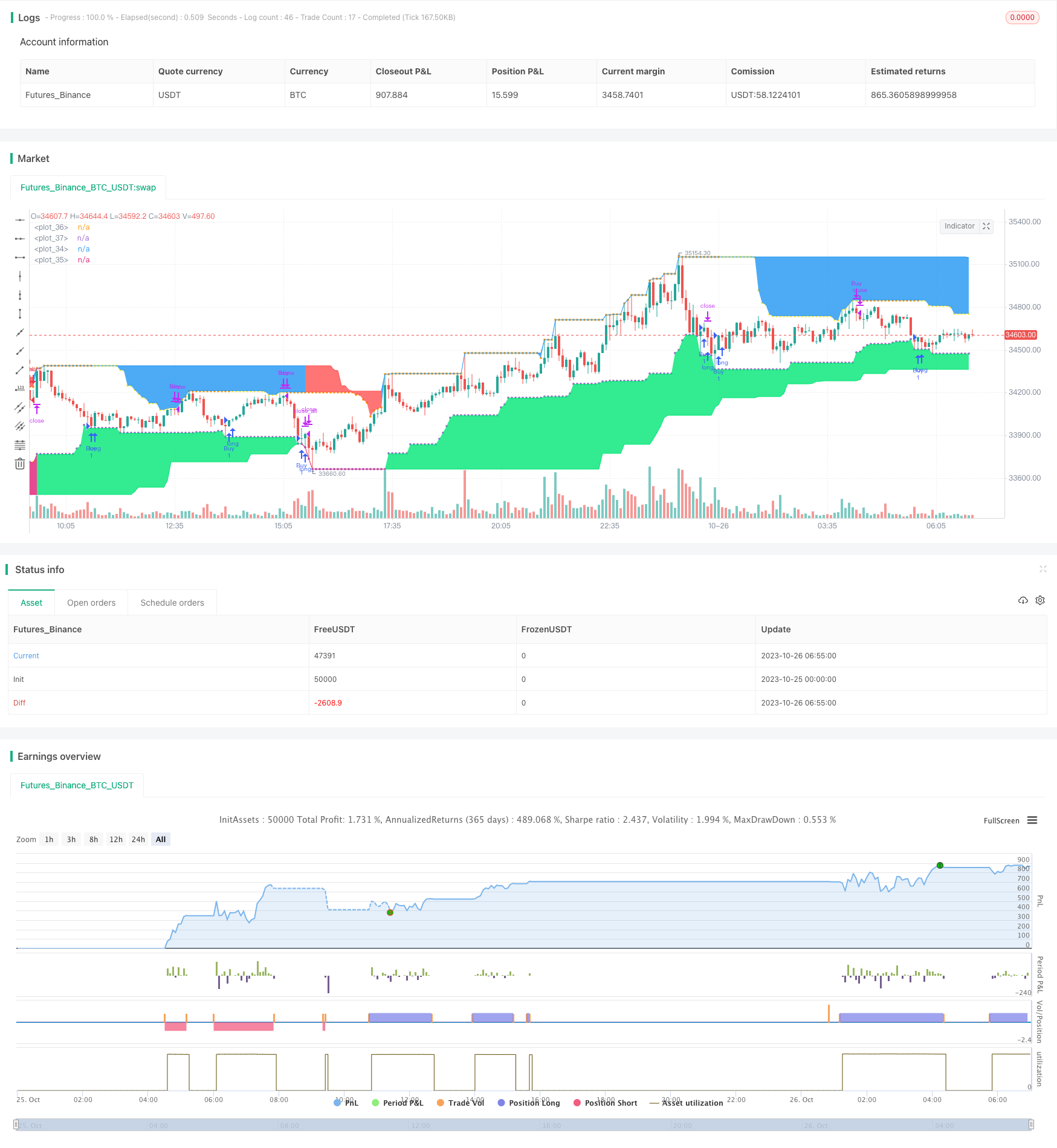
Overview
The trend following system is a trend following strategy based on a two-box system. It uses the long-term cycle box to determine the overall trend direction, and when the short-term box generates a signal, it selects a trading signal consistent with the long-term trend direction to enter the market. This strategy follows the trend and controls risks while maximizing profits.
Strategy Principle
This strategy uses two boxes to determine the trend. The long-term box uses a longer period to judge the main trend direction, and the short-term box uses a shorter period to judge specific trading signals.
The strategy first calculates the highest and lowest prices of the long-term range to determine the main trend direction. The trend direction is classified into three types.:
- The highest price where a candlestick crosses above the highest price, defined as an uptrend and valued1
- The lowest price where a candlestick crosses below the lowest price, defined as a downtrend, assigned value-1
- Otherwise, maintain the original trend direction
After identifying the main trend direction, the strategy begins to enter based on short-term box ranges. Specifically:
- When the main trend is upward and the lowest price of the short-term box is equal to the lowest price of the previous candlestick and lower than the current lowest price of the short-term box, go long
- When the main trend is downward and the highest price of the short-term box is equal to the highest price of the previous candlestick and higher than the current highest price of the short-term box, go short
Additionally, the strategy sets stop-loss and take-profit:
- Long stop loss is the lowest long-term range, and short stop loss is the highest long-term range
- Take profit for long positions is the highest price in the short-term range, and take profit for short positions is the lowest price in the short-term range
When the main trend turns, close all positions.
Advantage Analysis
This strategy has the following advantages:
- Using the dual-box judgment system, it can effectively identify the trend direction and reduce the probability of wrong transactions.
- Only enter a position when the short-term reversal signal aligns with the long-term trend to avoid being misled by short-term market noise.
- Uses a combination of long and short cycles, ensuring the ability to capture the main trend while retaining flexibility to adjust positions appropriately.
- Setting stop-loss and take-profit points is reasonable, allowing you to grasp trends while controlling risk
- Quickly close positions at major trend reversals to control losses in time
Risk Analysis
This strategy also carries the following risks:
- Improper long and short period settings can easily lead to frequent trading or missed opportunities
- A short-term trend reversal caused by an unexpected event does not necessarily mean a long-term trend change, and there is still a risk of loss at this time.
- Stop-loss point is too close, may be shaken out of the market
- The profit stop point is too loose and may not maximize profits.
- If there is an error in long-term trend judgment, subsequent transactions will suffer losses. expands
- Methods to deal with these risks include: adjusting long and short cycle parameters, optimizing stop loss and take profit positions, adding filter conditions, etc.
Optimization Direction
This strategy can be optimized from the following aspects:
- Add filtering conditions to avoid signals being misled by short-term false breakouts
- Optimize the long and short cycle parameters to make them more consistent with the characteristics of different varieties
- Dynamically adjust the stop-loss and take-profit positions to make the stop-loss more precise and the take-profit more adequate.
- Add position management strategies to make the position size more reasonable
- Combine with volume and other indicators to determine the reliability of trend turning
- Use machine learning methods to automatically optimize parameters and filtering conditions
Summary
The overall trend following system is a very practical trend following strategy. It has the ability to judge trends and make short-term adjustments at the same time, and it can control risks while tracking trends. Through continuous optimization, this strategy can become a powerful automated trend trading system. It contains the core philosophy of trend trading and is worthy of in-depth study.
||
Overview
The Trend Following System is a trend tracking strategy based on a double box system. It uses a long-term box to determine the overall trend direction and takes signals that align with the major trend when the short-term box triggers. This strategy follows trends while managing risks.
Strategy Logic
The strategy uses two boxes to determine the trend. The long-term box uses a longer period to judge the major trend direction, and the short-term box uses a shorter period to generate trading signals.
First, the strategy calculates the highest and lowest prices of the long-term box to determine the major trend direction. The trend direction can be:
- If the highest price crosses above the highest price of the previous bar, it is defined as an uptrend, assigned a value of 1
- If the lowest price crosses below the lowest price of the previous bar, it is defined as a downtrend, assigned a value of -1
- Otherwise, maintain the original trend direction
After determining the major trend, the strategy starts taking positions based on the short-term box signals. Specifically:
- When the major trend is up and the short-term box's lowest price equals the previous bar's lowest price and is lower than the current short-term box's lowest price, go long.
- When the major trend is down and the short-term box's highest price equals the previous bar's highest price and is higher than the current short-term box's highest price, go short.
In addition, stop loss and take profit are configured:
- Long stop loss is the lowest price of the long-term box, short stop loss is the highest price of the long-term box
- Long take profit is the highest price of the short-term box, short take profit is the lowest price of the short-term box
When the major trend reverses, close all positions.
Advantage Analysis
The advantages of this strategy include:
- The double box system effectively identifies trend directions and reduces incorrect trades
- Only taking reversal signals that align with the major trend avoids being misled by short-term market noise
- The combination of long and short periods ensures capturing major trends while maintaining position adjustment flexibility
- Reasonable stop loss and take profit points control risk while following trends
- Quickly flattening all positions when the major trend reverses minimizes losses
Risk Analysis
The risks of this strategy include:
- Improper long and short period settings may cause overtrading or missing opportunities
- Short-term reversals may not represent long-term trend changes, still posing loss risks
- Stop loss too close may get stopped out prematurely
- Take profit too loose may not maximize profits
- Wrong judgment of the major trend leads to losses
- Solutions include adjusting periods, optimizing stops/targets, adding filters etc.
Optimization Directions
The strategy can be improved by:
- Adding filters to avoid false breakouts
- Optimizing long and short periods for different products
- Dynamically adjusting stop loss and take profit levels
- Incorporating position sizing rules
- Using volume etc. to judge reliability of trend changes
- Utilizing machine learning to auto-optimize parameters and filters
Summary
The Trend Following System is a practical trend trading strategy combining trend determination and short-term adjustments. With continuous optimizations, it can become a robust automated system that tracks trends while controlling risks. It contains the core philosophies of trend trading and is worth in-depth studying.
Parameters
| Name | Default | What it controls |
|---|---|---|
| v_input_1 | 80 | Longterm Period |
| v_input_2 | 21 | Shortterm Period |
| v_input_3 | true | Show Target |
| v_input_4 | true | Show Trend |
Source Pine Script
/*backtest
start: 2023-10-25 00:00:00
end: 2023-10-26 07:00:00
period: 5m
basePeriod: 1m
exchanges: [{"eid":"Futures_Binance","currency":"BTC_USDT"}]
*/

// This source code is subject to the terms of the Mozilla Public License 2.0 at https://mozilla.org/MPL/2.0/
// © LonesomeTheBlue

//@version=4
strategy("Grab Trading System", overlay = true)
flb = input(defval = 80, title = "Longterm Period", minval = 1)
slb = input(defval = 21, title = "Shortterm Period", minval = 1)
showtarget = input(defval = true, title = "Show Target")
showtrend = input(defval = true, title = "Show Trend")

major_resistance = highest(flb)
major_support = lowest(flb)
minor_resistance = highest(slb)
minor_support = lowest(slb)

var int trend = 0
trend := high > major_resistance[1] ? 1 : low < major_support[1] ? -1 : trend
strategy.entry("Buy", true, when = trend == 1 and low[1] == minor_support[1] and low > minor_support)
strategy.entry("Sell", false, when = trend == -1 and high[1] == minor_resistance[1] and high < minor_resistance)

if strategy.position_size > 0
    strategy.exit("Buy", stop = major_support, comment = "Stop Buy")
    if high[1] == minor_resistance[1] and high < minor_resistance
        strategy.close("Buy", comment ="Close Buy")

if strategy.position_size < 0
    strategy.exit("Sell", stop = major_resistance, comment = "Stop Sell")
    if low[1] == minor_support[1] and low > minor_support
        strategy.close("Sell", comment ="Close Sell")

if strategy.position_size != 0 and change(trend)
    strategy.close_all()

majr = plot(major_resistance, color = showtrend and trend == -1 and trend[1] == -1 ? color.red : na)
majs = plot(major_support, color = showtrend and trend == 1 and trend[1] == 1 ? color.lime : na)
minr = plot(minor_resistance, color = showtarget and trend == 1 and strategy.position_size > 0 ? color.yellow : na, style = plot.style_circles)
mins = plot(minor_support, color = showtarget and trend == -1 and strategy.position_size < 0 ? color.yellow : na, style = plot.style_circles)

fill(majs, mins, color = showtrend and trend == 1 and trend[1] == 1 ? color.lime : na, transp = 85)
fill(majr, minr, color = showtrend and trend == -1 and trend[1] == -1 ? color.red : na, transp = 85)
Published by ChaoZhang on the FMZ strategy square · last modified 2023-11-02. Collected in the Quant Trading Vault. Unvalidated research: re-test with your own data and costs before trusting it.
Build this with AgenKit
A spec is not a trading system. Paste this into your coding agent and AgenKit runs a specialist team — architecture, test-first build, risk gates, review — with paper trading on by default.
/agenkit build a production-grade trading bot with a backtest engine, risk controls and paper trading by default from strategies/Double-Box-Trend-Following-System.md- npx agenkit install engineering-kit in your project
- Paste the command into your agent and approve each phase
- Get tests, backtest, risk controls and a paper-trading switch
Understand it first
Before you run this, read the lesson behind the idea and how to backtest it honestly. Specs like this one are the survivors of an unknown number of trials; deflate their results accordingly.
Related specs
- 200 EMA VWAP MFI Trend Following StrategyPine Script · Trend following · 1d
- 4 EMA Trend StrategyPine Script · Trend following · 1d
- ADX MA and EMA Long Only Trend Tracking StrategyPine Script · Trend following · 1d
- ATR Dynamic Profit Target and Stop Loss StrategyPine Script · Trend following · 1d
- ATR Dynamic Trend Following and EMA Crossover Trading StrategyPine Script · Trend following · 1d
- ATR and Moving Average Crossover Hybrid StrategyPine Script · Trend following · 1h