Strategy vault / Trend following
Dual Entry Position Averaging Trailing Stop Loss Strategy
This strategy adopts a dual entry approach. After the first entry, if the price does not reach the first take profit level, it will enter again at a higher price to achieve the effect of adding positions. At the same…
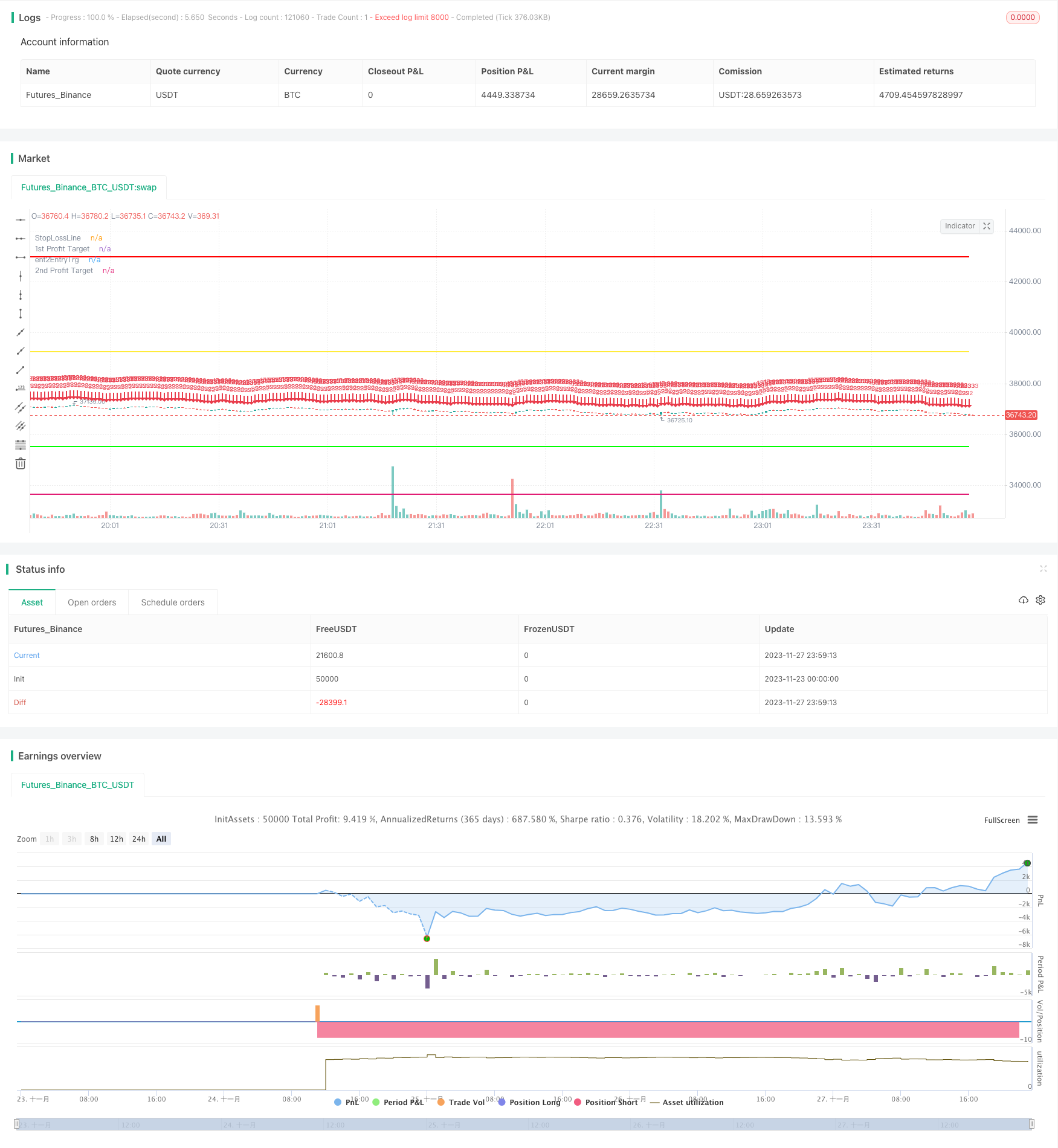
Overview
This strategy adopts a dual entry approach. After the first entry, if the price does not reach the first take profit level, it will enter again at a higher price to achieve the effect of adding positions. At the same time, the strategy adopts a position averaging trailing stop loss method to update the stop loss line in real time and set it to a certain percentage above the average entry price to lock in profits and control risks.
Strategy Logic
The strategy first judges if the price is below the 200-day simple moving average. If yes, the entry criteria are met. The strategy enters between 14:29 and 15:00 every day to form the first entry. After that, the strategy will plot the first take profit and stop loss lines.
If the price rises but does not reach the first take profit target, it will enter again at 5% above the first entry price to add positions. At this point, the strategy will update the stop loss line to 1.15 times the current average holding price. At the same time, the second take profit line will be plotted.
The strategy can lock in profits through two take profit targets and trailing stop loss, while obtaining more profits through adding positions.
Advantage Analysis
The strategy has the following advantages:
Adopting dual entry add-on method can obtain higher returns without increasing risks.
Real-time update of stop loss line position. The position averaging trailing stop loss method can effectively control risks and lock in profits.
Opening positions in a downtrend, it has certain countertrend trading capability.
Reasonable entry time and price levels avoid being trapped.
Reasonable parameter settings, tight take profit and stop loss levels mean high risk-reward ratio.
Risk Analysis
The strategy also has some risks:
The dual entry add-on method may amplify losses. If both entries finally hit stop loss, the loss would be greater.
If the stop loss level is set improperly, it may fail to effectively control risks and lead to unacceptable losses.
If the entry time is chosen poorly, it may result in adverse entry and higher probability of being trapped.
Unreasonable parameter settings like take profit being too distant or stop loss being too close may reduce profits.
These risks could be reduced and avoided through reasonable parameter optimization and strict risk control.
Optimization Directions
The strategy can also be optimized in the following aspects:
Test different technical indicators as entry signals to find better entry points.
Test and optimize take profit and stop loss levels to maximize risk-reward ratio.
Test different add-on methods to determine the optimal add-on multiples.
Add trend judgment rules to avoid countertrend entries.
Optimize the selection of entry time periods to ensure no adverse entries.
Conclusion
Overall, this strategy is very practical and has strong practical significance. The dual entry add-on method can obtain higher returns while controlling risks. The position averaging trailing stop loss can lock in profits and control risks effectively. With reasonable parameter optimization and strict risk control, this strategy can achieve steady and consistent Alpha.
Parameters
| Name | Default | What it controls |
|---|---|---|
| v_input_1 | 1.15 | Total Stop Loss |
| v_input_2 | 1.05 | Enter Second trade @ what higher 5%? |
| v_input_3 | 0.95 | First Trade Profit % Target |
| v_input_4 | 0.9 | Second Trade Profit % Target |
Source Pine Script
/*backtest
start: 2023-11-23 00:00:00
end: 2023-11-28 00:00:00
period: 1m
basePeriod: 1m
exchanges: [{"eid":"Futures_Binance","currency":"BTC_USDT"}]
*/

//              @version=4
strategy("8 Whittle Down", "8 WD", 1, initial_capital=0)


//              DUAL ENTRIES
//              ADDS ON MORE SHARES IF THE PILOT TRADE DOES NOT REACH PROFIT TARGET
//              RED     LINE        == STOP LOSS LINE
//              GREEN   LINE        == PROFIT TARGET FOR THE 1ST TRADE
//              YELLOW  LINE        == ADD ON SHARES TO THE TRADE
//              WHITE   LINE        == PROFIT TARGET FOR THE 1ST & SECOND TRADE COMBINED


StopLossPerc        = input(1.15, "Total Stop Loss", step=0.01)


T2EntTrgPerc        = input(1.05, "Enter Second trade @ what higher 5%?", step=0.01)    //  BUY STOP LIMIT ONLY WHEN ONE TRADE IS ALREADY OPEN & AIMS TO BUY DOUBLE THE OWNED SHARES AT A HIGHER ENTRY PRICE // YELLOW LINE

T1ProfTrgPerc       = input(0.95, "First Trade Profit % Target", step=0.01)
T2ProfTrgPerc       = input(0.90, "Second Trade Profit % Target", step=0.01)


RiskRange           = close*(StopLossPerc)-1
Shares              = floor(1000*1000/RiskRange) / 3                                    //  SPLITS THE RISK OVER THREE TRADES

F1                  = close < sma(security(syminfo.tickerid, "D", close[2]), 200)       //  HIGH OF OLD DATA -- SO NO REPAINTING
F2                  = strategy.opentrades == 0
buyTime             = time(timeframe.period, "1429-1500")                               //  BUY AT THE END OF THE  DAY


StopLossLine        = strategy.position_avg_price * StopLossPerc
StopLossCol         = strategy.opentrades != 0 ? #FF0000 : na
plot(StopLossLine,  "StopLossLine", StopLossCol, 2)


strategy.cancel_all()                                                                   //  CANCELS ALL ORDERS: BECAUSE THE SYSTEM WILL ADD A BUY STOP LIMIT ORDER FOR ENTRY TWO


///==============   ENTRY 1   ==============
if  F1 and buyTime and strategy.opentrades == 0
    strategy.entry("S1", false, qty=Shares)


T1Prof              = strategy.position_avg_price * T1ProfTrgPerc
plot(T1Prof,        "1st Profit Target", strategy.opentrades == 1 ? #00FF00 : na, 2)

strategy.exit("S1 Ex", "S1", limit=T1Prof, stop=StopLossLine )


///==============   ENTRY 2   ==============
T2EntryTrg          = strategy.position_avg_price * T2EntTrgPerc // enters on higher target than 1st entry
plot(T2EntryTrg,    "ent2EntryTrg", strategy.opentrades == 1 ? color.yellow : na, 2)


if  strategy.opentrades == 1
    strategy.order("S2", false, stop=T2EntryTrg, limit= T2EntryTrg, qty=Shares * 2)     //  BUYS MORE SHARES

T2Prof              = strategy.position_avg_price * T2ProfTrgPerc

T2Col               = strategy.opentrades == 2 ? color.white : na
plot(T2Prof,        "2nd Profit Target", T2Col, 2)


strategy.exit("S2 Ex", "S2", limit=T2Prof, stop=StopLossLine )
Published by ChaoZhang on the FMZ strategy square · last modified 2023-12-01. Collected in the Quant Trading Vault. Unvalidated research: re-test with your own data and costs before trusting it.
Build this with AgenKit
A spec is not a trading system. Paste this into your coding agent and AgenKit runs a specialist team — architecture, test-first build, risk gates, review — with paper trading on by default.
/agenkit build a production-grade trading bot with a backtest engine, risk controls and paper trading by default from strategies/Dual-Entry-Position-Averaging-Trailing-Stop-Loss-Strategy.md- npx agenkit install engineering-kit in your project
- Paste the command into your agent and approve each phase
- Get tests, backtest, risk controls and a paper-trading switch
Understand it first
Before you run this, read the lesson behind the idea and how to backtest it honestly. Specs like this one are the survivors of an unknown number of trials; deflate their results accordingly.
Related specs
- ADX MA and EMA Long Only Trend Tracking StrategyPine Script · Trend following · 1d
- ATR and Moving Average Crossover Hybrid StrategyPine Script · Trend following · 1h
- Adaptive FVG Detection and MA Trend Trading Strategy with Dynamic ResistancePine Script · Trend following · 1d
- Adaptive Risk Management Strategy Based on Dynamic ATR and Moving Average CrossoverPine Script · Trend following · 2h
- Adaptive Trading Strategy Based on Stochastic RSI Dual Line CrossoverPine Script · Trend following · 4h
- Adaptive Volatility Based Trend Following Short Strategy with Time Delay and Stop Loss ProtectionPine Script · Trend following · 2m