Strategy vault / Mean reversion
Dual Moving Average Reversal Trading Strategy 434196
This is a reversal trading strategy based on dual moving average indicators. By calculating two groups of moving averages with different parameter settings and judging the price trend according to their directional…
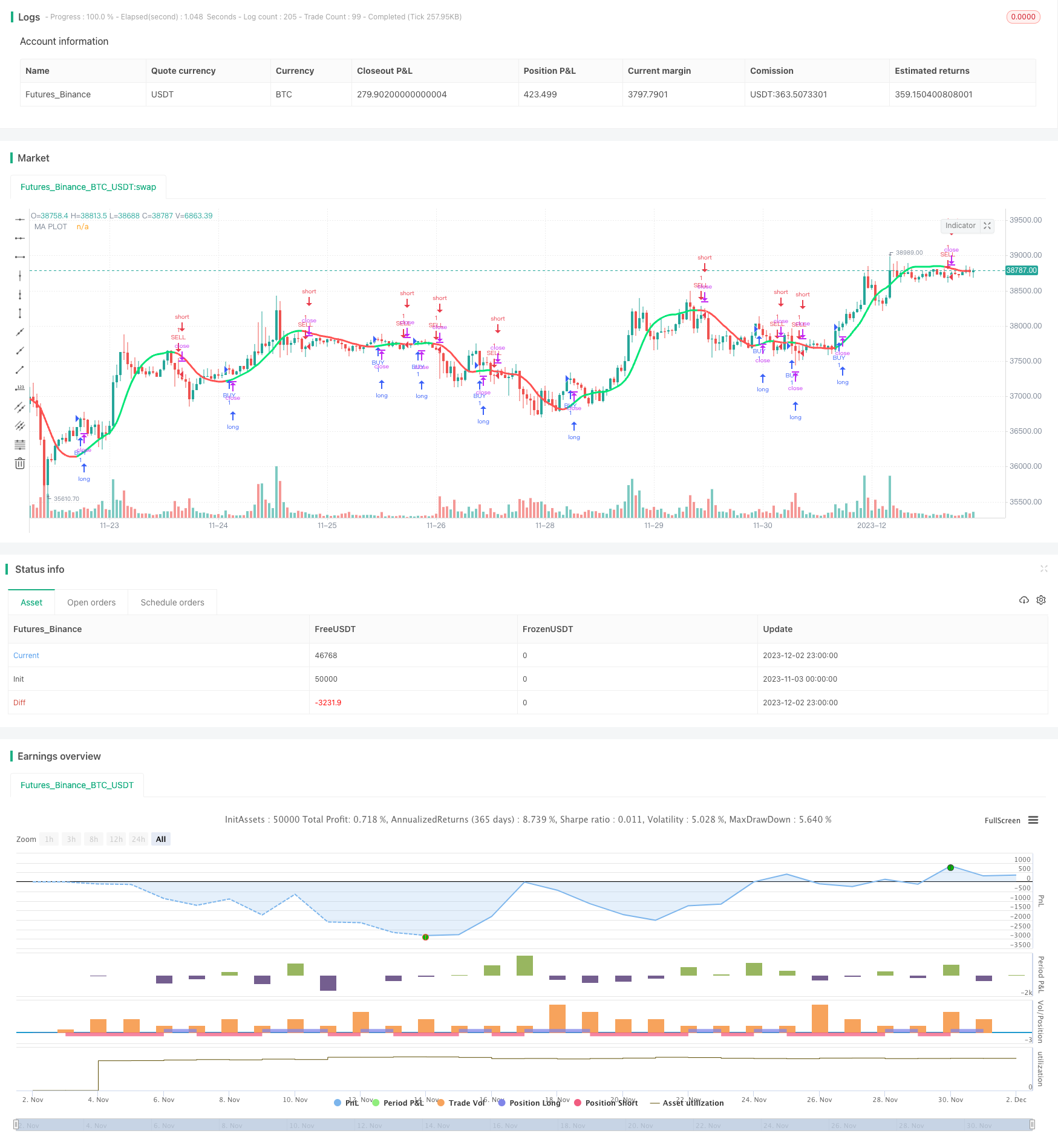
Overview
This is a reversal trading strategy based on dual moving average indicators. By calculating two groups of moving averages with different parameter settings and judging the price trend according to their directional changes, trading signals can be generated by setting the sensitivity parameter for directional changes.
Principles
The core indicator of this strategy is the dual moving average. The strategy allows selecting the type (SMA, EMA, etc.), length and price source (close price, typical price, etc.) of the moving average. After calculating two groups of moving averages, their directions are determined by defining the reaction parameter. A buy signal is generated when the fast line crosses above the slow line, and a sell signal is generated when it crosses below. The reaction parameter is used to adjust the sensitivity to identify turning points.
In addition, the strategy also sets the conditions to determine the change of direction and continued rise/fall to avoid generating wrong signals. And it visualizes the rise and fall of prices in different colors. When prices continue to rise, the movavg line is displayed in green, and in red when prices fall.
Advantage Analysis
The dual movavg strategy combines fast and slow lines with different parameter settings, which can effectively filter the noise in the trading market and identify stronger trends. Compared with a single movavg strategy, it reduces wrong signals and allows entering the market when the trend is more distinct, thereby obtaining a higher win rate.
The reaction parameter allows the strategy to be flexible and adaptable to different cycles and varieties. The strategic process is intuitive and simple, easy to understand and optimize.
Risk Analysis
The biggest risk of this strategy is missing the turning point and losing money or taking a reverse position. This relates to the reaction parameter setting. If the reaction is too small, wrong signals are prone to occur. If the reaction is too large, it may miss better entry points.
Another risk is the inability to effectively control losses. When prices fluctuate violently, it cannot quickly stop losses, leading to enlarged losses. This requires the use of stop-loss strategies to control risks.
Optimization Directions
The main optimization directions of this strategy focus on selecting reaction parameters, types and lengths of moving averages. Increasing reaction appropriately can reduce wrong signals. Moving average parameters can be tested according to different cycles and varieties to select the best combination for generating signals.
In addition, confirming trading signals with other auxiliary indicators such as RSI and KD is also an optimization idea. Or use machine learning methods to automatically optimize parameters.
Summary
Overall, this strategy is relatively simple and practical. By filtering with dual moving averages and generating trading signals, it can effectively identify trend reversals and is a typical trend-following strategy. After optimizing the parameter portfolio, its ability to capture trends and hold positions against the market will be improved. Using it with stop loss and position management mechanisms works better.
Parameters
| Name | Default | What it controls |
|---|---|---|
| v_input_1 | 0 | MA Type: : HullMA | EMA | WMA | VWMA | SMMA | DEMA | TEMA | SMA | ZEMA | TMA | SSMA |
| v_input_2 | 32 | MA Lenght |
| v_input_3_close | 0 | MA Source: close | high | low | open | hl2 | hlc3 | hlcc4 | ohlc4 |
| v_input_4 | 2 | MA Reaction |
Source Pine Script
/*backtest
start: 2023-11-03 00:00:00
end: 2023-12-03 00:00:00
period: 1h
basePeriod: 15m
exchanges: [{"eid":"Futures_Binance","currency":"BTC_USDT"}]
*/

//@version=3
strategy(shorttitle="MA_color strategy", title="Moving Average Color", overlay=true)

// === INPUTS

ma_type   = input(defval="HullMA", title="MA Type: ", options=["SMA", "EMA", "WMA", "VWMA", "SMMA", "DEMA", "TEMA", "HullMA", "ZEMA", "TMA", "SSMA"])
ma_len    = input(defval=32, title="MA Lenght", minval=1)
ma_src    = input(close, title="MA Source")
reaction  = input(defval=2, title="MA Reaction", minval=1)

// SuperSmoother filter
// © 2013  John F. Ehlers
variant_supersmoother(src,len) =>
    a1 = exp(-1.414*3.14159 / len)
    b1 = 2*a1*cos(1.414*3.14159 / len)
    c2 = b1
    c3 = (-a1)*a1
    c1 = 1 - c2 - c3
    v9 = 0.0
    v9 := c1*(src + nz(src[1])) / 2 + c2*nz(v9[1]) + c3*nz(v9[2])
    v9

variant_smoothed(src,len) =>
    v5 = 0.0
    v5 := na(v5[1]) ? sma(src, len) : (v5[1] * (len - 1) + src) / len
    v5

variant_zerolagema(src,len) =>
    ema1 = ema(src, len)
    ema2 = ema(ema1, len)
    v10 = ema1+(ema1-ema2)
    v10

variant_doubleema(src,len) =>
    v2 = ema(src, len)
    v6 = 2 * v2 - ema(v2, len)
    v6

variant_tripleema(src,len) =>
    v2 = ema(src, len)
    v7 = 3 * (v2 - ema(v2, len)) + ema(ema(v2, len), len)
    v7

variant(type, src, len) =>
    type=="EMA"     ? ema(src,len) :
      type=="WMA"   ? wma(src,len):
      type=="VWMA"  ? vwma(src,len) :
      type=="SMMA"  ? variant_smoothed(src,len) :
      type=="DEMA"  ? variant_doubleema(src,len):
      type=="TEMA"  ? variant_tripleema(src,len):
      type=="HullMA"? wma(2 * wma(src, len / 2) - wma(src, len), round(sqrt(len))) :
      type=="SSMA"  ? variant_supersmoother(src,len) :
      type=="ZEMA"  ? variant_zerolagema(src,len) :
      type=="TMA"   ? sma(sma(src,len),len) : sma(src,len)


// === Moving Average
ma_series = variant(ma_type,ma_src,ma_len)

direction = 0
direction := rising(ma_series,reaction) ? 1 : falling(ma_series,reaction) ? -1 : nz(direction[1])
change_direction= change(direction,1)
change_direction1= change(direction,1)

pcol = direction>0 ? lime : direction<0 ? red : na
plot(ma_series, color=pcol,style=line,join=true,linewidth=3,transp=10,title="MA PLOT")

/////// Alerts ///////

alertcondition(change_direction,title="Change Direction MA",message="Change Direction MA")


longCondition = direction>0
shortCondition = direction<0
if (longCondition)
    strategy.entry("BUY", strategy.long)
if (shortCondition)
    strategy.entry("SELL", strategy.short)
Published by ChaoZhang on the FMZ strategy square · last modified 2023-12-04. Collected in the Quant Trading Vault. Unvalidated research: re-test with your own data and costs before trusting it.
Build this with AgenKit
A spec is not a trading system. Paste this into your coding agent and AgenKit runs a specialist team — architecture, test-first build, risk gates, review — with paper trading on by default.
/agenkit build a production-grade trading bot with a backtest engine, risk controls and paper trading by default from strategies/Dual-Moving-Average-Reversal-Trading-Strategy-434196.md- npx agenkit install engineering-kit in your project
- Paste the command into your agent and approve each phase
- Get tests, backtest, risk controls and a paper-trading switch
Understand it first
Before you run this, read the lesson behind the idea and how to backtest it honestly. Specs like this one are the survivors of an unknown number of trials; deflate their results accordingly.
Related specs
- Advanced 15 Minute Chart Trading Signal StrategyPine Script · Mean reversion · 3h
- Advanced Momentum EMA Trend Following with RSI Overbought Oversold Trading StrategyPine Script · Mean reversion · 1d
- Advanced Quantitative Trading Strategy Combining RSI Divergence and Moving AveragesPine Script · Mean reversion · 1h
- Advanced Quantitative Trend Following and Cloud Reversal Composite Trading StrategyPine Script · Mean reversion · 1d
- BONK Multi Factor Trading StrategyPine Script · Mean reversion · 1d
- Bidirectional Moving Average Reversion Trading StrategyPine Script · Mean reversion · 1h