Strategy vault / Mean reversion
Dual Moving Average Reversion Strategy
The Dual Moving Average Reversion Strategy is a typical short-term mean reversion trading strategy. The strategy generates trading signals by two moving averages with different parameter settings. It aims to gain…
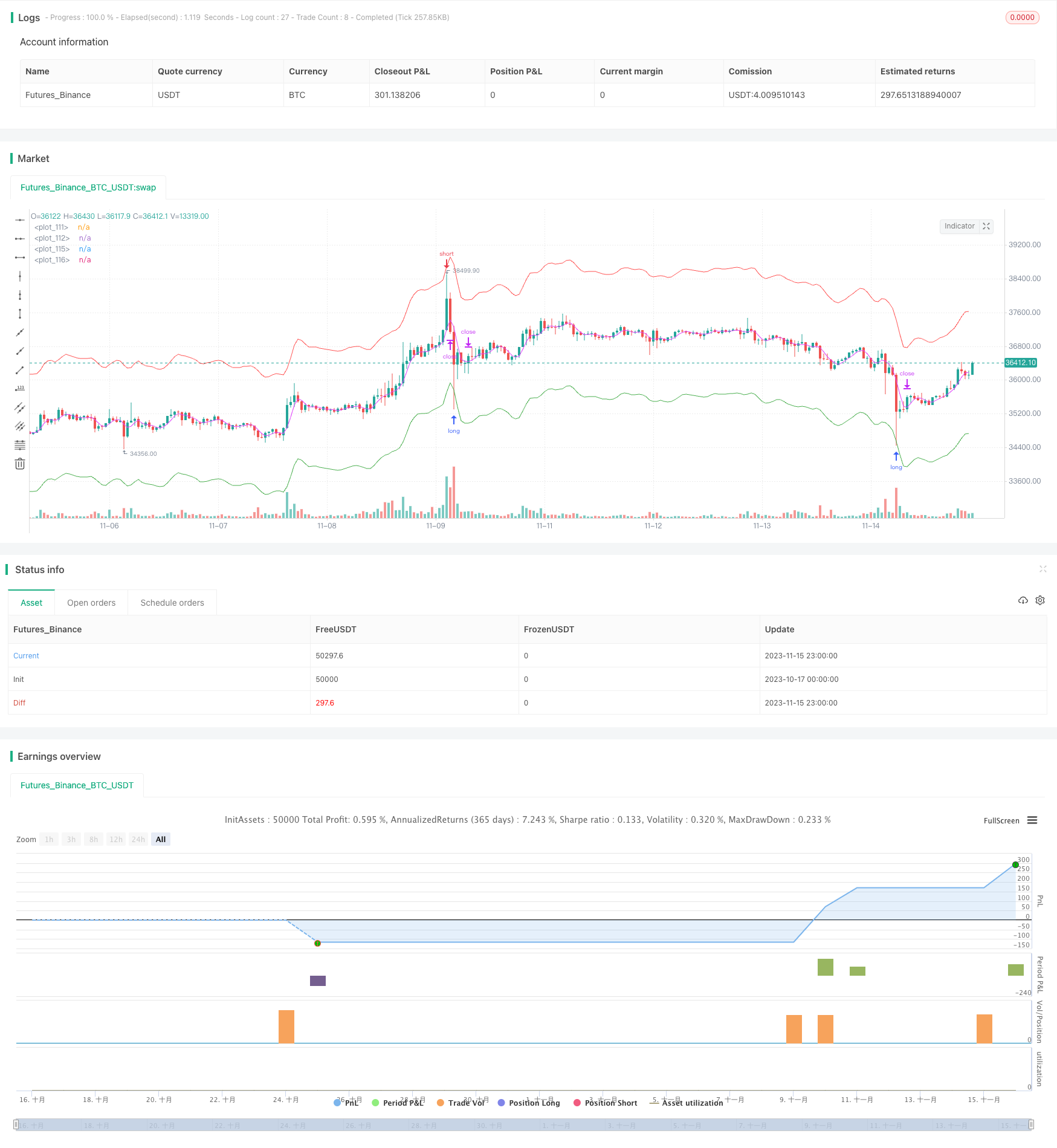
Overview
The Dual Moving Average Reversion Strategy is a typical short-term mean reversion trading strategy. The strategy generates trading signals by two moving averages with different parameter settings. It aims to gain profits when trend reversal happens.
Strategy Logic
The strategy uses two moving averages to generate trading signals. The first MA maopening is used to determine the trend direction. The second MA maclosing is used to generate trading signals.
When maopening goes up, it indicates the current market is in an uptrend. When maopening goes down, it indicates the current market is in a downtrend. maclosing is multiplied by a coefficient greater than 1 to make it more sensitive for generating early reversal signals.
Specifically, when maopening goes up and maclosing crosses below maopening, it indicates a trend reversal. The strategy will open short position. When maopening goes down and maclosing crosses above maopening, it indicates a trend reversal. The strategy will open long position.
The parameters of the strategy include MA type, length, data source etc. The trading performance can be optimized by adjusting these parameters. There are also some configurable options such as entry rule, stop loss etc.
Advantage Analysis
The main advantages of the Dual MA Reversion Strategy are:
Small drawdown, suitable for short-term trading. The fast moving averages can quickly capture short-term reversals with smaller drawdowns.
Simple to implement and easy to grasp. The crossover of two MAs generates clear trading signals.
Highly configurable with multiple adjustable parameters. The parameters of two MAs and coefficients can be optimized.
Easy to automate with clear logic flow. The simple logic and high frequency trading make it very suitable for automated trading.
Controllable risk with stop loss mechanism. Moving stop loss or value stop loss can limit the loss of single trade.
Risk Analysis
There are also some risks of the strategy:
Lagging of MA crossover signals. The MAs themselves lag behind the price. The crossover may happen after the trend has reversed for some time.
Risk of whipsaw trades. The reversed trend may quickly reverse again, causing consecutive losses.
Drawdown still exists. Though stop loss limits the single loss, consecutive stop loss can still lead to large drawdowns.
Overfitting risk. Excessive parameter optimization may lead to overfitting and poor performance in live trading.
The solutions include:
Optimize parameters to find faster MAs.
Add filters, like volume and volatility indicators, to avoid whipsaw trades.
Adjust stop loss position to lower the probability of consecutive stop loss.
Robustness test of parameter sets to evaluate overfitting risks.
Improvement Directions
The strategy can be further optimized in the following aspects:
Test different types of MAs to find more sensitive ones, like KAMA, ZLEMA etc.
Optimize MA lengths to find the optimal combination. Usually shorter periods have better performance.
Test different data sources, like close, median price, typical price etc.
Add trend filter to avoid unsuitable reversal signals, like Donchian Channel.
Add other indicators for confirmation, like MACD, OBV etc.
Enhance risk management mechanisms, like moving stop loss, maximum account loss etc.
Portfolio optimization to find the optimal asset allocation.
Robustness test of parameters to evaluate overfitting risks.
Conclusion
The Dual MA Reversion is a simple and practical short-term trading strategy. It is suitable for capturing short-term reversals with quantitative trading. However, risks like lagging and whipsaw trades exist. The strategy can be improved by optimizing parameters, adding filters, enhancing risk control etc. to develop a stable and efficient strategy with good real trading performance.
Parameters
| Name | Default | What it controls |
|---|---|---|
| v_input_2 | true | long1on |
| v_input_float_2 | 0.96 | Long |
| v_input_int_5 | 10 | Lot 1 |
| v_input_3 | true | short1on |
| v_input_float_3 | 1.04 | short |
| v_input_int_6 | 10 | Lot 1 |
| v_input_4 | timestamp(01 Jan 2010 00:00 +0000) | Start date |
| v_input_5 | timestamp(31 Dec 2030 23:59 +0000) | Final date |
| v_input_1 | false | (?Options)Entry on close |
| v_input_int_1 | false | | Offset View |
| v_input_int_2 | false | Trade |
| v_input_bool_1 | false | Use Kalman filter |
| v_input_string_1 | 0 | (?MA Opening)maopeningtyp: SMA | EMA | TEMA | DEMA | ZLEMA | WMA | Hma | Thma | Ehma | H | L | DMA |
| v_input_source_1_ohlc4 | 0 | maopeningsrc: ohlc4 | high | low | open | hl2 | hlc3 | hlcc4 | close |
| v_input_int_3 | 3 | maopeninglen |
| v_input_string_2 | 0 | (?MA Closing)maclosingtyp: SMA | EMA | TEMA | DEMA | ZLEMA | WMA | Hma | Thma | Ehma | H | L | DMA |
| v_input_source_2_ohlc4 | 0 | maclosingsrc: ohlc4 | high | low | open | hl2 | hlc3 | hlcc4 | close |
| v_input_int_4 | 3 | maclosinglen |
| v_input_float_1 | true | mul |
Source Pine Script
/*backtest
start: 2023-10-17 00:00:00
end: 2023-11-16 00:00:00
period: 1h
basePeriod: 15m
exchanges: [{"eid":"Futures_Binance","currency":"BTC_USDT"}]
*/

//@version=5
strategy(title = "hamster-bot MRS 2", overlay = true, default_qty_type = strategy.percent_of_equity, initial_capital = 100, default_qty_value = 100, pyramiding = 9, commission_value = 0.045, backtest_fill_limits_assumption = 1)
info_options = "Options"

on_close = input(false, title = "Entry on close", inline=info_options, group=info_options)
OFFS = input.int(0, minval = 0, maxval = 1, title = "| Offset View", inline=info_options, group=info_options)
trade_offset = input.int(0, minval = 0, maxval = 1, title = "Trade", inline=info_options, group=info_options)
use_kalman_filter = input.bool(false, title="Use Kalman filter", group=info_options)

//MA Opening
info_opening = "MA Opening"
maopeningtyp = input.string("SMA", title="Type", options=["SMA", "EMA", "TEMA", "DEMA", "ZLEMA", "WMA", "Hma", "Thma", "Ehma", "H", "L", "DMA"], title = "", inline=info_opening, group=info_opening)
maopeningsrc = input.source(ohlc4, title = "", inline=info_opening, group=info_opening)
maopeninglen = input.int(3, minval = 1, maxval = 200, title = "", inline=info_opening, group=info_opening)

//MA Closing
info_closing = "MA Closing"
maclosingtyp = input.string("SMA", title="Type", options=["SMA", "EMA", "TEMA", "DEMA", "ZLEMA", "WMA", "Hma", "Thma", "Ehma", "H", "L", "DMA"], title = "", inline=info_closing, group=info_closing)
maclosingsrc = input.source(ohlc4, title = "", inline=info_closing, group=info_closing)
maclosinglen = input.int(3, minval = 1, maxval = 200, title = "", inline=info_closing, group=info_closing)
maclosingmul = input.float(1, step = 0.005, title = "mul", inline=info_closing, group=info_closing)

long1on    = input(true, title = "", inline = "long1")
long1shift = input.float(0.96, step = 0.005, title = "Long", inline = "long1")
long1lot   = input.int(10, minval = 0, maxval = 10000, step = 10, title = "Lot 1", inline = "long1")
short1on    = input(true, title = "", inline = "short1")
short1shift = input.float(1.04, step = 0.005, title = "short", inline = "short1")
short1lot   = input.int(10, minval = 0, maxval = 10000, step = 10, title = "Lot 1", inline = "short1")
startTime = input(timestamp("01 Jan 2010 00:00 +0000"), "Start date", inline = "period")
finalTime = input(timestamp("31 Dec 2030 23:59 +0000"), "Final date", inline = "period")

HMA(_src, _length) =>  ta.wma(2 * ta.wma(_src, _length / 2) - ta.wma(_src, _length), math.round(math.sqrt(_length)))
EHMA(_src, _length) =>  ta.ema(2 * ta.ema(_src, _length / 2) - ta.ema(_src, _length), math.round(math.sqrt(_length)))
THMA(_src, _length) =>  ta.wma(ta.wma(_src,_length / 3) * 3 - ta.wma(_src, _length / 2) - ta.wma(_src, _length), _length)
tema(sec, length)=>
    tema1= ta.ema(sec, length)
    tema2= ta.ema(tema1, length)
    tema3= ta.ema(tema2, length)
    tema_r = 3*tema1-3*tema2+tema3
donchian(len) => math.avg(ta.lowest(len), ta.highest(len))
ATR_func(_src, _len)=>
    atrLow = low - ta.atr(_len)
    trailAtrLow = atrLow
    trailAtrLow := na(trailAtrLow[1]) ? trailAtrLow : atrLow >= trailAtrLow[1] ? atrLow : trailAtrLow[1]
    supportHit = _src <= trailAtrLow
    trailAtrLow := supportHit ? atrLow : trailAtrLow
    trailAtrLow
f_dema(src, len)=>
    EMA1 = ta.ema(src, len)
    EMA2 = ta.ema(EMA1, len)
    DEMA = (2*EMA1)-EMA2
f_zlema(src, period) =>
    lag = math.round((period - 1) / 2)
    ema_data = src + (src - src[lag])
    zl= ta.ema(ema_data, period)
f_kalman_filter(src) =>
    float value1= na
    float value2 = na
    value1 := 0.2 * (src - src[1]) + 0.8 * nz(value1[1])
    value2 := 0.1 * (ta.tr) + 0.8 * nz(value2[1])
    lambda = math.abs(value1 / value2)
    alpha = (-math.pow(lambda, 2) + math.sqrt(math.pow(lambda, 4) + 16 * math.pow(lambda, 2)))/8
    value3 = float(na)
    value3 := alpha * src + (1 - alpha) * nz(value3[1])
//SWITCH
ma_func(modeSwitch, src, len, use_k_f=true) =>
      modeSwitch == "SMA"   ? use_kalman_filter and use_k_f ? f_kalman_filter(ta.sma(src, len))  : ta.sma(src, len) :
      modeSwitch == "RMA"   ? use_kalman_filter and use_k_f ? f_kalman_filter(ta.rma(src, len))  : ta.rma(src, len) :
      modeSwitch == "EMA"   ? use_kalman_filter and use_k_f ? f_kalman_filter(ta.ema(src, len))  : ta.ema(src, len) :
      modeSwitch == "TEMA"  ? use_kalman_filter and use_k_f ? f_kalman_filter(tema(src, len))    : tema(src, len):
      modeSwitch == "DEMA"  ? use_kalman_filter and use_k_f ? f_kalman_filter(f_dema(src, len))  : f_dema(src, len):
      modeSwitch == "ZLEMA" ? use_kalman_filter and use_k_f ? f_kalman_filter(f_zlema(src, len)) : f_zlema(src, len):
      modeSwitch == "WMA"   ? use_kalman_filter and use_k_f ? f_kalman_filter(ta.wma(src, len))  : ta.wma(src, len):
      modeSwitch == "VWMA"  ? use_kalman_filter and use_k_f ? f_kalman_filter(ta.vwma(src, len)) : ta.vwma(src, len):
      modeSwitch == "Hma"   ? use_kalman_filter and use_k_f ? f_kalman_filter(HMA(src, len))     : HMA(src, len):
      modeSwitch == "Ehma"  ? use_kalman_filter and use_k_f ? f_kalman_filter(EHMA(src, len))    : EHMA(src, len):
      modeSwitch == "Thma"  ? use_kalman_filter and use_k_f ? f_kalman_filter(THMA(src, len/2))  : THMA(src, len/2):
      modeSwitch == "ATR"   ? use_kalman_filter and use_k_f ? f_kalman_filter(ATR_func(src, len)): ATR_func(src, len) :
      modeSwitch == "L"   ? use_kalman_filter and use_k_f ? f_kalman_filter(ta.lowest(len)): ta.lowest(len) :
      modeSwitch == "H"   ? use_kalman_filter and use_k_f ? f_kalman_filter(ta.highest(len)): ta.highest(len) :
      modeSwitch == "DMA"   ? donchian(len) : na

//Var
sum = 0.0
maopening = 0.0
maclosing = 0.0
os = maopeningsrc
cs = maclosingsrc
pos = strategy.position_size
p = 0.0
p := pos == 0 ? (strategy.equity / 100) / close : p[1]
truetime = true
loss = 0.0
maxloss = 0.0
equity = 0.0

//MA Opening
maopening := ma_func(maopeningtyp, maopeningsrc, maopeninglen)

//MA Closing
maclosing := ma_func(maclosingtyp, maclosingsrc, maclosinglen) * maclosingmul

long1 = long1on == false ? 0 : long1shift == 0 ? 0 : long1lot == 0 ? 0 : maopening == 0 ? 0 : maopening * long1shift
short1 = short1on == false ? 0 : short1shift == 0 ? 0 : short1lot == 0 ? 0 : maopening == 0 ? 0 : maopening * short1shift
//Colors
maopeningcol = maopening == 0 ? na : color.blue
maclosingcol = maclosing == 0 ? na : color.fuchsia
long1col = long1 == 0 ? na : color.green
short1col = short1 == 0 ? na : color.red
//Lines
plot(maopening, offset = OFFS, color = maopeningcol)
plot(maclosing, offset = OFFS, color = maclosingcol)
long1line = long1 == 0 ? close : long1
short1line = short1 == 0 ? close : short1
plot(long1line, offset = OFFS, color = long1col)
plot(short1line, offset = OFFS, color = short1col)

//Lots
lotlong1 = p * long1lot
lotshort1 = p * short1lot

//Entry
if maopening > 0 and maclosing > 0 and truetime
    //Long
    sum := 0
    strategy.entry("L", strategy.long, lotlong1, limit = on_close ? na : long1, when = long1 > 0 and pos <= sum and (on_close ? close <= long1[trade_offset] : true))
    sum := lotlong1

    //Short
    sum := 0
    pos := -1 * pos
    strategy.entry("S", strategy.short, lotshort1, limit = on_close ? na : short1, when = short1 > 0 and pos <= sum and (on_close ? close >= short1[trade_offset] : true))
    sum := lotshort1

strategy.exit("Exit", na, limit = maclosing)
if time > finalTime
strategy.close_all()Published by ChaoZhang on the FMZ strategy square · last modified 2023-11-17. Collected in the Quant Trading Vault. Unvalidated research: re-test with your own data and costs before trusting it.
Build this with AgenKit
A spec is not a trading system. Paste this into your coding agent and AgenKit runs a specialist team — architecture, test-first build, risk gates, review — with paper trading on by default.
/agenkit build a production-grade trading bot with a backtest engine, risk controls and paper trading by default from strategies/Dual-Moving-Average-Reversion-Strategy.md- npx agenkit install engineering-kit in your project
- Paste the command into your agent and approve each phase
- Get tests, backtest, risk controls and a paper-trading switch
Understand it first
Before you run this, read the lesson behind the idea and how to backtest it honestly. Specs like this one are the survivors of an unknown number of trials; deflate their results accordingly.
Related specs
- Bidirectional Moving Average Reversion Trading StrategyPine Script · Mean reversion · 1h
- Bollinger Bands Trend Reversal StrategyPine Script · Mean reversion · 10m
- Advanced Momentum EMA Trend Following with RSI Overbought Oversold Trading StrategyPine Script · Mean reversion · 1d
- Advanced Quantitative Trend Following and Cloud Reversal Composite Trading StrategyPine Script · Mean reversion · 1d
- Comprehensive Strategy of Multiple Candlestick PatternsPine Script · Mean reversion · 1h
- Customizable Non Repainting HTF MACD MFI Scalable Bot StrategyPine Script · Mean reversion · 1d