Strategy vault / Mean reversion
Dual Reversal Entry Strategy
The Dual Reversal Entry strategy generates entries by combining reversal signals from the MACD and Stochastic RSI indicators to accurately go long and short at trend reversal points. It belongs to the class of…
Overview
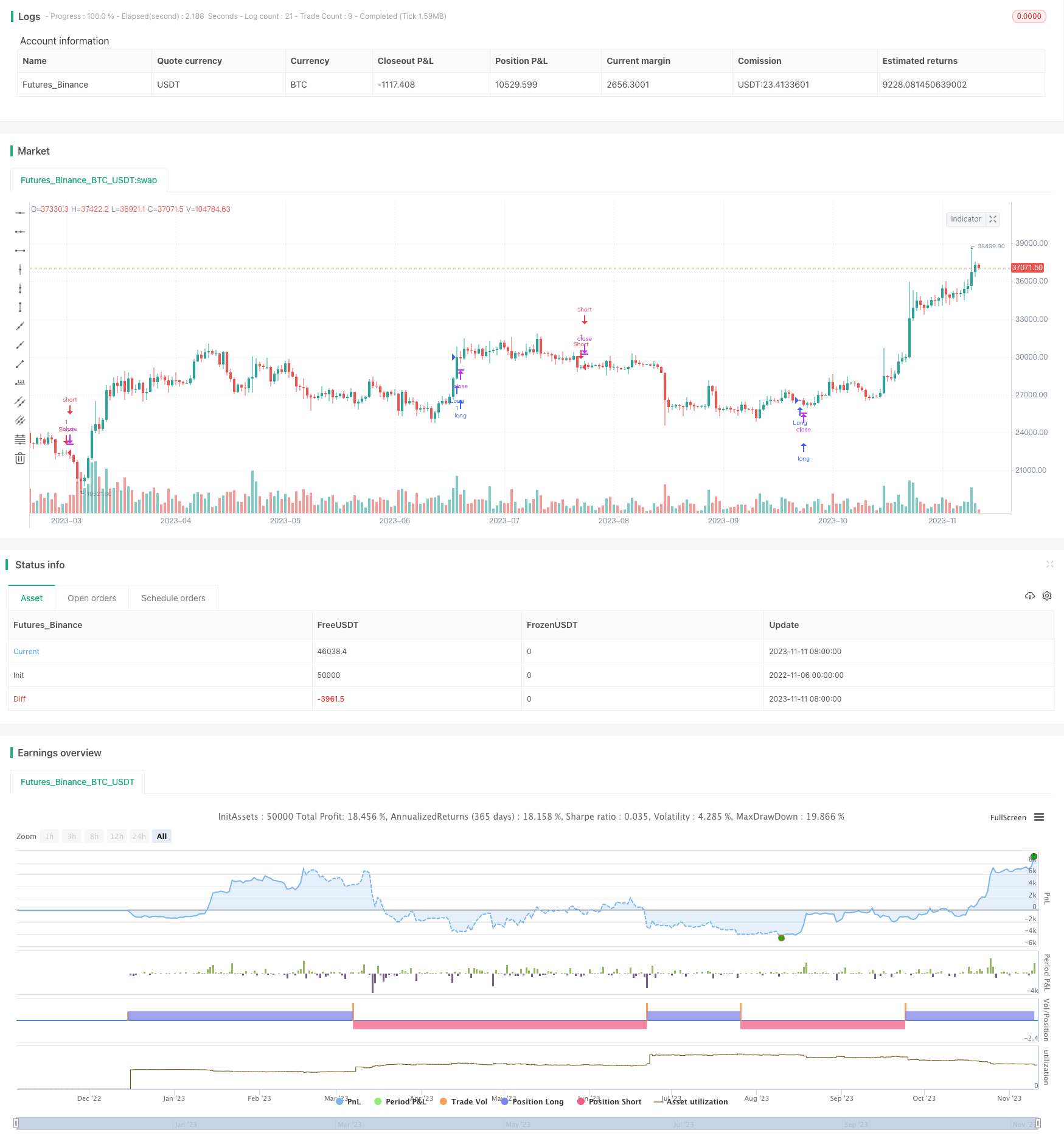
The Dual Reversal Entry strategy generates entries by combining reversal signals from the MACD and Stochastic RSI indicators to accurately go long and short at trend reversal points. It belongs to the class of reversal trading strategies.
Strategy Logic
The strategy consists of the following components:
Using the MACD indicator's crossover of the zero line to determine trend reversal.
Using the Stochastic RSI indicator to identify overbought and oversold conditions. Stochastic RSI combines RSI overbought/oversold principles, above 70 is overbought and below 30 is oversold.
When the MACD line crosses above zero (bullish reversal signal) and Stochastic RSI shows oversold, a buy signal is generated. When the MACD line crosses below zero (bearish reversal signal) and Stochastic RSI shows overbought, a sell signal is generated.
The strategy has both indicator plotting mode and execution mode. In indicator mode, reversal signals are marked with triangles. In strategy mode, long/short positions are opened on reversal signals.
Combining the MACD reversal signal with Stochastic RSI overbought/oversold levels improves the accuracy of entries. It provides good timing for entries at trend reversal points.
Advantages
- Dual indicator filtering improves entry accuracy
The dual reversal filters ensure entries are taken only after trend reversal, reducing false signals and improving entry accuracy.
- Reversal trading works for choppy/ranging markets
As a reversal strategy, it excels in choppy bear market conditions with frequent ups and downs and allows winning trades at each minor swing reversal.
- Beginner friendly without trend bias
It directly trades all reversals without the need to determine the major trend, simple to use for beginners.
- Flexible indicator or strategy modes
The modes allow flexible usage for analysis or automated executions.
Risks
- Higher risk of reversal trading
Without considering major trend, reversal trading has higher risk in strong trending markets, with likely consecutive losses opening countertrend. Need to combine with trend strategies.
- Difficult multi-parameter optimization
The multiple parameters of dual indicators make optimization challenging. Inappropriate parameters may cause over-trading or insufficient signals. Requires extensive testing.
- Requires high-frequency trading account
The high-frequency strategy needs low-cost trading accounts to support, otherwise fees may offset profits.
Enhancement Opportunities
- Optimize indicator parameters
Testing different parameter combinations to find the optimal settings for reliable signals. E.g. MACD periods, Stochastic lookback.
- Add trend filter
Adding a trend indicator and taking reversal signals only in trend direction avoids counter-trend trades. E.g. using MA to determine long-term trend.
- Implement stop loss
Adding stop loss by price or percentage to control risk on trades. Consider partial profit taking and adding to loser.
- Tighten entry conditions
Additional entry filters like volume spike or crossing moving average to reduce false entries.
Conclusion
The dual reversal entry strategy provides a novel and reliable approach to trade local reversals. It excels in choppy bear market conditions but has higher risks. Extensive optimization, trend filters and risk controls are needed to profit consistently when live trading.
Parameters
| Name | Default | What it controls |
|---|---|---|
| v_input_bool_1 | true | Strategy Mode |
| v_input_1 | 12 | MACD Fast Period |
| v_input_2 | 26 | MACD Slow Period |
| v_input_3 | 9 | MACD Signal Period |
| v_input_4 | 70 | Stochastic RSI Period |
| v_input_5 | 30 | %K Period |
| v_input_6 | 30 | %D Period |
| v_input_7 | 70 | Stochastic Overbought Level |
| v_input_8 | 30 | Stochastic Oversold Level |
Source Pine Script
/*backtest
start: 2022-11-06 00:00:00
end: 2023-11-12 00:00:00
period: 1d
basePeriod: 1h
exchanges: [{"eid":"Futures_Binance","currency":"BTC_USDT"}]
*/

//@version=5
strategy('RB Reversal Tabs Strategy', overlay=true)
//Developer: Andrew Palladino
//Owner: Rob Booker
//Date Modified: 11/25/2018
//Updated to Pinescript V5 and transformed into a Strategy by: Powerscooter	11/25/2022

StrategyMode = input.bool(true,"Strategy Mode")
macd_fast_period = input(title='MACD Fast Period', defval=12)
macd_slow_period = input(title='MACD Slow Period', defval=26)
macd_signal_period = input(title='MACD Signal Period', defval=9)
stoch_period = input(title='Stochastic RSI Period', defval=70)
prc_k_period = input(title='%K Period', defval=30)
prc_d_period = input(title='%D Period', defval=30)
stoch_ob = input(title='Stochastic Overbought Level', defval=70)
stoch_os = input(title='Stochastic Oversold Level', defval=30)

[macd_line, signal_line, hist_line] = ta.macd(close, macd_fast_period, macd_slow_period, macd_signal_period)

fast_prc_k = 100 * (close - ta.lowest(low, stoch_period)) / (ta.highest(high, stoch_period) - ta.lowest(low, stoch_period))
fast_prc_d = ta.sma(fast_prc_k, prc_d_period)

slow_prc_k = ta.sma(fast_prc_k, prc_k_period)
slow_prc_d = ta.sma(slow_prc_k, prc_d_period)

full_prc_k = ta.sma(fast_prc_k, prc_k_period)
full_prc_d = ta.sma(full_prc_k, prc_d_period)

is_buy_reversal = ta.crossover(macd_line, 0) and full_prc_k < stoch_os
is_sell_reversal = ta.crossunder(macd_line, 0) and full_prc_k > stoch_ob

plotshape(is_buy_reversal and not StrategyMode, style=shape.triangleup, color=color.new(color.green, 0), size=size.small, location=location.belowbar)
plotshape(is_sell_reversal and not StrategyMode, style=shape.triangledown, color=color.new(color.red, 0), size=size.small, location=location.abovebar)

//Orders
if is_buy_reversal and StrategyMode
	strategy.entry("Long",strategy.long)
if is_sell_reversal and StrategyMode
	strategy.entry("Short",strategy.short)
//plot(full_prc_k, color=blue)
//plot(full_prc_d, color=red)
//plot(macd_line, color=blue)
Published by ChaoZhang on the FMZ strategy square · last modified 2023-11-13. Collected in the Quant Trading Vault. Unvalidated research: re-test with your own data and costs before trusting it.
Build this with AgenKit
A spec is not a trading system. Paste this into your coding agent and AgenKit runs a specialist team — architecture, test-first build, risk gates, review — with paper trading on by default.
/agenkit build a production-grade trading bot with a backtest engine, risk controls and paper trading by default from strategies/Dual-Reversal-Entry-Strategy.md- npx agenkit install engineering-kit in your project
- Paste the command into your agent and approve each phase
- Get tests, backtest, risk controls and a paper-trading switch
Understand it first
Before you run this, read the lesson behind the idea and how to backtest it honestly. Specs like this one are the survivors of an unknown number of trials; deflate their results accordingly.
Related specs
- Advanced 15 Minute Chart Trading Signal StrategyPine Script · Mean reversion · 3h
- Dynamic Adaptive Multi Timeframe Trend Following and Range Reversal Hybrid StrategyPine Script · Mean reversion · 2d
- Momentum Reversal Trading Strategy 428631Pine Script · Mean reversion · 2h
- Multi Indicator Divergence Trading Strategy with Adaptive Take Profit and Stop LossPine Script · Mean reversion · 1h
- A Dual Reversal Momentum Index Trading StrategyPine Script · Mean reversion · 1h
- Dual Oscillation Reversal Signal to Noise Ratio Optimization Combo StrategyPine Script · Mean reversion · 1h