Dual Standard Deviation Bollinger Bands Momentum Breakout Strategy
This strategy represents an innovative application of the Bollinger Bands indicator, utilizing dual standard deviation bands for momentum capture. The core mechanism relies on a system of Bollinger Bands constructed…
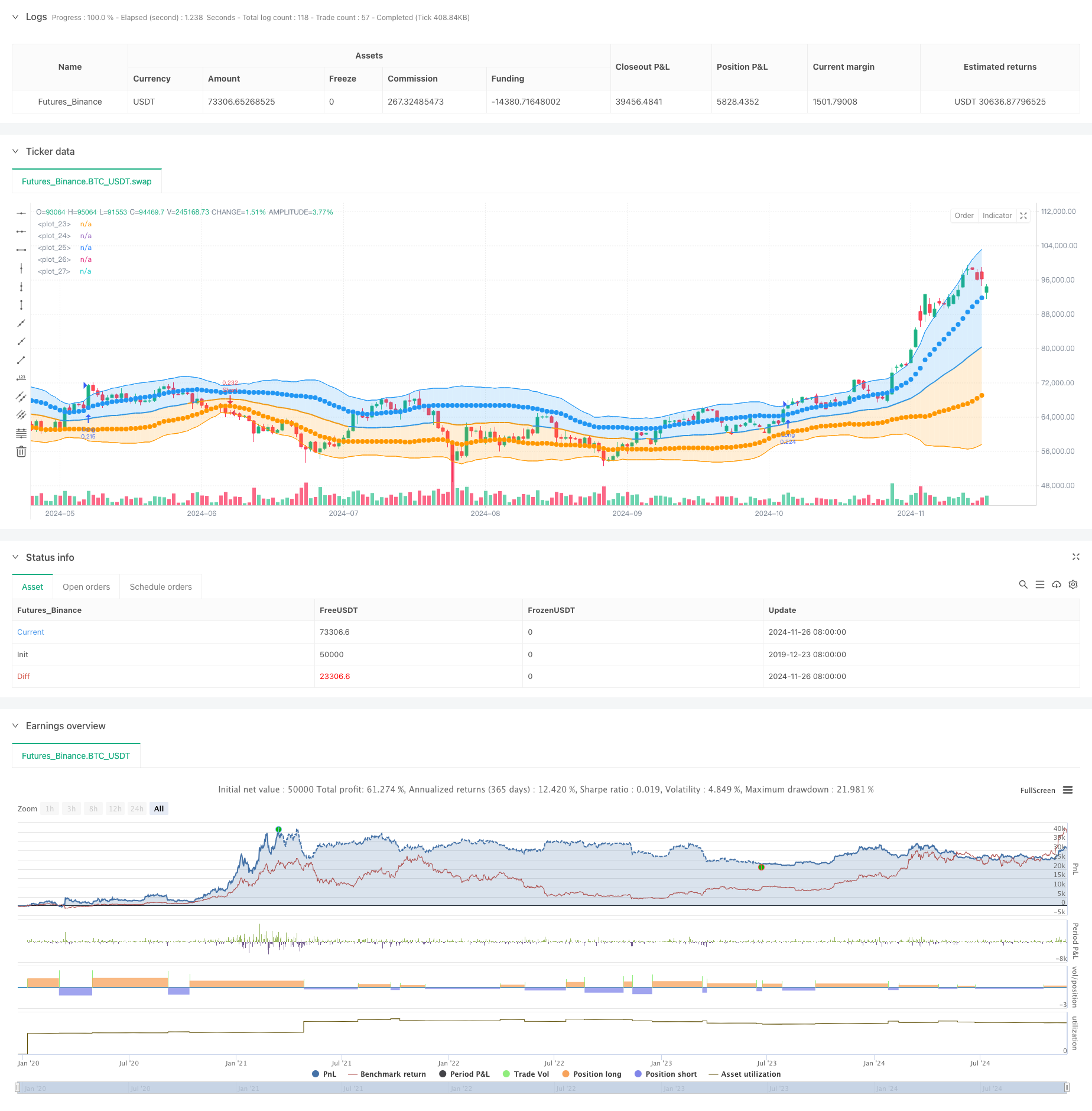
Overview
This strategy represents an innovative application of the Bollinger Bands indicator, utilizing dual standard deviation bands for momentum capture. The core mechanism relies on a system of Bollinger Bands constructed using two different standard deviation levels (1SD and 2SD), generating trading signals when price breaks through the 2SD channel. Through precise mathematical modeling and statistical principles, this strategy provides traders with a systematic trading approach.
Strategy Principles
The strategy employs a 34-period moving average as the middle band, with upper and lower bands calculated using both single and double standard deviations. Buy signals are generated when price breaks above the 2SD upper band, while sell signals occur when price breaks below the 2SD lower band. The strategy includes automatic stop-loss mechanisms, closing long positions when price breaks below the lower band and short positions when price breaks above the upper band. A money management system is implemented, using 30% of account equity per trade for effective risk control.
Strategy Advantages
- Dual standard deviation design provides more precise market extreme judgments
- Automated entry/exit mechanisms reduce human judgment errors
- Comprehensive money management system ensures controlled risk
- Highly adaptable parameters suitable for different market conditions
- High degree of visualization with clear trading signals
- Combines trend following and volatility breakout trading approaches
Strategy Risks
- May generate frequent false breakouts in ranging markets
- Stop-loss settings might lead to premature exits in highly volatile markets
- Fixed position sizing might increase risk during consecutive losses
- Improper parameter settings may result in lagging signals Risk management recommendations:
- Confirm signals with additional technical indicators
- Dynamically adjust standard deviation multiplier
- Implement trailing stop-loss mechanisms
- Adjust position size based on volatility
Optimization Directions
- Introduce adaptive standard deviation calculation methods for automatic adjustment of band width based on market volatility
- Add volume confirmation mechanism to improve breakout signal reliability
- Optimize money management system with dynamic position sizing
- Implement trend filters to reduce false signals in ranging markets
- Develop intelligent parameter optimization system for automated strategy tuning
Summary
This innovative strategy based on the classic Bollinger Bands indicator provides a trading system with both theoretical foundation and practical utility through its dual standard deviation design. While maintaining operational simplicity and intuitiveness, the strategy offers traders a reliable trading tool through rigorous mathematical modeling and comprehensive risk control mechanisms. Although there is room for optimization, its core logic is sound and demonstrates good practical value.
Source Pine Script
/*backtest
start: 2019-12-23 08:00:00
end: 2024-11-27 00:00:00
period: 1d
basePeriod: 1d
exchanges: [{"eid":"Futures_Binance","currency":"BTC_USDT"}]
*/

//@version=5
// Baker Odeh's Strategy - Bollinger Bands : 27/SEP/2014 01:36 : 1.0
// This displays the traditional Bollinger Bands, the difference is
// that the 1st and 2nd StdDev are outlined with two colors and two
// different levels, one for each Standard Deviation

strategy(shorttitle="Baker Odeh's Strategy - Bollinger Bands", title="Baker Odeh's Strategy - Bollinger Bands", overlay=true, currency=currency.NONE, initial_capital=30, default_qty_type=strategy.percent_of_equity, default_qty_value=20)
src = input(close)
length = input.int(34, minval=1)
mult = input.float(2.0, minval=0.001, maxval=50)

basis = ta.sma(src, length)
dev = ta.stdev(src, length)
dev2 = mult * dev

upper1 = basis + dev
lower1 = basis - dev
upper2 = basis + dev2
lower2 = basis - dev2

colorBasis = src >= basis ? color.blue : color.orange

pBasis = plot(basis, linewidth=2, color=colorBasis)
pUpper1 = plot(upper1, color=color.new(color.blue, 0), style=plot.style_circles)
pLower1 = plot(lower1, color=color.new(color.orange, 0), style=plot.style_circles)
pUpper2 = plot(upper2, color=color.new(color.blue, 0))
pLower2 = plot(lower2, color=color.new(color.orange, 0))

fill(pBasis, pUpper2, color=color.new(color.blue, 80))
fill(pUpper1, pUpper2, color=color.new(color.blue, 80))
fill(pBasis, pLower2, color=color.new(color.orange, 80))
fill(pLower1, pLower2, color=color.new(color.orange, 80))

if (close > upper2)
    strategy.entry("Long", strategy.long)

if (close < lower2)
    strategy.entry("Short", strategy.short)

if (close <= lower2)
    strategy.close("Long")

if (close >= upper2)
    strategy.close("Short")
Published by ChaoZhang on the FMZ strategy square · last modified 2024-11-28. Collected in the Quant Trading Vault. Unvalidated research: re-test with your own data and costs before trusting it.
Build this with AgenKit
A spec is not a trading system. Paste this into your coding agent and AgenKit runs a specialist team — architecture, test-first build, risk gates, review — with paper trading on by default.
/agenkit build a production-grade trading bot with a backtest engine, risk controls and paper trading by default from strategies/Dual-Standard-Deviation-Bollinger-Bands-Momentum-Breakout-Strategy.md- npx agenkit install engineering-kit in your project
- Paste the command into your agent and approve each phase
- Get tests, backtest, risk controls and a paper-trading switch
Understand it first
Before you run this, read the lesson behind the idea and how to backtest it honestly. Specs like this one are the survivors of an unknown number of trials; deflate their results accordingly.
Related specs
- Dynamic Bollinger Bands Breakout Quantitative Trading StrategyPine Script · Breakout · 2d
- Multi Indicator Momentum Breakout with Smoothed Candlestick Trading StrategyPine Script · Breakout · 6h
- Multi factor Intelligent Trading StrategyPine Script · Breakout · 1d
- Bollinger Band Breakout Trading StrategyPine Script · Breakout · 2h
- Bollinger Bands Breakout Strategy 442259Pine Script · Breakout · 1h
- Bollinger Breakout Stock StrategyPine Script · Breakout · 1h