Strategy vault / Trend following
Dynamic SMMA and SMA Crossover Strategy
This strategy uses the crossover signals between the 50-period Smoothed Moving Average (SMMA) and 20-period Simple Moving Average (SMA) to determine entries and exits. It generates buy signals when the fast SMA line…
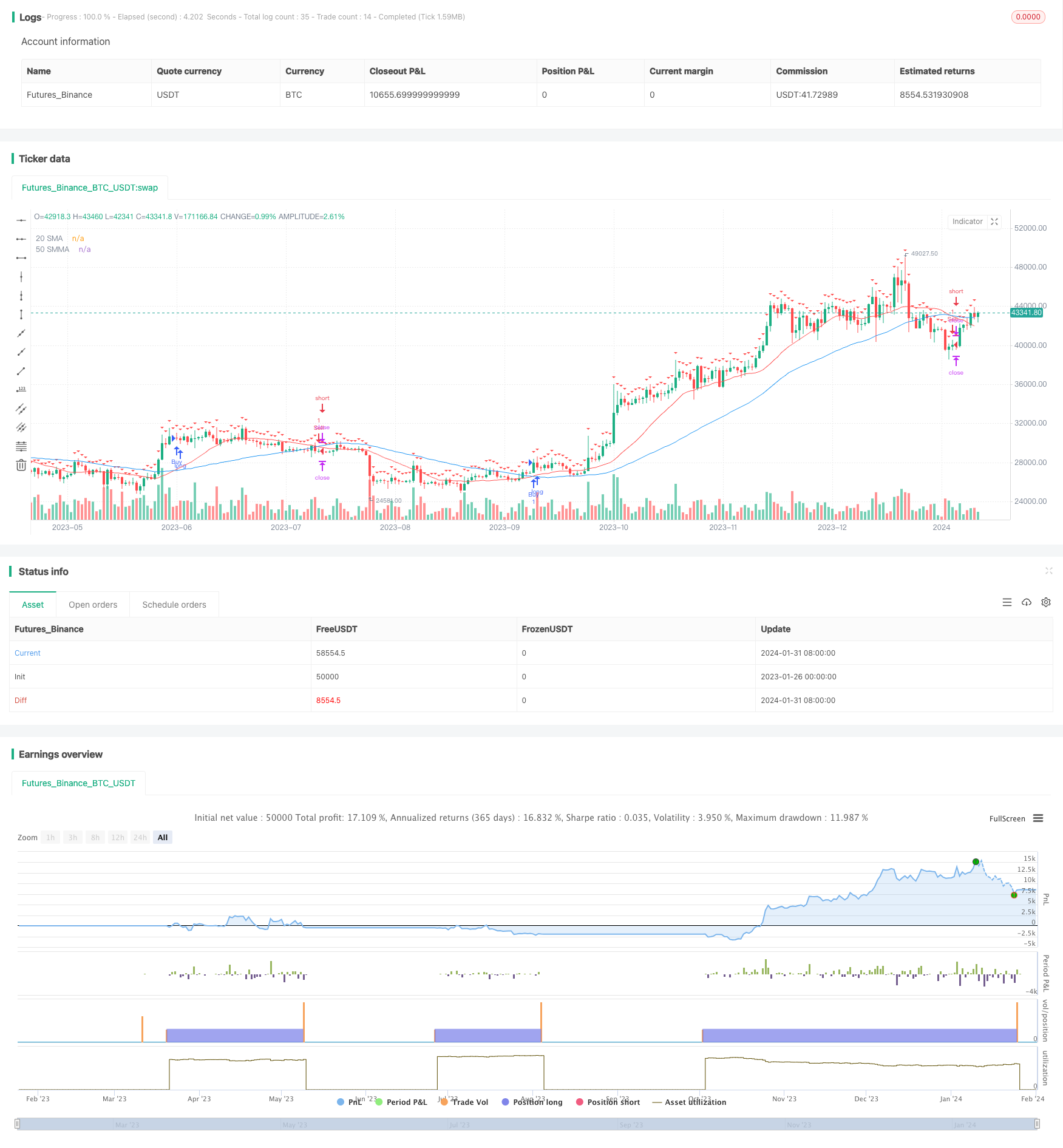
Overview
This strategy uses the crossover signals between the 50-period Smoothed Moving Average (SMMA) and 20-period Simple Moving Average (SMA) to determine entries and exits. It generates buy signals when the fast SMA line crosses above the slow SMMA line, and sell signals when the SMA crosses below the SMMA. At the same time, the strategy presets fixed take profit and dynamic stop loss levels to lock in profits and control risk.
Strategy Logic
- Calculate and plot the 50-period SMMA and 20-period SMA.
- When the SMA crosses above the SMMA from below, a buy signal is generated. Conversely, when the SMA crosses below the SMMA from above, a sell signal is generated.
- Upon buy and sell signal occurrences, establish "Buy" and "Sell" positions respectively.
- Set a fixed take profit level of 150 ticks for each position.
- Set a dynamic stop loss level at the closing price of the next bar after the signal bar.
- If price hits the take profit level, take profit occurs. If price hits stop loss level, stop loss is triggered.
Strengths
- Dual moving average strategies are easy to operate with simple principles and easy to understand.
- SMMA is an improvement over SMA to better capture trends.
- Combining SMA and SMMA of different periods helps filter noise while catching trends.
- Adopting dynamic stop loss can adjust stop level based on market changes to effectively control risks.
- Preset take profit level helps lock in profits in a timely manner.
Risks
- Dual moving average strategies tend to generate false signals and be whipsawed. Signal filtering can be used to avoid over-trading.
- Fixed take profit may miss strong trends. Moving take profit or profit ratio based take profit can be considered.
- Dynamic stop loss may get too close to market price in volatile conditions. Appropriate widening of stop loss range should be considered.
- Differences across products and timeframes need attention.
Optimization Directions
Test combinations of different parameters (cycle periods, filter criteria etc) to find optimal.
Incorporate other factors like volume spikes to filter signals.
Employ parameter optimization tools to find optimum parameters.
Consider integrating other take profit methods like trailing stop or profit ratio based exits.
Calculate dynamic stop loss range based on market volatility.
Conclusion
This strategy has relatively simple logic, capturing trend directions via dual moving averages. Flexible usage of fixed take profit and dynamic stop loss for profit taking and risk control strikes a balance between risk and reward. Further parameter and logic optimization can adapt this strategy to a wider range of market conditions.
Source Pine Script
/*backtest
start: 2023-01-26 00:00:00
end: 2024-02-01 00:00:00
period: 1d
basePeriod: 1h
exchanges: [{"eid":"Futures_Binance","currency":"BTC_USDT"}]
*/

//@version=4
strategy("50 SMMA and 20 SMA Crossover with TP and SL", overlay=true)

// Define 50 SMMA
smma50 = sma(close, 50)

// Define 20 SMA
sma20 = sma(close, 20)

// Plotting the SMMA and SMA
plot(smma50, color=color.blue, title="50 SMMA")
plot(sma20, color=color.red, title="20 SMA")

// Initialize TP and SL variables
tp = 150
var float sl_price = na

// Buy Signal
buySignal = crossover(sma20, smma50)
strategy.entry("Buy", strategy.long, when = buySignal)
strategy.exit("Take Profit/Stop Loss", from_entry="Buy", profit=tp, loss=sl_price)

// Sell Signal
sellSignal = crossunder(sma20, smma50)
strategy.entry("Sell", strategy.short, when = sellSignal)
strategy.exit("Take Profit/Stop Loss", from_entry="Sell", profit=tp, loss=sl_price)

// Update stop loss level on every crossover
if (buySignal or sellSignal)
    sl_price := close[bar_index + 1]

// Plot Stop Loss level
plotshape(series=sl_price != na, title="Stop Loss Level", location=location.abovebar, color=color.red, style=shape.triangledown, size=size.small)
Published by ChaoZhang on the FMZ strategy square · last modified 2024-02-02. Collected in the Quant Trading Vault. Unvalidated research: re-test with your own data and costs before trusting it.
Build this with AgenKit
A spec is not a trading system. Paste this into your coding agent and AgenKit runs a specialist team — architecture, test-first build, risk gates, review — with paper trading on by default.
/agenkit build a production-grade trading bot with a backtest engine, risk controls and paper trading by default from strategies/Dynamic-SMMA-and-SMA-Crossover-Strategy.md- npx agenkit install engineering-kit in your project
- Paste the command into your agent and approve each phase
- Get tests, backtest, risk controls and a paper-trading switch
Understand it first
Before you run this, read the lesson behind the idea and how to backtest it honestly. Specs like this one are the survivors of an unknown number of trials; deflate their results accordingly.
Related specs
- Adaptive Trading Strategy Based on Stochastic RSI Dual Line CrossoverPine Script · Trend following · 4h
- Dual Moving Average Convergence Trend Tracking StrategyPine Script · Trend following · 1d
- Dual SMA Crossover StrategyPine Script · Trend following · 5m
- Dynamic Moving Average and Bollinger Bands Cross Strategy with Fixed Stop Loss Optimization ModelPine Script · Trend following · 3h
- Dynamic Signal Line Trend Following Strategy Combining ATR and VolumePine Script · Trend following · 1h
- EMA SMA Trend Following with Swing Trading Strategy Combined Volume Filter and Percentage Take Profit Stop Loss SystemPine Script · Trend following · 1d