Strategy vault / Trend following
Dynamic Stop Loss Adjustment Elephant Bar Trend Following Strategy
This strategy is a trend following system based on bar pattern recognition, primarily identifying "elephant bars" (price bars significantly larger than average) to capture potential trend initiation points. The…
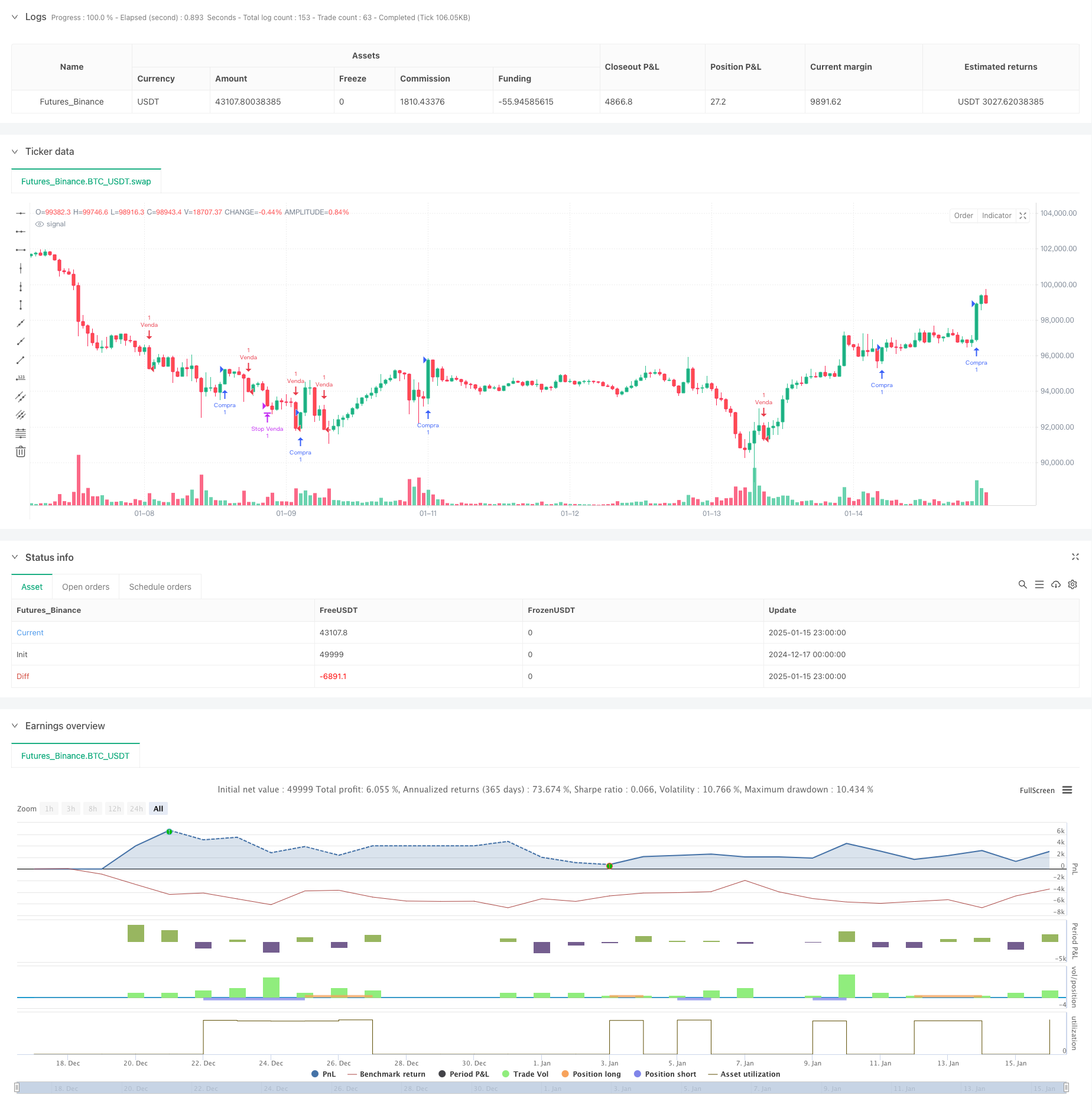
Overview
This strategy is a trend following system based on bar pattern recognition, primarily identifying "elephant bars" (price bars significantly larger than average) to capture potential trend initiation points. The strategy's key feature is its dynamic stop-loss adjustment scheme, which adaptively modifies stop-loss positions based on price movement progress, both protecting profits and allowing sufficient price flexibility.
Strategy Principles
The strategy operates based on the following key steps:
- Calculate the average bar size over a specific period as a benchmark
- Identify if the current bar meets "elephant bar" characteristics:
- Bar size significantly exceeds average (configurable multiplier)
- Closing price within specific percentage range of high/low
- Or matches hammer/inverted hammer patterns
- Determine trade direction based on elephant bar direction
- Set initial stop-loss and profit targets
- Dynamically adjust stop-loss as price moves favorably:
- Move stop-loss above cost when reaching 60% target
- Further tighten stop-loss at 80% target
- Significantly tighten stop-loss and adjust profit target at 90% target
Strategy Advantages
- Dynamic risk management: Protects profits while allowing trends to develop through dynamic stop-loss adjustment
- Pattern recognition flexibility: Includes special patterns like hammer lines beyond traditional elephant bars
- Strong parameter adaptability: Key parameters like bar size multiplier and target percentages can be adjusted to market characteristics
- Reasonable risk-reward ratio: Conservative initial stop-loss with dynamic adjustment for larger gains as trends develop
Strategy Risks
- False breakout risk: Elephant bar patterns may produce false breakouts requiring proper filtering conditions
- Ranging market risk: Frequent stop-losses may be triggered in sideways markets
- Stop adjustment risk: Aggressive stop-loss adjustments may lead to premature exits
- Parameter sensitivity: Strategy effectiveness is sensitive to parameter settings, requiring thorough testing
Optimization Directions
- Enhanced market environment filtering:
- Add trend indicators to identify current market conditions
- Apply different parameter settings in different market environments
- Improved stop-loss mechanism:
- Incorporate trailing stops
- Dynamically adjust stop distances based on volatility
- Optimized entry timing:
- Integrate volume indicators
- Add reversal confirmation signals
- Enhanced profit-taking approach:
- Implement partial profit exits
- Dynamically adjust profit targets based on market structure
Summary
The strategy effectively tracks trends through key price pattern identification and dynamic risk management. Its core advantage lies in the adaptive stop-loss management mechanism, which protects profits while maximizing trend opportunities. Further optimization of market environment recognition and risk management mechanisms shows promise for consistent performance across different market conditions.
Source Pine Script
/*backtest
start: 2024-12-17 00:00:00
end: 2025-01-16 00:00:00
period: 1h
basePeriod: 1h
exchanges: [{"eid":"Futures_Binance","currency":"BTC_USDT","balance":49999}]
*/

//@version=6
strategy("Estratégia Barra Elefante com Stop Dinâmico", overlay=true)

// Parâmetros configuráveis
num_barras = input.int(15, title="Número de Barras para Média", minval=1, maxval=100)
percentual_fechamento_valido = input.float(10, title="Percentual do Máximo de Pavio (%)", minval=1, maxval=100)
percentual_condicao_tamanho = input.float(1.8, title="Multiplicador do Tamanho Médio da Barra", minval=0.1, step=0.1)
percentual_lucro = input.float(1.8, title="% de Lucro do Alvo ref. Tam. da Barra", minval=0.1, step=0.1)

var bool executou_entrada = false

// Calcula o tamanho de cada barra
barra_tamanho = math.abs(close - open)

// Calcula a média do tamanho das últimas 'num_barras' barras
media_tamanho = ta.sma(barra_tamanho, num_barras)

// Definição das variáveis para o corpo do candle, sombra superior e sombra inferior
corpo = barra_tamanho
sombra_superior = high - math.max(close, open)
sombra_inferior = math.min(close, open) - low

// Condições para verificar se a sombra é pelo menos 2x maior que o corpo
sombra_sup_maior = sombra_superior >= 2 * corpo
sombra_inf_maior = sombra_inferior >= 2 * corpo

// Define a relação mínima entre a sombra e o corpo
relacao_minima = 2.0

fechamento_valido = ((close >= high - (percentual_fechamento_valido / 100) * (high - low)) or (close <= low + (percentual_fechamento_valido / 100) * (high - low)))

// Condição para verificar se o fechamento está próximo da máxima ou mínima
fechamento_proximo_max = close >= (high - (high - low) * 0.1)  // Fechamento nos 20% superiores
fechamento_proximo_min = close <= (low + (high - low) * 0.1)   // Fechamento nos 20% inferiores

// definição de candle martelo
eh_martelo = (sombra_sup_maior and fechamento_proximo_max) and (math.abs(high - low) > 1.5*media_tamanho)
eh_martelo_invertido = (sombra_inf_maior and fechamento_proximo_min) and (math.abs(low - high) > 1.5*media_tamanho)

// Compara o tamanho da barra atual com a média usando o percentual configurável
condicao_tamanho = (barra_tamanho > percentual_condicao_tamanho * media_tamanho) and (fechamento_valido or (eh_martelo or eh_martelo_invertido))

// Variáveis para entrada
comprar_condicao = (condicao_tamanho and close > open)
vender_condicao = (condicao_tamanho and close < open)

// Stop Loss inicial
stop_loss_compra = low[1] + (barra_tamanho / 5)  // Para compra, stop é na mínima do candle anterior ajustado
stop_loss_venda = high[1] - (barra_tamanho / 5) // Para venda, stop é na máxima do candle anterior ajustado

// Take Profit inicial (multiplicador configurado)
take_profit_compra = close + percentual_lucro * barra_tamanho
take_profit_venda = close - percentual_lucro * barra_tamanho

// Variáveis para controle do progresso do preço
lucro_alvo_60 = close + 0.6 * (take_profit_compra - close)  // 60% do alvo
lucro_alvo_80 = close + 0.8 * (take_profit_compra - close)  // 80% do alvo
lucro_alvo_90 = close + 0.9 * (take_profit_compra - close)  // 90% do alvo

// Ajustes dinâmicos do Stop Loss e Alvo
if (strategy.position_size > 0)  // Para compras
    if (high >= lucro_alvo_60)
        stop_loss_compra := close + 0.1 * barra_tamanho  // Ajusta Stop para 10% acima da entrada
    if (high >= lucro_alvo_80)
        stop_loss_compra := close + 0.5 * barra_tamanho  // Ajusta Stop para 50% acima da entrada
    if (high >= lucro_alvo_90)
        stop_loss_compra := close + 0.8 * barra_tamanho  // Ajusta Stop para 80% acima da entrada
        take_profit_compra := close + 0.5 * barra_tamanho  // Ajusta Alvo para +50% do último fechamento

if (strategy.position_size < 0)  // Para vendas
    if (low <= lucro_alvo_60)
        stop_loss_venda := close - 0.1 * barra_tamanho  // Ajusta Stop para 10% abaixo da entrada
    if (low <= lucro_alvo_80)
        stop_loss_venda := close - 0.5 * barra_tamanho  // Ajusta Stop para 50% abaixo da entrada
    if (low <= lucro_alvo_90)
        stop_loss_venda := close - 0.8 * barra_tamanho  // Ajusta Stop para 80% abaixo da entrada
        take_profit_venda := close - 0.5 * barra_tamanho  // Ajusta Alvo para -50% do último fechamento

// Executando as ordens de compra e venda
if (not executou_entrada) and (comprar_condicao)
    strategy.entry("Compra", strategy.long)
    strategy.exit("Stop Compra", "Compra", stop=stop_loss_compra, limit=take_profit_compra)
    executou_entrada := true  // Marca que a entrada foi feita

if (not executou_entrada) and (vender_condicao)
    strategy.entry("Venda", strategy.short)
    strategy.exit("Stop Venda", "Venda", stop=stop_loss_venda, limit=take_profit_venda)
    executou_entrada := true  // Marca que a entrada foi feita

// Para visualização, vamos colorir as barras
barcolor(comprar_condicao ? color.rgb(14, 255, 22) : na)
barcolor(vender_condicao ? #d606ff : na)
bgcolor((eh_martelo) ? color.new(color.green, 60) : na)
bgcolor((eh_martelo_invertido) ? color.new(color.red, 60) : na)

// Reseta o controle de execução no início de cada nova barra
if barstate.isnew
executou_entrada := falsePublished by ChaoZhang on the FMZ strategy square · last modified 2025-01-17. Collected in the Quant Trading Vault. Unvalidated research: re-test with your own data and costs before trusting it.
Build this with AgenKit
A spec is not a trading system. Paste this into your coding agent and AgenKit runs a specialist team — architecture, test-first build, risk gates, review — with paper trading on by default.
/agenkit build a production-grade trading bot with a backtest engine, risk controls and paper trading by default from strategies/Dynamic-Stop-Loss-Adjustment-Elephant-Bar-Trend-Following-Strategy.md- npx agenkit install engineering-kit in your project
- Paste the command into your agent and approve each phase
- Get tests, backtest, risk controls and a paper-trading switch
Understand it first
Before you run this, read the lesson behind the idea and how to backtest it honestly. Specs like this one are the survivors of an unknown number of trials; deflate their results accordingly.
Related specs
- ADX MA and EMA Long Only Trend Tracking StrategyPine Script · Trend following · 1d
- ATR and Moving Average Crossover Hybrid StrategyPine Script · Trend following · 1h
- Adaptive FVG Detection and MA Trend Trading Strategy with Dynamic ResistancePine Script · Trend following · 1d
- Adaptive Risk Management Strategy Based on Dynamic ATR and Moving Average CrossoverPine Script · Trend following · 2h
- Adaptive Trading Strategy Based on Stochastic RSI Dual Line CrossoverPine Script · Trend following · 4h
- Adaptive Volatility Based Trend Following Short Strategy with Time Delay and Stop Loss ProtectionPine Script · Trend following · 2m