Strategy vault / Mean reversion
Dynamic Trailing Stop Loss Strategy 436142
This strategy determines the trend direction based on daily candlesticks, and uses the new high or low points formed by 15-minute candlesticks as stop loss price or trailing stop loss price, so as to dynamically…
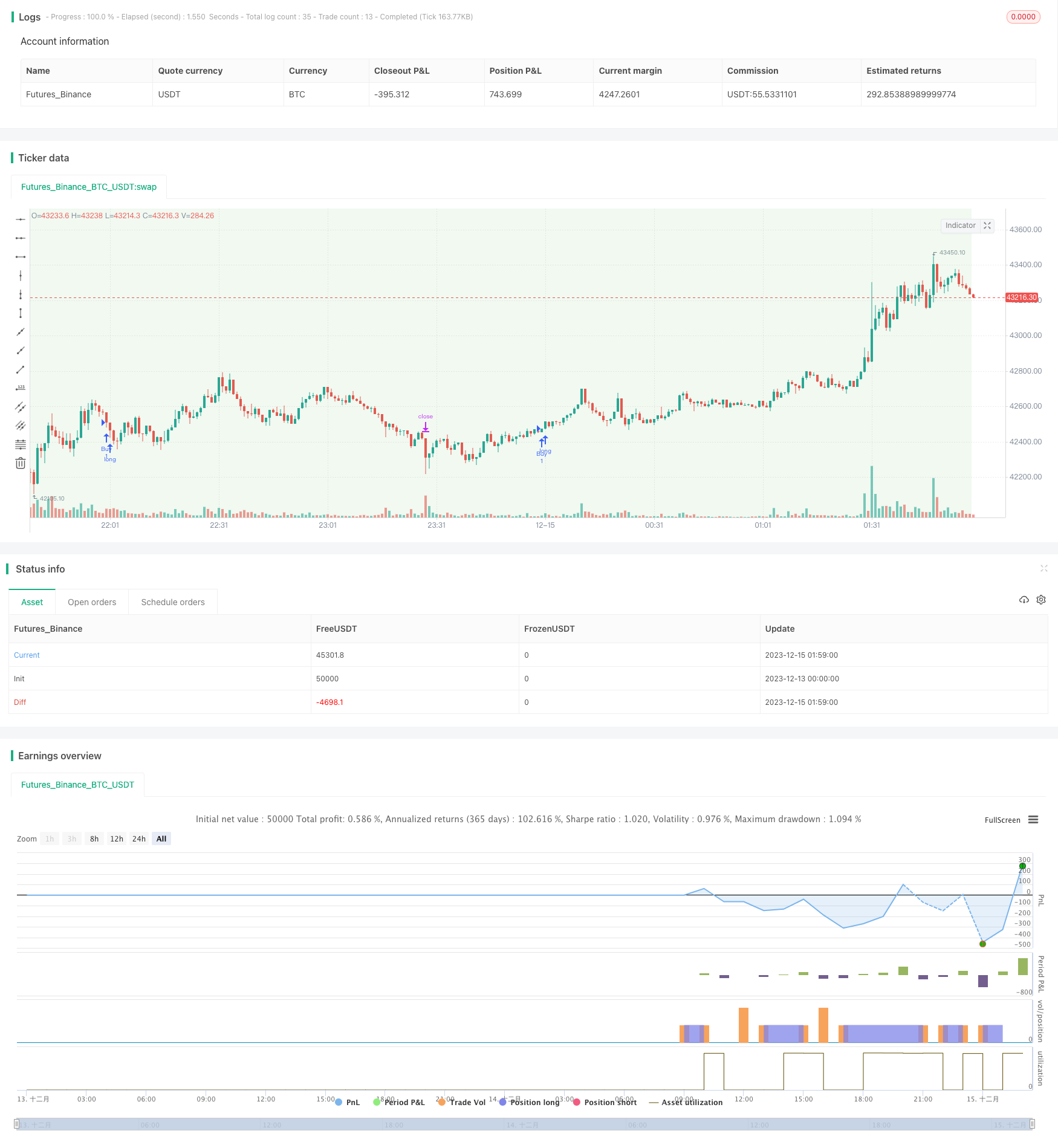
Overview
This strategy determines the trend direction based on daily candlesticks, and uses the new high or low points formed by 15-minute candlesticks as stop loss price or trailing stop loss price, so as to dynamically adjust stop loss and lock in more profits.
Strategy Logic
Compare closing price of daily candlesticks with highest and lowest price of previous daily candlestick to determine the trend direction. If closing price is higher than previous day's highest price, it is defined as an uptrend. If closing price is lower than previous day's lowest price, it is defined as a downtrend.
When in an uptrend, go long when the closing price of the 15-minute candlestick is higher than the highest price of the previous 15-minute candlestick. When in a downtrend, go short when the closing price of the 15-minute candlestick is lower than the lowest price of the previous 15-minute candlestick.
Set the lowest price of the previous 15-minute candlestick as the stop loss price after going long. Set the highest price of the previous 15-minute candlestick as the stop loss price after going short.
When the 15-minute candlestick makes a new high or low again, adjust the stop loss price accordingly. Adjust to the new low after going long. Adjust to the new high after going short. This realizes dynamic trailing stop loss.
Advantage Analysis
The biggest advantage of this strategy is that it can dynamically adjust the stop loss price. While ensuring risk control, it maximizes profit taking and reduces the probability of stop loss being hit.
Specifically advantages include:
Trend operation based judgments can timely determine market trends and choose the right trading direction.
15-minute timeframe trading allows frequent entries and exits to capture more opportunities.
Dynamic stop loss adjustment based on new highs or lows reduces risks of stop loss being hit.
Reasonable stop loss positioning largely avoids unnecessary losses.
Risk Analysis
The main risk of this strategy comes from errors in trend judgments. Specific risks include:
Incorrect daily trend judgment may lead to wrong trade direction.
Prices may fluctuate violently in the short term, increasing probability of 15-minute stop loss being hit.
Improper identification of trend reversal points may lead to losses.
Corresponding solutions:
Add indicators from other timeframes for comprehensive judgments to avoid reliance on just one timeframe.
Evaluate market volatility and relax stop loss range appropriately during high volatility.
Add trend reversal point identification mechanism to close positions timely before reversals.
Optimization Directions
There is still room for further optimization:
Add other timeframe indicators to optimize trend capturing.
Test different stop loss ratio settings to find optimal parameters.
Add volume indicators to avoid errors from volume divergence.
Add trend reversal mechanisms to optimize exit points.
Evaluate widening Trailing Stop price intervals to further reduce risks of stop loss being hit.
Summary
The overall performance of this strategy is good. The logic is clear and easy to understand. It has advantages like dynamic stop loss adjustment, frequent trading, and trading along trends. It can effectively control risks and lock in profits, and is worth further testing and optimization. But there is still room for improvement. It is recommended to improve from aspects like comprehensive judgment from multiple angles, parameter optimization, adding trend reversal identification mechanisms, etc, to further strengthen the stability and profitability of the strategy.
Source Pine Script
/*backtest
start: 2023-12-13 00:00:00
end: 2023-12-15 02:00:00
period: 1m
basePeriod: 1m
exchanges: [{"eid":"Futures_Binance","currency":"BTC_USDT"}]
*/

//@version=5
strategy("Anand's Strategy", overlay=true)

// Get the high and low of the previous day's candle
prev_high = request.security(syminfo.tickerid, "D", high[2])
prev_low = request.security(syminfo.tickerid, "D", low[2])

// var float prev_high = na
// var float prev_low = na

prev_close = request.security(syminfo.tickerid, "D", close[1])


getDayIndexedHighLow(_bar) =>
    _indexed_high = request.security(syminfo.tickerid, "D", high[_bar])
    _indexed_low = request.security(syminfo.tickerid, "D", low[_bar])
    [_indexed_high, _indexed_low]

var index = 2

while index >= 0
    [indexed_high_D, indexed_low_D] =  getDayIndexedHighLow(index)

    if prev_close > indexed_high_D or prev_close < indexed_low_D
        prev_high := indexed_high_D
        prev_low := indexed_low_D
        break
    // Decrease the index to move to the previous 15-minute candle
    index := index - 1


// Determine the trade direction based on the candle criterion
trade_direction = prev_close > prev_high ? 1 : (prev_close < prev_low ? -1 : 0)

// Get the current close from 15-minute timeframe
current_close = request.security(syminfo.tickerid, "15", close[1])
prev_high_15m = request.security(syminfo.tickerid, "15", high[2])
prev_low_15m = request.security(syminfo.tickerid, "15", low[2])

// var float prev_high_15m = na
// var float prev_low_15m = na

getIndexedHighLow(_bar) =>
    _indexed_high = request.security(syminfo.tickerid, "15", high[_bar])
    _indexed_low = request.security(syminfo.tickerid, "15", low[_bar])
    [_indexed_high, _indexed_low]


// Loop through previous 15-minute candles until the condition is met
var  i = 2

while i >= 2
    [indexed_high_15m, indexed_low_15m] =  getIndexedHighLow(i)

    if current_close > indexed_high_15m or current_close < indexed_low_15m
        prev_high_15m := indexed_high_15m
        prev_low_15m := indexed_low_15m
        break
    // Decrease the index to move to the previous 15-minute candle
    i := i - 1


buy_condition = trade_direction == 1 and current_close > prev_high_15m
stop_loss_buy = prev_low_15m

// Sell Trade Criteria in Negative Trend
sell_condition = trade_direction == -1 and current_close < prev_low_15m
stop_loss_sell = prev_high_15m


// Trailing Stop Loss for Buy Trade
// Custom Trailing Stop Function for Buy Trade
var float trail_stop_buy = na
trailing_buy_condition = buy_condition and current_close > trail_stop_buy
if trailing_buy_condition
    trail_stop_buy := current_close

// Custom Trailing Stop Function for Sell Trade
var float trail_stop_sell = na
trailing_sell_condition = sell_condition and current_close < trail_stop_sell
if trailing_sell_condition
    trail_stop_sell := current_close

// Take Buy Trade with Stop Loss
if (buy_condition)
    strategy.entry("Buy", strategy.long)
    strategy.exit("Buy Stop Loss", "Buy", stop=stop_loss_buy)

// Take Sell Trade with Stop Loss
if (sell_condition)
    strategy.entry("Sell", strategy.short)
    strategy.exit("Sell Stop Loss", "Sell", stop=stop_loss_sell)

// Set the background color based on the trade direction
bgcolor(trade_direction == 1 ? color.new(color.green, 90) : trade_direction == -1 ? color.new(color.red, 90) : na)Published by ChaoZhang on the FMZ strategy square · last modified 2023-12-21. Collected in the Quant Trading Vault. Unvalidated research: re-test with your own data and costs before trusting it.
Build this with AgenKit
A spec is not a trading system. Paste this into your coding agent and AgenKit runs a specialist team — architecture, test-first build, risk gates, review — with paper trading on by default.
/agenkit build a production-grade trading bot with a backtest engine, risk controls and paper trading by default from strategies/Dynamic-Trailing-Stop-Loss-Strategy-436142.md- npx agenkit install engineering-kit in your project
- Paste the command into your agent and approve each phase
- Get tests, backtest, risk controls and a paper-trading switch
Understand it first
Before you run this, read the lesson behind the idea and how to backtest it honestly. Specs like this one are the survivors of an unknown number of trials; deflate their results accordingly.
Related specs
- 1 2 3 Pattern Quantitative Trading Strategy with EMAs MACD and 4th Candle ExtensionPine Script · Mean reversion · 1h
- 3 10 Oscillator Profile Flagging StrategyPine Script · Mean reversion · 1d
- A Trend Reversal Strategy Based on Moving Averages Price Patterns and VolumePine Script · Mean reversion · 1d
- ATR and EMA based Dynamic Take Profit and Stop Loss Adaptive StrategyPine Script · Mean reversion · 1h
- Adaptive Mean Reversion Trading Strategy Based on Chande Momentum OscillatorPine Script · Mean reversion · 1d
- Adaptive Moving Average Tracking StrategyPine Script · Mean reversion · 1d