Strategy vault / Trend following
Ehlers Stochastic Cyber Cycle Strategy
The Ehlers Stochastic Cyber Cycle Strategy is a quantitative trading strategy that generates trading signals using Ehlers' stochastic cycle indicator. This strategy combines the advantages of stochastic indicators…
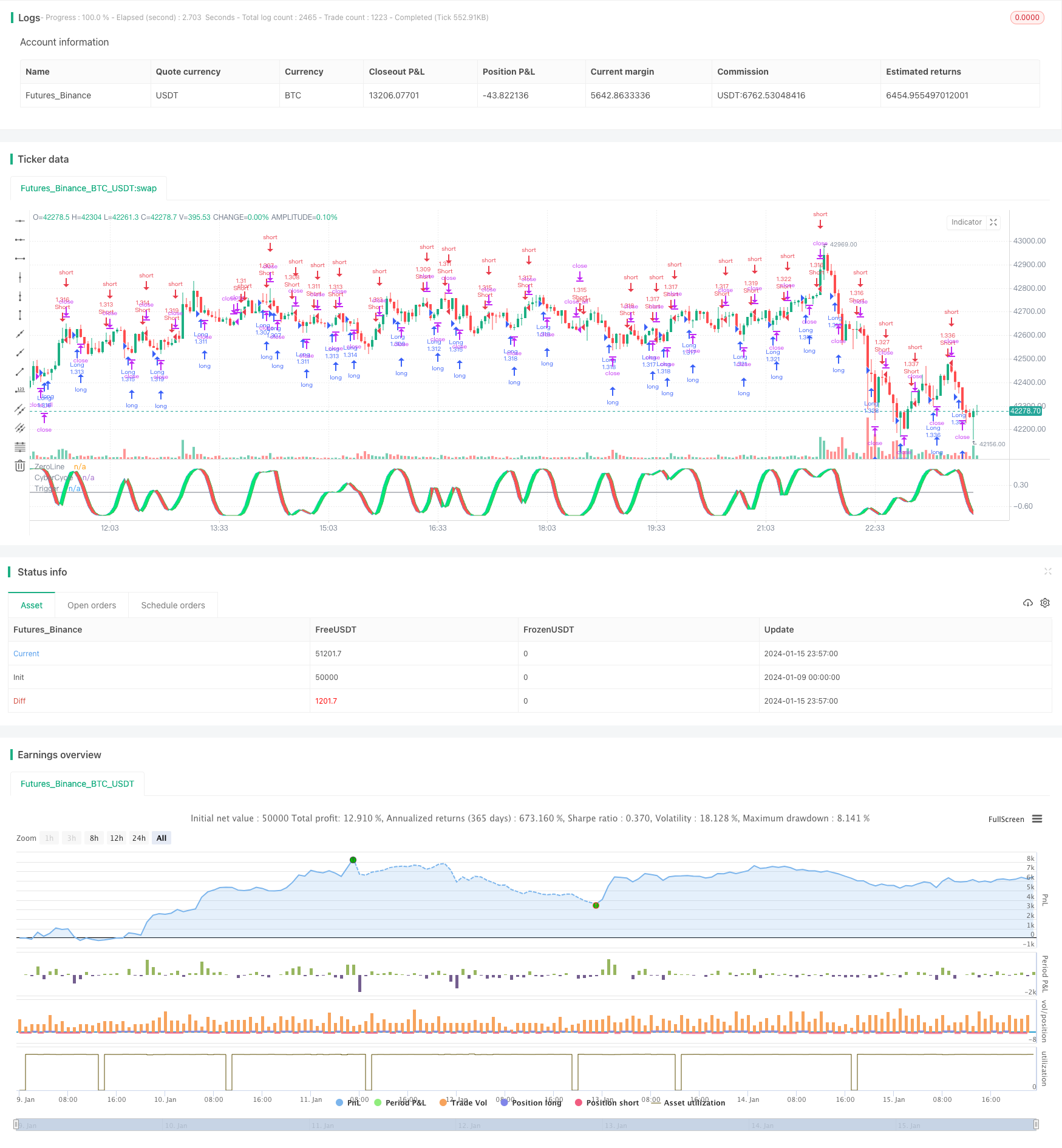
Overview
The Ehlers Stochastic Cyber Cycle Strategy is a quantitative trading strategy that generates trading signals using Ehlers' stochastic cycle indicator. This strategy combines the advantages of stochastic indicators and cycle indicators, aiming to capture cyclical opportunities in the market.
Strategy Logic
This strategy first constructs a smoothed cycle indicator, then builds a stochastic indicator value based on that indicator. The generation of trading signals is determined by the crossover of the moving average line of this stochastic indicator value.
Specifically, the smoothed cycle indicator is calculated as:
smooth = (src + 2 * src[1] + 2 * src[2] + src[3]) / 6
Where src is the input price data, such as closing price. This indicator combines the current price and the prices of the previous 3 time periods to construct a smoothed cycle signal.
Based on this smoothed indicator, the stochastic cycle cycle can then be calculated:
cycle := (1 - .5 * alpha) * (1 - .5 * alpha) *
           (smooth - 2 * smooth[1] + smooth[2]) +
           2 * (1 - alpha) * cycle[1] -
           (1 - alpha) * (1 - alpha) * cycle[2]
This calculation formula contains the second order difference of the smoothed periodic signal, and the values of the previous two cycles. α is a smoothing factor that adjusts the weight of new and old cycle values.
Finally, a 0-100 random value value1 is calculated based on this cycle indicator. And the signal value signal is constructed based on the 10-day moving average of value1. Trading signals are issued when the moving average line of signal crosses up or down.
Advantages of the Strategy
This strategy combines stochastic indicators and cycle indicators to integrate the advantages of both. Compared to simple trend strategies such as moving averages, this strategy can better capture cyclical opportunities and thus achieve better results.
The main advantages are:
- Cycle indicators can identify cyclic patterns, stochastic indicators provide trading opportunities
- Dual indicator design can effectively filter false signals
- Customizable parameters suit different market environments
Risks of the Strategy
The main risks of this strategy are:
- Improper parameter settings may lead to frequent trading, increasing trading costs and slippage costs
- Cannot effectively handle markets with violent price fluctuations, which may lead to large losses
- Cycle indicators rely heavily on curve fitting, improper fitting may generate wrong signals
Risks can be controlled by optimizing parameter settings, setting stop loss points, combining other filtering indicators, etc.
Optimization Directions
This strategy can also be optimized in the following aspects:
- Combine with other technical indicators for signal filtering, such as Bollinger Bands, RSI, etc., to reduce false signals
- Add adaptive exit mechanisms, dynamically adjust stop loss points according to market volatility
- Use machine learning methods to automatically optimize parameters to dynamically adapt to the market
- Optimize capital utilization through leverage, compounding and other means
Conclusion
The Ehlers Stochastic Cyber Cycle Strategy integrates the advantages of stochastic and cycle indicators through dual signal design to effectively control risks, and can achieve good returns in markets with strong cyclicality. With further optimization, this strategy can become a worthwhile quantitative trading strategy to recommend.
Parameters
| Name | Default | What it controls |
|---|---|---|
| v_input_1_hl2 | 0 | Source: hl2 | high | low | open | close | hlc3 | hlcc4 | ohlc4 |
| v_input_2 | 0.07 | Alpha |
| v_input_3 | 9 | Lag |
| v_input_4 | 8 | Stochastic len |
| v_input_5 | true | oppositeTrade |
Source Pine Script
/*backtest
start: 2024-01-09 00:00:00
end: 2024-01-16 00:00:00
period: 3m
basePeriod: 1m
exchanges: [{"eid":"Futures_Binance","currency":"BTC_USDT"}]
*/

//@version=3
strategy("Ehlers Stochastic Cyber Cycle Strategy",overlay=false, default_qty_type = strategy.percent_of_equity, default_qty_value = 100.0, pyramiding = 1, commission_type = strategy.commission.percent, commission_value = 0.1)
src = input(hl2, title = "Source")
alpha = input(.07, title = "Alpha")
lag = input(9, title = "Lag")
smooth = (src + 2 * src[1] + 2 * src[2] + src[3]) / 6
len = input(8, title = "Stochastic len")
cycle = na
if na(cycle[7])
    cycle := (src - 2 * src[1] + src[2]) / 4
else
    cycle := (1 - .5 * alpha) * (1 - .5 * alpha) * (smooth - 2 * smooth[1] + smooth[2]) + 2 * (1 - alpha) * cycle[1] - (1 - alpha) * (1 - alpha) * cycle[2]

value1 = stoch(cycle, cycle, cycle, len) / 100
value2 = 2 * ((4 * value1 + 3 * value1[1] + 2 * value1[2] + value1[3]) / 10 - 0.5)

signal = value2
oppositeTrade = input(true)
barsSinceEntry = 0
barsSinceEntry := nz(barsSinceEntry[1]) + 1
if strategy.position_size == 0
    barsSinceEntry := 0
if (crossover(signal, signal[1]) and not oppositeTrade) or (oppositeTrade and crossunder(signal, signal[1]))
    strategy.entry("Long", strategy.long)
    barsSinceEntry := 0
if (crossunder(signal, signal[1]) and not oppositeTrade) or (oppositeTrade and crossover(signal, signal[1]))
    strategy.entry("Short", strategy.short)
    barsSinceEntry := 0
if strategy.openprofit < 0 and barsSinceEntry > 8
    strategy.close_all()
    barsSinceEntry := 0


plot(0, title="ZeroLine", color=gray)
plotSrc = signal
cyclePlot = plot(plotSrc, title = "CyberCycle", color = blue)
triggerPlot = plot(plotSrc[1], title = "Trigger", color = green)
fill(cyclePlot, triggerPlot, color = plotSrc < plotSrc[1] ? red : lime, transp = 50)
Published by ChaoZhang on the FMZ strategy square · last modified 2024-01-17. Collected in the Quant Trading Vault. Unvalidated research: re-test with your own data and costs before trusting it.
Build this with AgenKit
A spec is not a trading system. Paste this into your coding agent and AgenKit runs a specialist team — architecture, test-first build, risk gates, review — with paper trading on by default.
/agenkit build a production-grade trading bot with a backtest engine, risk controls and paper trading by default from strategies/Ehlers-Stochastic-Cyber-Cycle-Strategy.md- npx agenkit install engineering-kit in your project
- Paste the command into your agent and approve each phase
- Get tests, backtest, risk controls and a paper-trading switch
Understand it first
Before you run this, read the lesson behind the idea and how to backtest it honestly. Specs like this one are the survivors of an unknown number of trials; deflate their results accordingly.
Related specs
- Multi Indicator Trend Divergence Quantitative Trading StrategyPine Script · Trend following · 1d
- Multi Technical Indicator Moving Average Crossover Trend Following Quantitative Trading StrategyPine Script · Trend following · 1h
- Quantitative Trend Tracking Strategy Based on Multiple Technical IndicatorsPine Script · Trend following · 1m
- Triple SuperTrend Quantitative Trading StrategyPine Script · Trend following · 1d
- Enhanced Moving Average Crossover Sakkoulas Trading StrategyPine Script · Trend following · 1h
- Trend Following Strategy Based on Multiple IndicatorsPine Script · Trend following · 2h