Strategy vault / Mean reversion
Elders Force Index Quantitative Trading Strategy Based on Standard Deviation and Moving Averages
This strategy is a quantitative trading system based on Elder's Force Index (EFI), combining standard deviation and moving averages for signal generation, while using ATR for dynamic stop-loss and take-profit…
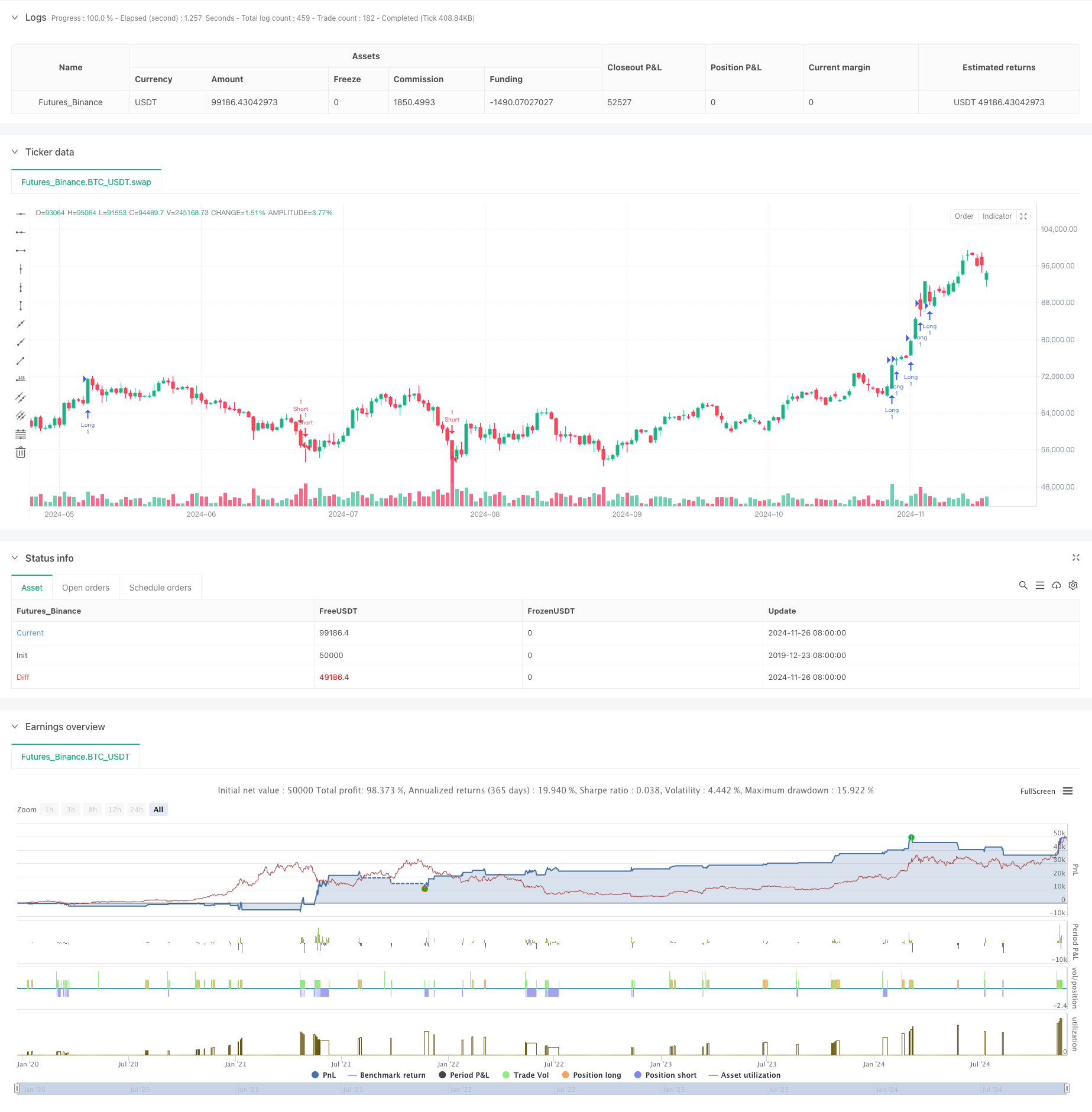
Overview
This strategy is a quantitative trading system based on Elder's Force Index (EFI), combining standard deviation and moving averages for signal generation, while using ATR for dynamic stop-loss and take-profit positioning. The strategy calculates fast and slow EFI indicators, normalizes them using standard deviation, and generates trading signals through crossover analysis, creating a complete trading system. It employs dynamic stop-loss and trailing take-profit mechanisms to effectively control risks while pursuing higher returns.
Strategy Principle
The strategy is built on several core elements:
- Uses two different periods (13 and 50) to calculate fast and slow force indices
- Normalizes both EFI periods using standard deviation to make signals more statistically significant
- Generates long signals when both fast and slow EFI simultaneously break above the standard deviation threshold
- Generates short signals when both fast and slow EFI simultaneously break below the standard deviation threshold
- Uses ATR for dynamic stop-loss positioning that adjusts with price movement
- Implements ATR-based trailing take-profit mechanism to protect and grow profits
Strategy Advantages
- Signal system combines momentum and volatility characteristics, improving trading reliability
- Standard deviation normalization makes signals statistically significant, reducing false signals
- Dynamic stop-loss mechanism effectively controls risk and prevents large drawdowns
- Trailing take-profit mechanism both protects and allows profits to grow
- Clear strategy logic with adjustable parameters, suitable for optimization across different markets
Strategy Risks
- May generate false signals in highly volatile markets, requiring additional filtering mechanisms
- Sensitive parameter selection might lead to overtrading, increasing transaction costs
- Potential lag at trend reversal points, affecting strategy performance
- Improper stop-loss positioning might result in premature exits or excessive losses
- Need to consider the impact of transaction costs on strategy returns
Optimization Directions
- Add market condition assessment mechanism to use different parameters in different market states
- Introduce volume filters to improve signal reliability
- Optimize stop-loss and take-profit parameters to better adapt to market volatility
- Add trend filters to avoid frequent trading in ranging markets
- Consider adding time filters to avoid trading during unfavorable periods
Summary
The strategy builds a complete trading system by combining EFI indicators, standard deviation, and ATR. Its strengths lie in high signal reliability and reasonable risk control, though optimization for different market environments is still needed. The strategy's stability and profitability can be further improved by adding market condition assessment, volume filtering, and other mechanisms. Overall, it provides a solid quantitative trading framework with practical value.
Source Pine Script
/*backtest
start: 2019-12-23 08:00:00
end: 2024-11-27 00:00:00
period: 1d
basePeriod: 1d
exchanges: [{"eid":"Futures_Binance","currency":"BTC_USDT"}]
*/

//@version=5
strategy("Elder's Force Index Strategy with ATR-Based SL and TP", overlay=true)

// Input parameters for fast and long EFI
efi_fast_length = input.int(13, "Fast EFI Length", minval=1)
efi_long_length = input.int(50, "Long EFI Length", minval=1)
stdev_length = input.int(50, "Standard Deviation Length", minval=2, maxval=300)
numdev = input.float(2, "Number of Deviations", minval=1, maxval=20, step=0.1)
atr_length = input.int(14, "ATR Length", minval=1)
atr_multiplier_sl = input.float(1.5, "ATR Multiplier for Stop Loss", step=0.1)
trailing_tp_multiplier = input.float(0.5, "Multiplier for Trailing Take Profit", step=0.1)

// Elder's Force Index Calculation for Fast and Long EFI
efi_fast = ta.ema((close - close[1]) * volume, efi_fast_length)
efi_long = ta.ema((close - close[1]) * volume, efi_long_length)

// Calculate Standard Deviation for Fast EFI
efi_fast_average = ta.sma(efi_fast, stdev_length)
efi_fast_stdev = ta.stdev(efi_fast, stdev_length)
efi_fast_diff = efi_fast - efi_fast_average
efi_fast_result = efi_fast_diff / efi_fast_stdev

// Calculate Standard Deviation for Long EFI
efi_long_average = ta.sma(efi_long, stdev_length)
efi_long_stdev = ta.stdev(efi_long, stdev_length)
efi_long_diff = efi_long - efi_long_average
efi_long_result = efi_long_diff / efi_long_stdev

// Define upper and lower standard deviation levels
upper_sd = numdev
lower_sd = -numdev

// Define entry conditions based on crossing upper and lower standard deviations
long_condition = efi_fast_result > upper_sd and efi_long_result > upper_sd
short_condition = efi_fast_result < lower_sd and efi_long_result < lower_sd

// Check if a position is already open
is_position_open = strategy.position_size != 0

// Calculate ATR for stop loss and take profit
atr = ta.atr(atr_length)

// Initialize stop loss and take profit variables
var float stop_loss = na
var float take_profit = na

// Execute trades based on conditions, ensuring only one trade at a time
if (long_condition and not is_position_open)
    strategy.entry("Long", strategy.long)
    stop_loss := close - atr * atr_multiplier_sl  // Set initial stop loss based on ATR
    take_profit := close + atr * trailing_tp_multiplier  // Set initial take profit based on ATR

if (short_condition and not is_position_open)
    strategy.entry("Short", strategy.short)
    stop_loss := close + atr * atr_multiplier_sl  // Set initial stop loss based on ATR
    take_profit := close - atr * trailing_tp_multiplier  // Set initial take profit based on ATR

// Update exit conditions
if (is_position_open)
    // Update stop loss for trailing
    if (strategy.position_size > 0)  // For long positions
        stop_loss := math.max(stop_loss, close - atr * atr_multiplier_sl)

        // Adjust take profit based on price movement
        take_profit := math.max(take_profit, close + atr * trailing_tp_multiplier)

    else if (strategy.position_size < 0)  // For short positions
        stop_loss := math.min(stop_loss, close + atr * atr_multiplier_sl)

        // Adjust take profit based on price movement
        take_profit := math.min(take_profit, close - atr * trailing_tp_multiplier)

    // Set exit conditions
    strategy.exit("Long Exit", from_entry="Long", stop=stop_loss, limit=take_profit)
    strategy.exit("Short Exit", from_entry="Short", stop=stop_loss, limit=take_profit)
Published by ChaoZhang on the FMZ strategy square · last modified 2024-11-28. Collected in the Quant Trading Vault. Unvalidated research: re-test with your own data and costs before trusting it.
Build this with AgenKit
A spec is not a trading system. Paste this into your coding agent and AgenKit runs a specialist team — architecture, test-first build, risk gates, review — with paper trading on by default.
/agenkit build a production-grade trading bot with a backtest engine, risk controls and paper trading by default from strategies/Elders-Force-Index-Quantitative-Trading-Strategy-Based-on-Standard-Deviation-and-Moving-Averages.md- npx agenkit install engineering-kit in your project
- Paste the command into your agent and approve each phase
- Get tests, backtest, risk controls and a paper-trading switch
Understand it first
Before you run this, read the lesson behind the idea and how to backtest it honestly. Specs like this one are the survivors of an unknown number of trials; deflate their results accordingly.
Related specs
- Advanced Momentum EMA Trend Following with RSI Overbought Oversold Trading StrategyPine Script · Mean reversion · 1d
- Dynamic Adaptive Multi Timeframe Trend Following and Range Reversal Hybrid StrategyPine Script · Mean reversion · 2d
- Multi Signal Adaptive Trading StrategyPine Script · Mean reversion · 1d
- Multi Indicator Synergistic Trend Reversal Quantitative Trading StrategyPine Script · Mean reversion · 1d
- Dual Smooth Moving Average Trading StrategyPine Script · Mean reversion · 2d
- Advanced Quantitative Trend Following and Cloud Reversal Composite Trading StrategyPine Script · Mean reversion · 1d