Strategy vault / Mean reversion
EVWMA based MACD Trading Strategy
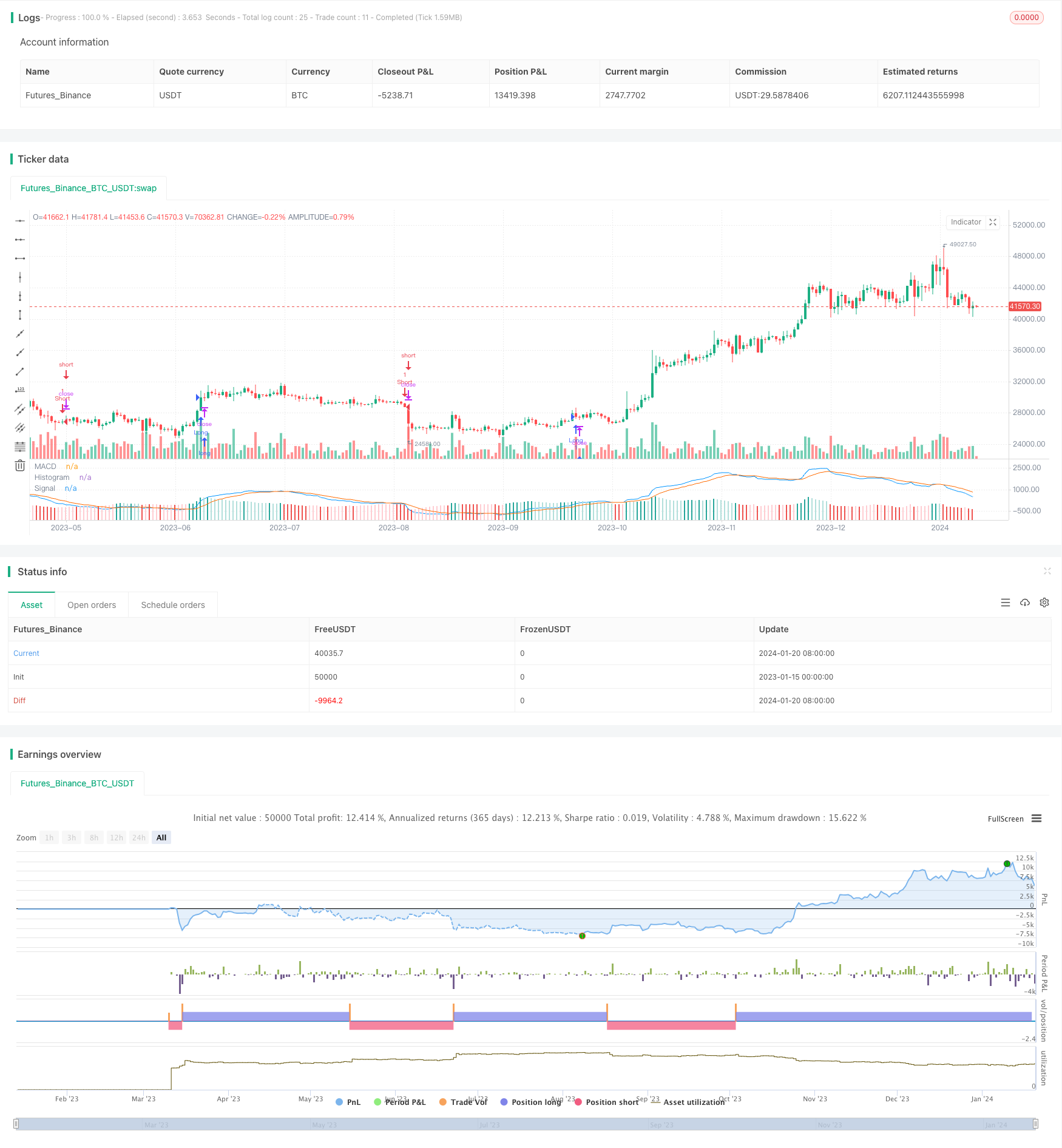
This strategy is a MACD trading strategy based on Elastic Volume Weighted Moving Average (EVWMA). It utilizes the advantages of EVWMA and designs a strategy with clear trading signals and strong practicality.
Overview
This strategy is a MACD trading strategy based on Elastic Volume Weighted Moving Average (EVWMA). It utilizes the advantages of EVWMA and designs a strategy with clear trading signals and strong practicality.
Principles
The EVWMA indicator incorporates volume information into the calculation of moving averages, allowing moving averages to more accurately reflect price changes. The calculations of the fast line and slow line in this strategy are both based on EVWMA. The parameter settings of the fast line are more sensitive to capture short-term price fluctuations; the parameter settings of the slow line are more robust to filter out some noise. The MACD formed by the two EVWMAs triggers long and short signals on crossover, and the histogram provides visually enhanced trading prompts.
Advantage Analysis
The biggest advantage of this strategy is that by leveraging the power of the EVWMA indicator, the parameters settings of the MACD strategy become more stable and trading signals become clearer. Compared with simple moving averages, EVWMA can better grasp market trend changes. This makes the strategy more adaptable to work stably across various market environments.
Risk Analysis
The main risk of this strategy is that MACD itself has a certain lag and cannot promptly capture price reversals. In addition, the parameter settings of EVWMA also affect strategy performance. If the fast and slow line parameters are not set properly, the trading signals will be chaotic, affecting profitability.
To mitigate risks, parameters should be adjusted appropriately to have a moderate difference between the fast and slow lines. The histogram can assist in judging whether a parameter adjustment is needed. In addition, stop loss strategies can also be designed to avoid excessively large single losses.
Optimization Directions
The main aspects for optimizing this strategy include:
Use adaptive parameter setting techniques to automatically adjust EVWMA parameters according to market conditions to ensure signal clarity.
Increase stop loss mechanisms to effectively control single losses.
Incorporate other indicators to filter false signals. For example, combine with volume to only trigger signals during significant price changes.
Optimize entry point selections. Currently the strategy opens positions on MACD zero line crossovers. Testing if using divergence performs better can be examined.
Conclusion
This strategy utilizes the advantages of the EVWMA indicator to build a simple and practical MACD strategy. It has better stability and adaptability. At the same time, it also has the lag problem inherent in MACD. We can improve the strategy's robustness through adaptive parameter optimization, stop loss design, signal filtering and other aspects.
Parameters
| Name | Default | What it controls |
|---|---|---|
| v_input_1 | 10 | Fast Sum Length |
| v_input_2 | 20 | Slow Sum Length |
| v_input_3 | 9 | Signal Smoothing |
Source Pine Script
/*backtest
start: 2023-01-15 00:00:00
end: 2024-01-21 00:00:00
period: 1d
basePeriod: 1h
exchanges: [{"eid":"Futures_Binance","currency":"BTC_USDT"}]
*/

//@version=4
strategy("QuantNomad - EVWMA MACD Strategy", shorttitle = "EVWMA MACD", overlay = false)

// Inputs
fast_sum_length = input(10, title = "Fast Sum Length",  type = input.integer)
slow_sum_length = input(20, title = "Slow Sum Length",  type = input.integer)
signal_length   = input(9,  title = "Signal Smoothing", type = input.integer, minval = 1, maxval = 50)

// Calculate Volume Period
fast_vol_period = sum(volume, fast_sum_length)
slow_vol_period = sum(volume, slow_sum_length)

// Calculate EVWMA
fast_evwma = 0.0
fast_evwma := ((fast_vol_period - volume) * nz(fast_evwma[1], close) + volume * close) / (fast_vol_period)

// Calculate EVWMA
slow_evwma = 0.0
slow_evwma := ((slow_vol_period - volume) * nz(slow_evwma[1], close) + volume * close) / (slow_vol_period)

// Calculate MACD
macd   = fast_evwma - slow_evwma
signal = ema(macd, signal_length)
hist   = macd - signal

// Plot
plot(hist,   title = "Histogram", style = plot.style_columns, color=(hist>=0 ? (hist[1] < hist ? #26A69A : #B2DFDB) : (hist[1] < hist ? #FFCDD2 : #EF5350) ), transp=0 )
plot(macd,   title = "MACD",      color = #0094ff, transp=0)
plot(signal, title = "Signal",    color = #ff6a00, transp=0)

// Strategy
strategy.entry("Long",   true, when = crossover(fast_evwma, slow_evwma))
strategy.entry("Short", false, when = crossunder(fast_evwma, slow_evwma))
Published by ChaoZhang on the FMZ strategy square · last modified 2024-01-22. Collected in the Quant Trading Vault. Unvalidated research: re-test with your own data and costs before trusting it.
Build this with AgenKit
A spec is not a trading system. Paste this into your coding agent and AgenKit runs a specialist team — architecture, test-first build, risk gates, review — with paper trading on by default.
/agenkit build a production-grade trading bot with a backtest engine, risk controls and paper trading by default from strategies/EVWMA-based-MACD-Trading-Strategy.md- npx agenkit install engineering-kit in your project
- Paste the command into your agent and approve each phase
- Get tests, backtest, risk controls and a paper-trading switch
Understand it first
Before you run this, read the lesson behind the idea and how to backtest it honestly. Specs like this one are the survivors of an unknown number of trials; deflate their results accordingly.
Related specs
- Advanced 15 Minute Chart Trading Signal StrategyPine Script · Mean reversion · 3h
- BONK Multi Factor Trading StrategyPine Script · Mean reversion · 1d
- Customizable Non Repainting HTF MACD MFI Scalable Bot StrategyPine Script · Mean reversion · 1d
- Dynamic Adaptive Multi Timeframe Trend Following and Range Reversal Hybrid StrategyPine Script · Mean reversion · 2d
- MACD Cross Period Trading StrategyPine Script · Mean reversion · 1d
- MACD Double Optimization Trading StrategyPine Script · Mean reversion · 1d