Strategy vault / Trend following
Extreme version of Noros Trend Moving Averages Strategy
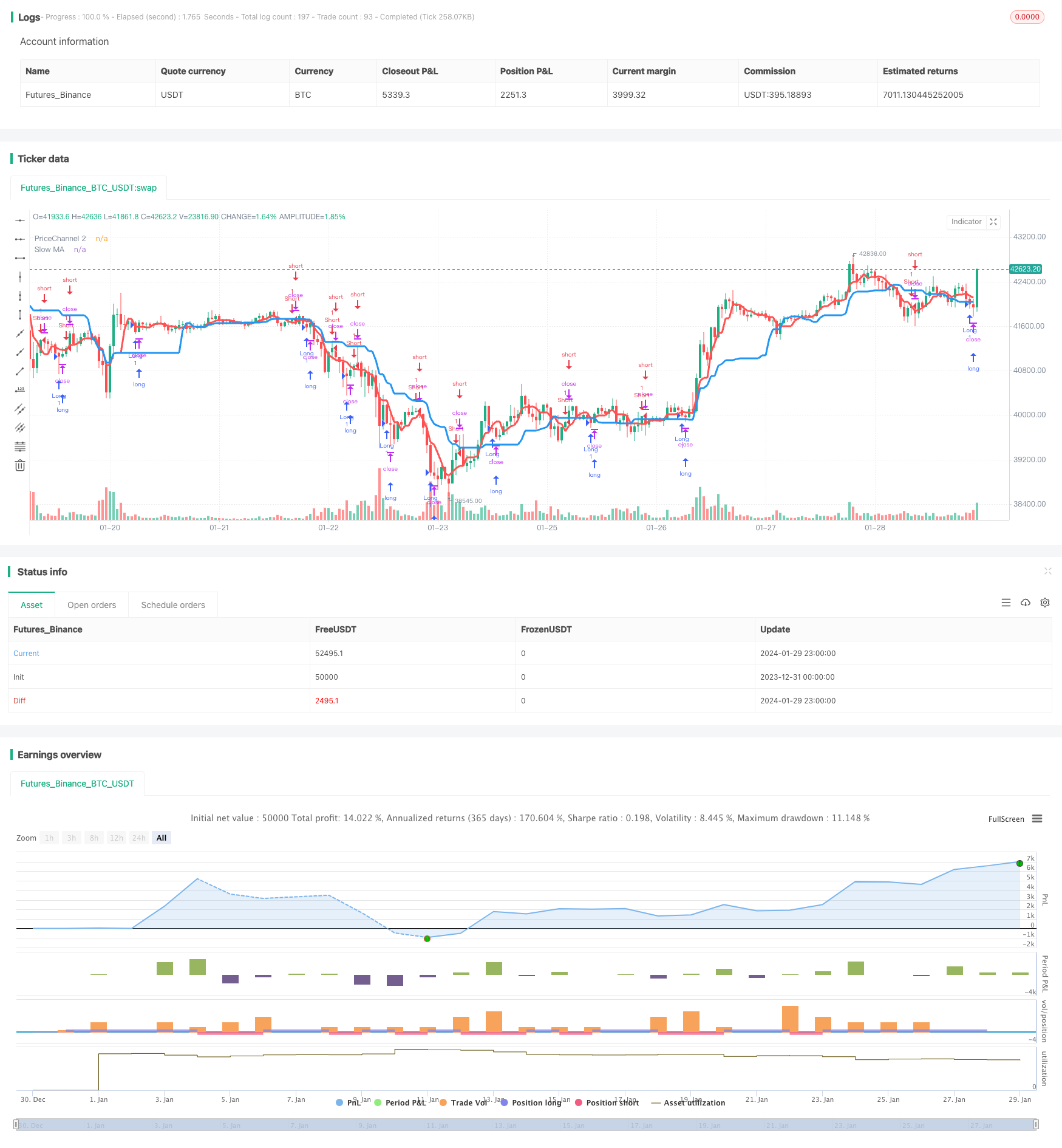
This strategy uses two moving average indicators to identify trend direction and long/short opportunities. The slower moving average (blue line) is used to determine the overall trend direction, while the faster…
Overview
This strategy uses two moving average indicators to identify trend direction and long/short opportunities. The slower moving average (blue line) is used to determine the overall trend direction, while the faster moving average (red line) combined with the price channel is used to discover trading opportunities.
Strategy Logic
Calculate two moving averages - a slower MA with period 21 to determine the overall trend, and a faster MA with period 5 that combines with price channel to find trading opportunities.
Check if the current price breaks through the price channel formed in the previous period. A breakout signals a potential trading opportunity.
Count the number and direction of recent candlesticks. For example, several consecutive bearish candlesticks may signal a long opportunity, while consecutive bullish candlesticks may signal a short opportunity. The number of candlesticks is configurable via the Bars parameter.
Combine all the above factors to generate long/short signals. A signal is triggered when price move aligns with slower MA trend direction, fast MA or price channel produces signal, and candlestick move matches condition.
Advantages
The dual moving average system effectively tracks trend direction.
Faster MA and price channel combined detects early breakout points to catch trading opportunities.
Also considers candlestick direction and counts to avoid being trapped by market reversals.
Customizable MA parameters work for different products and timeframes.
Risks and Mitigations
Dual MAs can produce false signals during sideways markets. Can add oscillators or ATR to avoid trading choppy markets.
Still risks getting trapped in exceptional market moves. Can set proper stop loss to limit downside.
Impossible to fully avoid reversals. Will keep improving logic and parameters to make strategy more robust.
Enhancement Opportunities
Add supporting indicators like ADX, MACD to avoid wrong trades in choppy markets.
Dynamic stop loss calculation, e.g. based on ATR and risk preference.
Parameter optimization via machine learning for adaptive capability.
Fine tune parameters based on instrument characteristics, e.g. shorter periods for crypto.
Conclusion
Overall this strategy works very well in tracking trending markets, with additional breakout opportunities. With proper enhancements it can be made into a commercially viable high quality quant strategy. We will continue improving it to trade more markets stably.
Parameters
| Name | Default | What it controls |
|---|---|---|
| v_input_1 | true | long |
| v_input_2 | true | short |
| v_input_3 | false | stops |
| v_input_4 | 5 | Stop, % |
| v_input_5 | false | Use OHLC4 |
| v_input_6 | true | Use fast MA Filter |
| v_input_7 | 5 | fast MA Period |
| v_input_8 | 21 | slow MA Period |
| v_input_9 | 2 | Bars Q |
| v_input_10 | false | Need trend Background? |
| v_input_11 | false | Need entry arrows? |
| v_input_12 | true | Need extreme? (crypto/fiat only!!!) |
Source Pine Script
/*backtest
start: 2023-12-31 00:00:00
end: 2024-01-30 00:00:00
period: 1h
basePeriod: 15m
exchanges: [{"eid":"Futures_Binance","currency":"BTC_USDT"}]
*/

//@version=2
strategy(title = "Noro's Trend MAs Strategy v1.9 Extreme", shorttitle = "Trend MAs str 1.9 extreme", overlay=true, default_qty_type = strategy.percent_of_equity, default_qty_value=100.0, pyramiding=0)

//Settings
needlong = input(true, "long")
needshort = input(true, "short")
needstops = input(false, "stops")
stoppercent = input(5, defval = 5, minval = 1, maxval = 50, title = "Stop, %")
useohlc4 = input(false, defval = false, title = "Use OHLC4")
usefastsma = input(true, "Use fast MA Filter")
fastlen = input(5, defval = 5, minval = 1, maxval = 50, title = "fast MA Period")
slowlen = input(21, defval = 20, minval = 2, maxval = 200, title = "slow MA Period")
bars = input(2, defval = 2, minval = 0, maxval = 3, title = "Bars Q")
needbg = input(false, defval = false, title = "Need trend Background?")
needarr = input(false, defval = false, title = "Need entry arrows?")
needex = input(true, defval = true, title = "Need extreme? (crypto/fiat only!!!)")

src = useohlc4 == true ? ohlc4 : close

//PriceChannel 1
lasthigh = highest(src, slowlen)
lastlow = lowest(src, slowlen)
center = (lasthigh + lastlow) / 2

//PriceChannel 2
lasthigh2 = highest(src, fastlen)
lastlow2 = lowest(src, fastlen)
center2 = (lasthigh2 + lastlow2) / 2

//Trend
trend = low > center and low[1] > center[1] ? 1 : high < center and high[1] < center[1] ? -1 : trend[1]

//Bars
bar = close > open ? 1 : close < open ? -1 : 0
redbars = bars == 0 ? 1 : bars == 1 and bar == -1 ? 1 : bars == 2 and bar == -1 and bar[1] == -1 ? 1 : bars == 3 and bar == -1 and bar[1] == -1 and bar[2] == -1 ? 1 : 0
greenbars = bars == 0 ? 1 : bars == 1 and bar == 1 ? 1 : bars == 2 and bar == 1 and bar[1] == 1 ? 1 : bars == 3 and bar == 1 and bar[1] == 1 and bar[2] == 1 ? 1 : 0

//Signals
up = trend == 1 and (low < center2 or usefastsma == false) and (redbars == 1) ? 1 : 0
dn = trend == -1 and (high > center2 or usefastsma == false) and (greenbars == 1) ? 1 : 0

up2 = high < center and high < center2 and bar == -1 ? 1 : 0
dn2 = low > center and low > center2 and bar == 1 ? 0 : 0

//Lines
plot(center, color = blue, linewidth = 3, transp = 0, title = "Slow MA")
plot(center2, color = red, linewidth = 3, transp = 0, title = "PriceChannel 2")

//Arrows
plotarrow(up == 1 and needarr == true ? 1 : 0, colorup = black, colordown = black, transp = 0)
plotarrow(dn == 1 and needarr == true ? -1 : 0, colorup = black, colordown = black, transp = 0)

//Background
col = needbg == false ? na : trend == 1 ? lime : red
bgcolor(col, transp = 90)

//Alerts
alertcondition(up == 1, title='buy', message='Uptrend')
alertcondition(dn == 1, title='sell', message='Downtrend')

//Trading
stoplong = up == 1 and needstops == true ? close - (close / 100 * stoppercent) : stoplong[1]
stopshort = dn == 1 and needstops == true ? close + (close / 100 * stoppercent) : stopshort[1]

longCondition = up == 1 or (up2 == 1 and needex == true)
if (longCondition)
    strategy.entry("Long", strategy.long, needlong == false ? 0 : na)
    strategy.exit("Stop Long", "Long", stop = stoplong)

shortCondition = dn == 1
if (shortCondition)
    strategy.entry("Short", strategy.short, needshort == false ? 0 : na)
strategy.exit("Stop Short", "Short", stop = stopshort)Published by ChaoZhang on the FMZ strategy square · last modified 2024-01-31. Collected in the Quant Trading Vault. Unvalidated research: re-test with your own data and costs before trusting it.
Build this with AgenKit
A spec is not a trading system. Paste this into your coding agent and AgenKit runs a specialist team — architecture, test-first build, risk gates, review — with paper trading on by default.
/agenkit build a production-grade trading bot with a backtest engine, risk controls and paper trading by default from strategies/Extreme-version-of-Noros-Trend-Moving-Averages-Strategy.md- npx agenkit install engineering-kit in your project
- Paste the command into your agent and approve each phase
- Get tests, backtest, risk controls and a paper-trading switch
Understand it first
Before you run this, read the lesson behind the idea and how to backtest it honestly. Specs like this one are the survivors of an unknown number of trials; deflate their results accordingly.
Related specs
- Multi Dimensional Short Term Trend Predictor Technical Analysis and Volatility Adaptive Trading StrategyPine Script · Trend following · 1h
- Multi Indicator Dynamic Trend Following Strategy Based on EMA and SMAPine Script · Trend following · 1d
- Advanced Quantitative Trading Strategy Multi Dimensional Super Trend ATR Dynamic Tracking SystemPine Script · Trend following · 1h
- Dual EMA Crossover Trend Following Strategy with ATR and ADX FiltersPine Script · Trend following · 1d
- Dynamic Trend Identification Strategy with Exponential Moving Average and Adaptive Volatility ThresholdPine Script · Trend following · 1h
- Multi Indicator Crossover Dynamic Stop Loss Trend Following StrategyPine Script · Trend following · 1d