Fixed Grid Trading Strategy
This strategy adopts fixed grid trading approach by setting the starting price and percentage between each grid layer. Then it calculates 10 fixed buy and sell prices based on the percentage to implement…
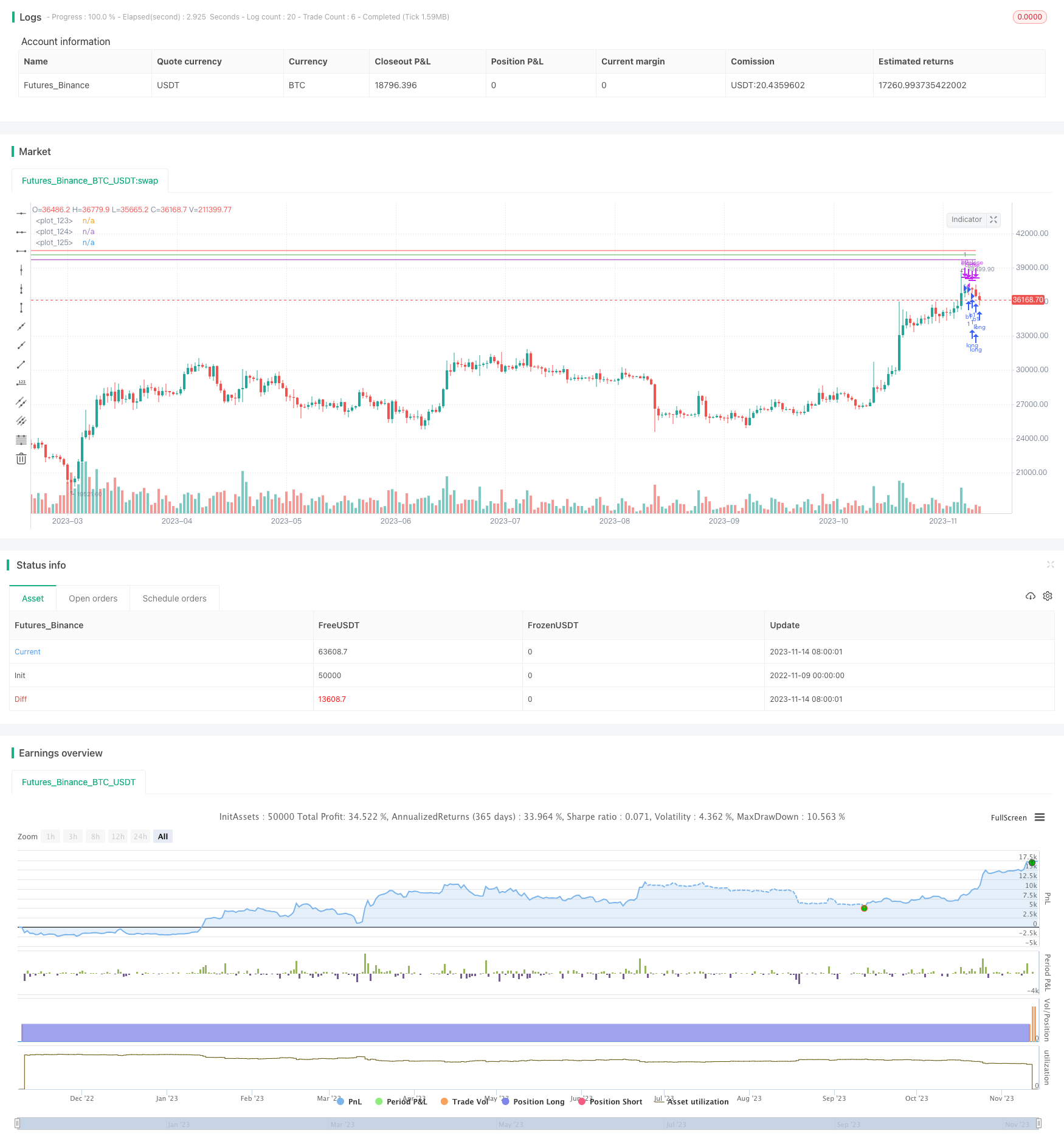
Overview
This strategy adopts fixed grid trading approach by setting the starting price and percentage between each grid layer. Then it calculates 10 fixed buy and sell prices based on the percentage to implement low-buy-high-sell grid trading strategy.
Strategy Logic
The strategy first sets the starting price sprice and grid distance percentage gridpercent. Then it calculates 10 layers of buy and sell prices based on the starting price and percentage.
Buy price formula:
b1=sprice-(sprice*p1)
b2=sprice-(sprice*p2)
b3=sprice-(sprice*p3)
...
Where p1~p10 are percentages calculated layer by layer based on gridpercent.
Sell price formula:
s1=b1+(sprice*p1)
s2=b2+(sprice*p1)
s3=b3+(sprice*p1)
...
The buy condition triggers when close price is lower than the buy price:
if (close<b1)
strategy.entry("b1", strategy.long, when=(close<b1))
Similarly, sell condition triggers when close price is higher than sell price:
if (close>s1)
strategy.exit("b1", when=(close>s1))
This implements the low-buy-high-sell grid trading strategy.
Advantages
The fixed grid strategy has the following advantages:
Achieves auto low-buy-high-sell without timing the market, lowers trading difficulty.
Setting proper grid distance effectively controls risk and avoids chasing.
Profitable whether market goes up or down.
Flexibility to adjust grid params for different market conditions.
Scaling up position size by adding grid layers.
Incorporating stop loss avoids huge loss in extreme market events.
Risks
The strategy also has some risks:
Trading fees eat up profit during range-bound market.
Improper starting price and grid settings lead to loss.
Price gap may cause loss during extreme events.
Mechanical trading has order insertion risk.
Concentrated events may amplify losses.
Solutions:
Optimize grid params to ensure profit > fees.
Backtest to find optimal starting price and grid distance.
Add stop loss to control risks.
Relax order price to avoid insertion.
Set risk control to limit max loss.
Enhancements
The strategy can be enhanced in the following ways:
Dynamically adjust grid distance based on volatility.
Compute price range to dynamically set starting price.
Add ML model to predict price and adjust grid.
Optimize stop loss based on historical stop loss points.
Incorporate position sizing based on profit level.
Optimize position management to maximize capital utilization.
Improve execution using TWAP to reduce impact cost.
Conclusion
The strategy implements fixed grid trading by setting buy and sell prices based on starting price and grid percentage, achieving auto low-buy-high-sell. It's important to manage risks by optimizing parameters, dynamic adjustments and stop loss for profit locking and loss control. Incorporating advanced ML and money management techniques can further improve strategy profitability and win rate.
Parameters
| Name | Default | What it controls |
|---|---|---|
| v_input_1 | 40500 | Starting price |
| v_input_2 | true | Percent |
Source Pine Script
/*backtest
start: 2022-11-09 00:00:00
end: 2023-11-15 00:00:00
period: 1d
basePeriod: 1h
exchanges: [{"eid":"Futures_Binance","currency":"BTC_USDT"}]
*/

// This source code is subject to the terms of the Mozilla Public License 2.0 at https://mozilla.org/MPL/2.0/
// © Lionkind

//@version=5
strategy("Grid HW", overlay = true, margin_long = 1, margin_short = 1)

// Fix 35k price as starting point and 1% as a distance

sprice=input(40500,"Starting price")
gridpercent=input(1,"Percent")

// calculate the % of the 10 layers

p1=((gridpercent*1)/100)
p2=((gridpercent*2)/100)
p3=((gridpercent*3)/100)
p4=((gridpercent*4)/100)
p5=((gridpercent*5)/100)
p6=((gridpercent*6)/100)
p7=((gridpercent*7)/100)
p8=((gridpercent*8)/100)
p9=((gridpercent*9)/100)
p10=((gridpercent*10)/100)

//set buy prices

b1=sprice-(sprice*p1)
b2=sprice-(sprice*p2)
b3=sprice-(sprice*p3)
b4=sprice-(sprice*p4)
b5=sprice-(sprice*p5)
b6=sprice-(sprice*p6)
b7=sprice-(sprice*p7)
b8=sprice-(sprice*p8)
b9=sprice-(sprice*p9)
b10=sprice-(sprice*p10)

//set sell prices

s1=b1+(sprice*p1)
s2=b2+(sprice*p1)
s3=b3+(sprice*p1)
s4=b4+(sprice*p1)
s5=b5+(sprice*p1)
s6=b6+(sprice*p1)
s7=b7+(sprice*p1)
s8=b8+(sprice*p1)
s9=b9+(sprice*p1)
s10=b10+(sprice*p1)

//Long conditions

lc1=close<b1
lc2=close<b2
lc3=close<b3
lc4=close<b4
lc5=close<b5
lc6=close<b6
lc7=close<b7
lc8=close<b8
lc9=close<b9
lc10=close<b10

//exit conditions
ec1=close>s1
ec2=close>s2
ec3=close>s3
ec4=close>s4
ec5=close>s5
ec6=close>s6
ec7=close>s7
ec8=close>s8
ec9=close>s9
ec10=close>s10

//long orders
if (lc1)
    strategy.entry("b1", strategy.long, when=(lc1))

if (lc2)
    strategy.entry("b2", strategy.long, when=(lc2))

if (lc3)
    strategy.entry("b3", strategy.long, when=(lc3))
if (lc4)
    strategy.entry("b4", strategy.long, when=(lc4))
if (lc5)
    strategy.entry("b5", strategy.long, when=(lc5))
if (lc6)
    strategy.entry("b6", strategy.long, when=(lc6))
if (lc7)
    strategy.entry("b7", strategy.long, when=(lc7))
if (lc8)
    strategy.entry("b8", strategy.long, when=(lc8))
if (lc9)
    strategy.entry("b9", strategy.long, when=(lc9))
if (lc10)
    strategy.entry("b10", strategy.long, when=(lc10))

//exit orders
if (ec1)
    strategy.exit("b1", when=(ec1), limit=1)
if (ec2)
    strategy.exit("b2", when=(ec2), limit=1)
if (ec3)
    strategy.exit("b3", when=(ec3), limit=1)
if (ec4)
    strategy.exit("b4", when=(ec4), limit=1)
if (ec5)
    strategy.exit("b5", when=(ec5), limit=1)
if (ec6)
    strategy.exit("b6", when=(ec6), limit=1)
if (ec7)
    strategy.exit("b7", when=(ec7), limit=1)
if (ec8)
    strategy.exit("b8", when=(ec8), limit=1)
if (ec9)
    strategy.exit("b9", when=(ec9), limit=1)
if (ec10)
    strategy.exit("b10", when=(ec10), limit=1)


plot(b1,color=color.green)
plot(s1, color=color.red)
plot(b2, color=color.purple)Published by ChaoZhang on the FMZ strategy square · last modified 2023-11-16. Collected in the Quant Trading Vault. Unvalidated research: re-test with your own data and costs before trusting it.
Build this with AgenKit
A spec is not a trading system. Paste this into your coding agent and AgenKit runs a specialist team — architecture, test-first build, risk gates, review — with paper trading on by default.
/agenkit build a grid bot with inventory caps and order deduplication from strategies/Fixed-Grid-Trading-Strategy.md- npx agenkit install engineering-kit in your project
- Paste the command into your agent and approve each phase
- Get tests, backtest, risk controls and a paper-trading switch
Understand it first
Before you run this, read the lesson behind the idea and how to backtest it honestly. Specs like this one are the survivors of an unknown number of trials; deflate their results accordingly.
Related specs
- Adaptive Bollinger Bands Grid Trading Strategy with Dynamic Level AdjustmentPine Script · Grid · 1d
- Adaptive Grid Trading Strategy Based on Quantitative Trading PlatformPine Script · Grid · 1h
- Assassins Grid B A Dynamic Grid Trading StrategyPine Script · Grid · 1d
- Bollinger Fibonacci Grid Tracking Trend StrategyPine Script · Grid · 1h
- Double Bottom Reversal Mean Reversion DCA Grid StrategyPine Script · Grid · 3m
- Grid Trading Risk Hedging StrategyPine Script · Grid · 5m