Strategy vault / Trend following
FraMA and MA Crossover Trading Strategy Based on FRAMA Indicator
This strategy calculates the fast moving average line ma fast and slow moving average line ma slow first, and then combines with the FRAMA adaptive moving average line. It goes long when ma fast crosses over ma slow…
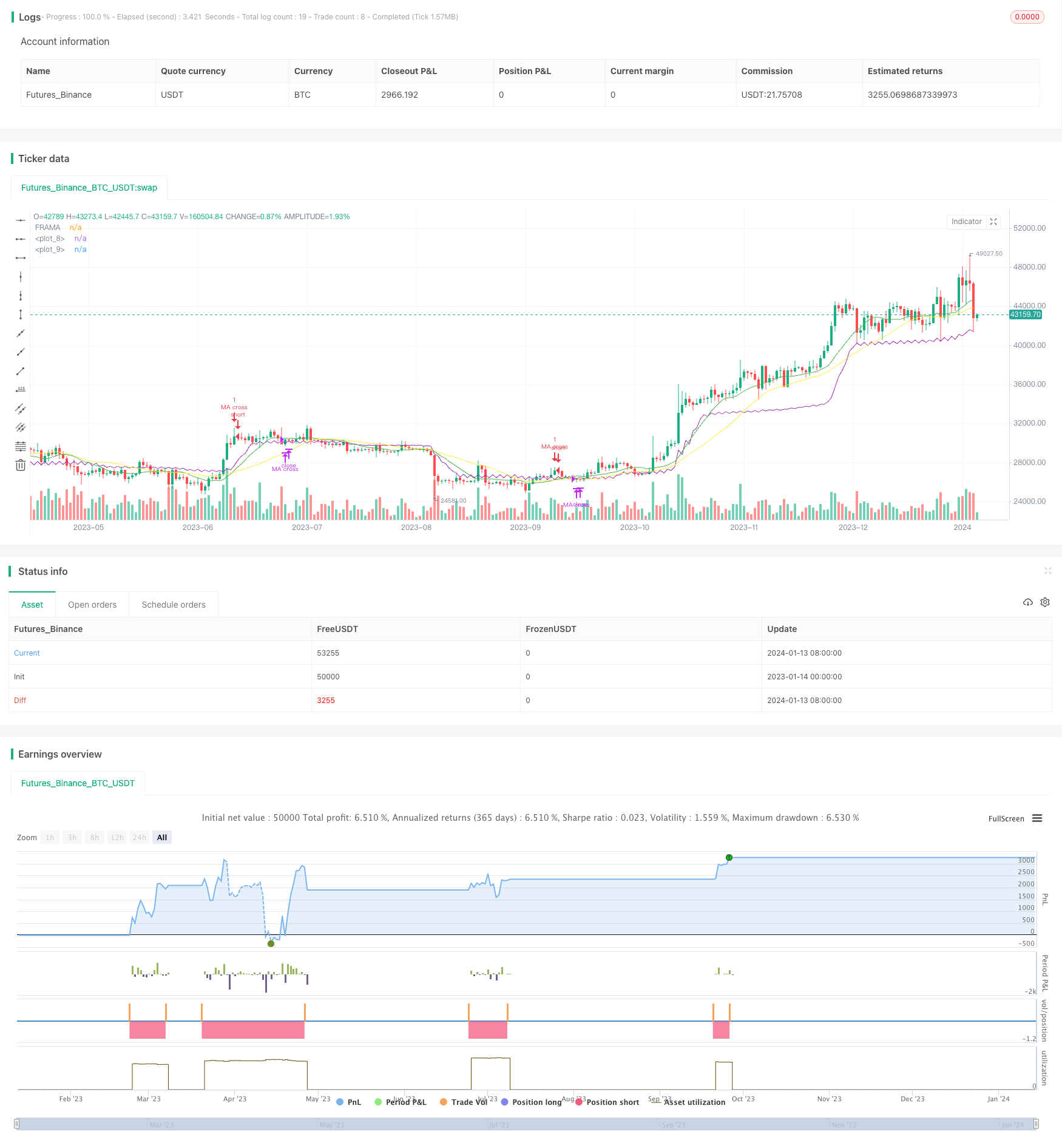
Summary
This strategy calculates the fast moving average line ma_fast and slow moving average line ma_slow first, and then combines with the FRAMA adaptive moving average line. It goes long when ma_fast crosses over ma_slow, and closes position when ma_slow crosses below ma_fast or FRAMA falls below close price.
Strategy Logic
Calculate the 13-day simple moving average ma_fast and 26-day simple moving average ma_slow.
Calculate the FRAMA adaptive moving average line out. The FRAMA formula is complex, the main idea is to dynamically adjust the smoothness α of the moving average based on the highest, lowest and volatility of prices.
Go long when ma_fast crosses over ma_slow. This indicates the short-term moving average starts to move up and runs faster than the long-term one, matching the trending characteristics.
Close position when ma_slow crosses below ma_fast or FRAMA falls below close price. These indicate trend reversal signals.
Advantage Analysis
Combines the advantages of dual moving average system and adaptive moving average system. Dual MA system is good at catching trends, while adaptive MA system filters out noises better.
FRAMA indicator automatically adjusts parameters, avoiding the subjectivity of manual parameter tuning.
Using two exit signals enables timely catching trend reversals.
Risk Analysis
Dual moving average crossovers can have whipsaws, resulting in intermittent losses.
Adaptive moving averages introduce more parameters, risking overfitting.
Only considers price factors without trading volume filter, hence may miss opportunities.
Optimization
Test different MA periods to find the optimal combination.
Add volume confirmation to avoid false signals, e.g. requiring volume spikes.
Optimize entry and exit rules to make the strategy more robust, e.g. only taking signals in continuation patterns.
Conclusion
This strategy combines dual moving average crossover and FRAMA adaptive moving average, automatically adapting to market conditions by dynamically adjusting parameters. Dual MAs are good at catching trends while FRAMA filters out noises. Using two exit signals also makes the strategy more robust. Next steps could be further parameter optimization and adding volume filter to improve it.
Parameters
| Name | Default | What it controls |
|---|---|---|
| v_input_1_hl2 | 0 | price: hl2 | high | low | open | close | hlc3 | hlcc4 | ohlc4 |
| v_input_2 | 16 | len |
| v_input_3 | true | FC |
| v_input_4 | 198 | SC |
Source Pine Script
/*backtest
start: 2023-01-14 00:00:00
end: 2024-01-14 00:00:00
period: 1d
basePeriod: 1h
exchanges: [{"eid":"Futures_Binance","currency":"BTC_USDT"}]
*/

//@version=2
strategy("Fractal Adaptive Moving Average",shorttitle="FRAMA",overlay=true)


ma_fast = sma(close,13)

ma_slow = sma(close,26)
plot(ma_fast,color = green)
plot(ma_slow, color = yellow)
price = input(hl2)
len = input(defval=16,minval=1)
FC = input(defval=1,minval=1)
SC = input(defval=198,minval=1)
len1 = len/2
w = log(2/(SC+1))
H1 = highest(high,len1)
L1 = lowest(low,len1)
N1 = (H1-L1)/len1
H2 = highest(high,len)[len1]
L2 = lowest(low,len)[len1]
N2 = (H2-L2)/len1
H3 = highest(high,len)
L3 = lowest(low,len)
N3 = (H3-L3)/len
dimen1 = (log(N1+N2)-log(N3))/log(2)
dimen = iff(N1>0 and N2>0 and N3>0,dimen1,nz(dimen1[1]))
alpha1 = exp(w*(dimen-1))
oldalpha = alpha1>1?1:(alpha1<0.01?0.01:alpha1)
oldN = (2-oldalpha)/oldalpha
N = (((SC-FC)*(oldN-1))/(SC-1))+FC
alpha_ = 2/(N+1)
alpha = alpha_<2/(SC+1)?2/(SC+1):(alpha_>1?1:alpha_)
out = (1-alpha)*nz(out[1]) + alpha*price
plot(out,title="FRAMA",color=purple,transp=0)
entry() => crossover(ma_fast, ma_slow) and (out < close)
exit() => crossover(ma_slow, ma_fast) or crossunder(out, close)

strategy.entry(id= "MA cross", long = true, when = entry())
strategy.close(id= "MA cross", when = exit())
Published by ChaoZhang on the FMZ strategy square · last modified 2024-01-15. Collected in the Quant Trading Vault. Unvalidated research: re-test with your own data and costs before trusting it.
Build this with AgenKit
A spec is not a trading system. Paste this into your coding agent and AgenKit runs a specialist team — architecture, test-first build, risk gates, review — with paper trading on by default.
/agenkit build a production-grade trading bot with a backtest engine, risk controls and paper trading by default from strategies/FraMA-and-MA-Crossover-Trading-Strategy-Based-on-FRAMA-Indicator.md- npx agenkit install engineering-kit in your project
- Paste the command into your agent and approve each phase
- Get tests, backtest, risk controls and a paper-trading switch
Understand it first
Before you run this, read the lesson behind the idea and how to backtest it honestly. Specs like this one are the survivors of an unknown number of trials; deflate their results accordingly.
Related specs
- Adaptive Trading Strategy Based on Stochastic RSI Dual Line CrossoverPine Script · Trend following · 4h
- Dual Moving Average Convergence Trend Tracking StrategyPine Script · Trend following · 1d
- Dual SMA Crossover StrategyPine Script · Trend following · 5m
- Dynamic Moving Average and Bollinger Bands Cross Strategy with Fixed Stop Loss Optimization ModelPine Script · Trend following · 3h
- Dynamic Signal Line Trend Following Strategy Combining ATR and VolumePine Script · Trend following · 1h
- EMA SMA Trend Following with Swing Trading Strategy Combined Volume Filter and Percentage Take Profit Stop Loss SystemPine Script · Trend following · 1d