Grid based Position Accumulation Strategy Based on Martingale Theory
This strategy is a grid-based position accumulation model based on Martingale theory, which balances costs by dynamically adjusting position sizes during price declines. The core strategy involves increasing…
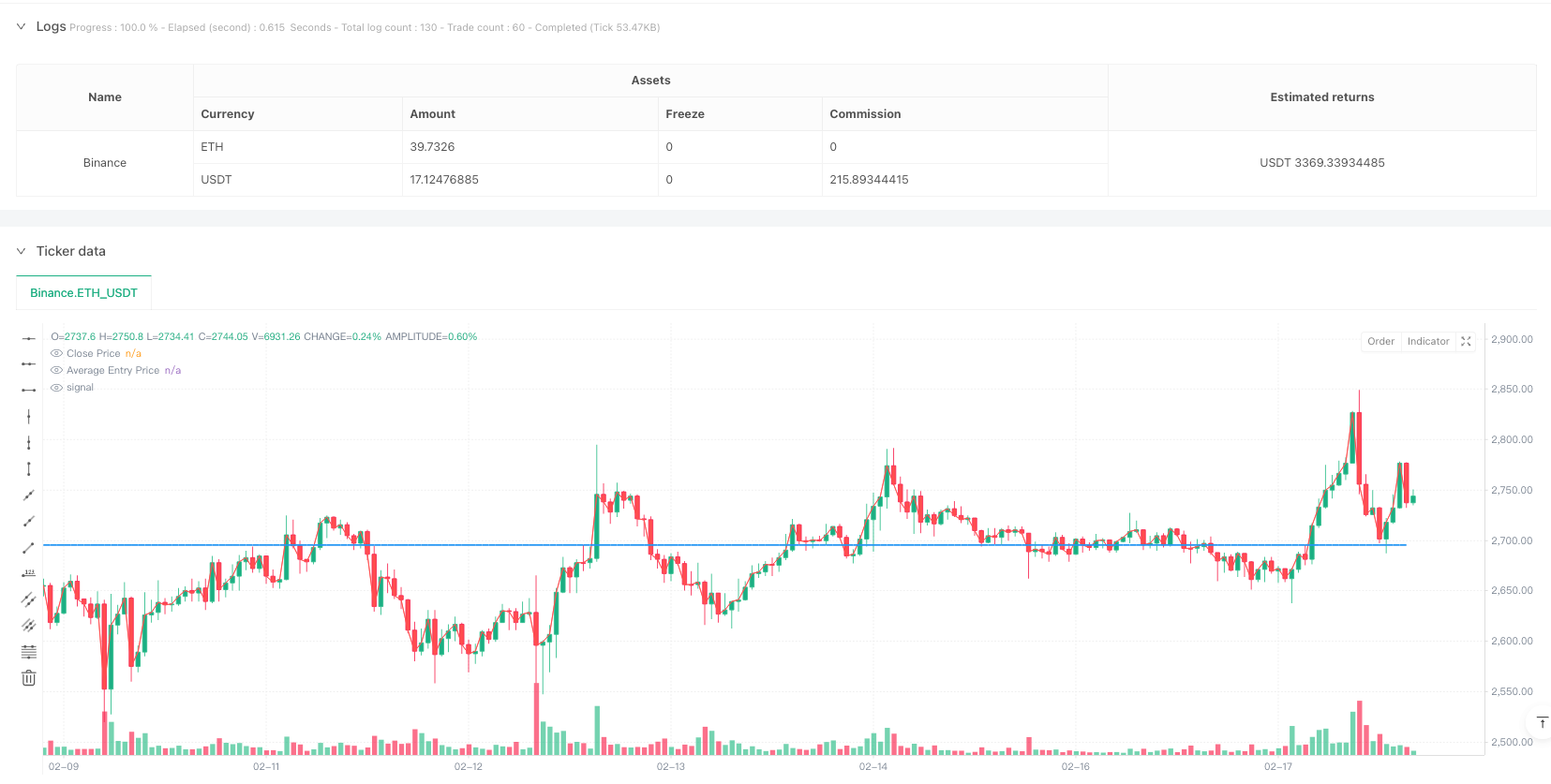
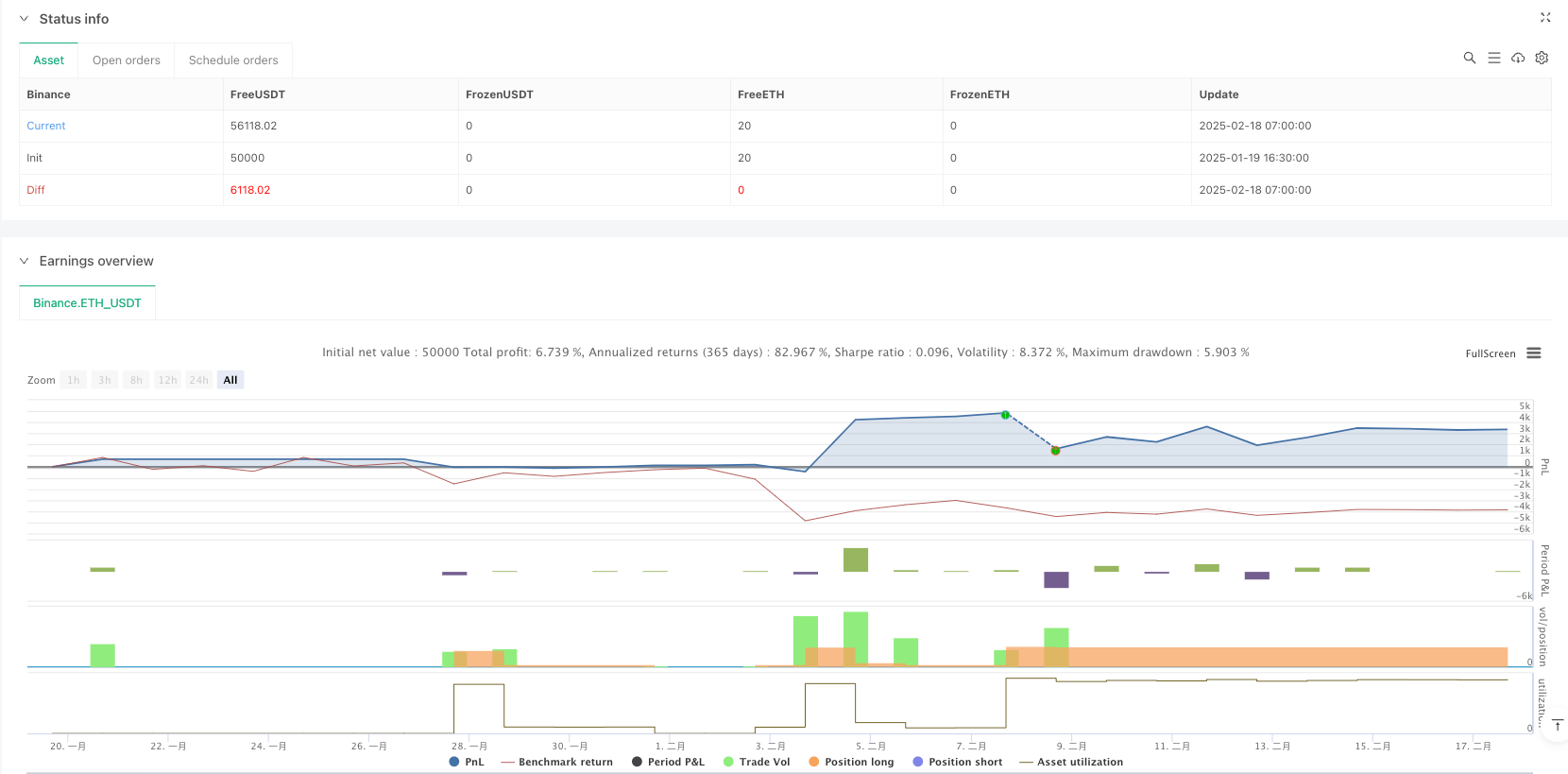
Overview
This strategy is a grid-based position accumulation model based on Martingale theory, which balances costs by dynamically adjusting position sizes during price declines. The core strategy involves increasing positions when price drops by 8%, with each new position being twice the size of the previous one, while setting a 5% profit target. This strategy is particularly suitable for capturing price regression opportunities in oscillating markets.
Strategy Principle
The strategy employs several key technical indicators and parameter settings:
- Drop monitoring: Uses 15 candlesticks as lookback period to measure price decline by comparing current price to highest price
- Position accumulation mechanism: Triggers position increase when price drops 8%, doubling the size each time
- Cost calculation: Dynamically calculates weighted average cost through cumulative cost and quantity
- Take profit condition: Automatically closes position when price rises to 105% of average cost
- Risk control mechanism: Sets maximum position accumulation times to 10, forcing position closure after exceeding
Strategy Advantages
- Cost balancing: Quickly reduces average cost through exponential position increase, improving profit probability
- Controllable risk: Sets maximum accumulation times to avoid infinite position trapping
- Automatic execution: Clear strategy logic suitable for automated trading systems
- Stable returns: Excellent performance in oscillating markets, capable of continuous small stable returns
- Strong adaptability: Parameters can be flexibly adjusted according to market conditions
Strategy Risks
- Capital requirement: Exponential position increase requires large capital reserves
- Drawdown risk: Continuous downtrend may lead to significant drawdowns
- Execution risk: High-frequency trading may face slippage and fee impacts
- System risk: Drastic market fluctuations may trigger frequent trades Solutions:
- Set reasonable initial position and capital ratio
- Add trend filters to avoid counter-trend trading
- Optimize trading frequency and fee control
- Improve risk control mechanism, enhance market volatility monitoring
Strategy Optimization Directions
- Dynamic parameter adjustment:
- Automatically adjust drop threshold based on market volatility
- Adjust accumulation multiplier based on volume changes
- Trend filtering:
- Add trend indicators to avoid counter-trend operations in strong trends
- Optimize entry timing through multi-timeframe analysis
- Risk control improvement:
- Add drawdown limits and total position control
- Implement volatility-based dynamic stop loss
- Trading optimization:
- Optimize order execution strategy to reduce slippage
- Implement intelligent position management
Summary
This strategy combines Martingale theory with grid trading to create a highly adaptive trading system. The strategy performs excellently in oscillating markets and can achieve stable returns through scientific position management and risk control. However, attention must be paid to capital management and market environment compatibility when using it, and thorough backtesting is recommended before live implementation.
Source Pine Script
/*backtest
start: 2025-01-19 16:30:00
end: 2025-02-18 08:00:00
period: 1h
basePeriod: 1h
exchanges: [{"eid":"Binance","currency":"ETH_USDT"}]
*/

//@version=5
strategy("Lila Rai's doubling strategy", overlay=true)

// Input for price drop thresholds
dropPercent = 0.95  // 8% drop (100% - 8%)
takeProfitPercent = 1.05  // 5% TP above avg entry

var float avgPrice = na
var int qty = 1  // Start with 1 lot
var float totalCost = 0
var float totalQty = 0
var int doublingCount = 0  // To count the number of times the position size is doubled

// Calculate price movement
lookbackBars = 15  // Assuming 1-minute chart
priceChange = close / ta.highest(close, lookbackBars)

// Buy condition: price drops 8%
if (priceChange < dropPercent)
    totalCost := totalCost + close * qty  // Add cost of new position
    totalQty := totalQty + qty  // Update total quantity
    avgPrice := totalCost / totalQty  // Compute weighted average price
    strategy.order("DCA Buy", strategy.long, qty)
    qty := qty * 2  // Double the next position size
    doublingCount := doublingCount + 1  // Increase the doubling count

// Condition for selling in loss after 5 doublings
if (doublingCount >= 10)
    strategy.close("DCA Buy")  // Close the position at market price
    doublingCount := 0  // Reset the doubling count after selling
    qty := 1  // Reset qty to 1 for fresh buying

// Take Profit Condition: 5% above avg price
if (not na(avgPrice))
    takeProfit = avgPrice * takeProfitPercent
    strategy.exit("Take Profit", from_entry="DCA Buy", limit=takeProfit)

// Reset qty if take profit is hit
if (strategy.position_size == 0)
    qty := 1  // Reset qty after exiting in profit

// Plot indicators
plot(avgPrice, title="Average Entry Price", color=color.blue, linewidth=2)
plot(close, title="Close Price", color=color.red, linewidth=1)
Published by ianzeng123 on the FMZ strategy square · last modified 2025-02-20. Collected in the Quant Trading Vault. Unvalidated research: re-test with your own data and costs before trusting it.
Build this with AgenKit
A spec is not a trading system. Paste this into your coding agent and AgenKit runs a specialist team — architecture, test-first build, risk gates, review — with paper trading on by default.
/agenkit build a grid bot with inventory caps and order deduplication from strategies/Grid-based-Position-Accumulation-Strategy-Based-on-Martingale-Theory.md- npx agenkit install engineering-kit in your project
- Paste the command into your agent and approve each phase
- Get tests, backtest, risk controls and a paper-trading switch
Understand it first
Before you run this, read the lesson behind the idea and how to backtest it honestly. Specs like this one are the survivors of an unknown number of trials; deflate their results accordingly.
Related specs
- Adaptive Bollinger Bands Grid Trading Strategy with Dynamic Level AdjustmentPine Script · Grid · 1d
- Adaptive Grid Trading Strategy Based on Quantitative Trading PlatformPine Script · Grid · 1h
- Assassins Grid B A Dynamic Grid Trading StrategyPine Script · Grid · 1d
- Bollinger Fibonacci Grid Tracking Trend StrategyPine Script · Grid · 1h
- Double Bottom Reversal Mean Reversion DCA Grid StrategyPine Script · Grid · 3m
- Fixed Grid Trading StrategyPine Script · Grid · 1d