Strategy vault / Market making
HFT High Frequency Order Flow Factor
An entry-level order flow high-frequency alpha factor, which can be used as a reference for the optimal buying and selling pricing distance of the market maker's strategy. The signal is normalized to [-1, 1]. Trend 1…
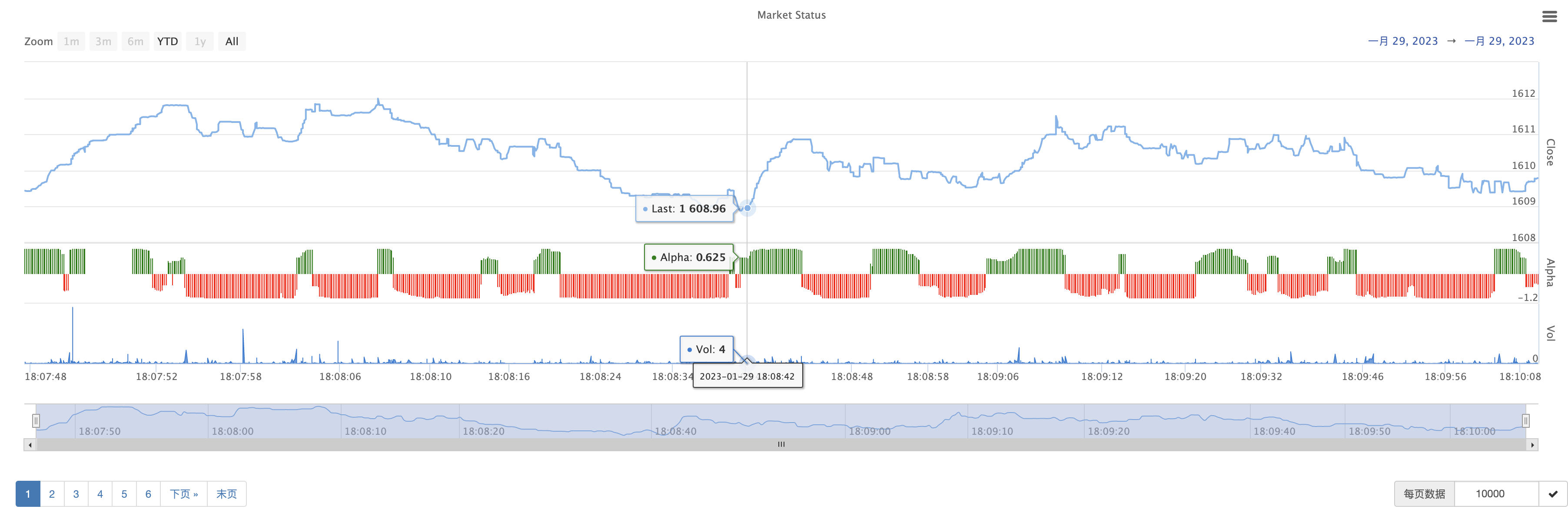
An entry-level order flow high-frequency alpha factor, which can be used as a reference for the optimal buying and selling pricing distance of the market maker's strategy. The signal is normalized to [-1, 1]. Trend 1 represents a buyer's market, and trend -1 is a seller's market. The strategy will draw the factor value and the last transaction price in real time. The strategy uses OKX and Binance Futures websocket interfaces for receiving and calculation. The figure below shows the indicator's effect, which indicates a certain effectiveness, and is publicly shared for quantitative enthusiasts who are beginners in high-frequency trading.
Parameters
| Name | Default | What it controls |
|---|---|---|
| QSize | 100 | QSize |
Source JavaScript
let _chart = Chart({
    subtitle: {
        text: "Market Status",
    },
    yAxis: [{
        height: "60%",
        lineWidth: 1,
        title: {
            text: 'Close',
        },
        opposite: true,
        labels: {
            align: "right",
            x: -3,
        }
    }, {
        title: {
            text: 'Alpha',
        },
        top: "60%",
        height: "20%",
        offset: 0,
        lineWidth: 1
    }, {
        title: {
            text: 'Vol',
        },
        top: "80%",
        height: "20%",
        offset: 0,
        lineWidth: 1
    }],

    series: [{
        name: 'Last',
        lineWidth: 1,
        data: [],
        id: 'primary',
        tooltip: {
            xDateFormat: '%Y-%m-%d %H:%M:%S'
        },
        yAxis: 0
    }, {
        type: 'column',
        lineWidth: 2,
        name: 'Alpha',
        data: [],
        yAxis: 1,
        color: 'green',
        zones: [{
            value: 0,
            color: 'red'
        }]
    }, {
        lineWidth: 1,
        type: 'area',
        color: '#257ed4',
        name: 'Vol',
        data: [],
        yAxis: 2
    }],
})

function calc_alpha(trades) {
    let tick_sell_vol = 0
    let tick_buy_vol = 0
    let last_buy_vol = 0
    let last_sell_vol = 0
    let rightPos = Math.ceil(trades.length * 0.382)
    trades.forEach(function(trade, idx) {
        if (trade.side == 'buy') {
            if (idx >= rightPos) {
                last_buy_vol += trade.qty
            }
            tick_buy_vol += trade.qty
        } else {
            if (idx >= rightPos) {
                last_sell_vol += trade.qty
            }
            tick_sell_vol += trade.qty
        }
    })

    let tanh = function(x) {
        // return [-1, 1]
        return (Math.exp(x) - Math.exp(-x)) / (Math.exp(x) + Math.exp(-x))
    }

    let positive_ratio = last_buy_vol / tick_sell_vol
    let negative_ratio = last_sell_vol / tick_buy_vol
    let trade_ratio = 0
    if (positive_ratio > negative_ratio) {
        trade_ratio = tanh(positive_ratio)
    } else {
        trade_ratio = tanh(-negative_ratio)
    }
    return _N(trade_ratio, 3)
}

let _trades = []
let _vol = 0

function onTick(ctx, event) {
    if (event.trades) {
        event.trades.forEach(function(trade) {
            _vol += trade.qty
            _trades.push(trade)
            if (_trades.length > QSize) {
                _trades.shift()
            }
        })
        if (_trades.length >= QSize) {
            let val = calc_alpha(_trades)
            _chart.add(0, [event.ts, _trades[_trades.length-1].price])
            _chart.add(1, [event.ts, val])
            _chart.add(2, [event.ts, _vol])
            _vol = 0
        }
    }
}

function main() {
    _chart.reset()
    let ct = exchange.SetContractType("swap")
    let debug = false
    let useMargin = false
    let okxAccessKey = ""
    let okxPhrase = ""
    let ctx = $.NewWSS(exchange, function(ws, e) {
        let msg = null
        if (e.GetName() == 'Futures_OKCoin') {
            msg = {
                op: "subscribe",
                args: []
            }
            let instId = ct.InstrumentID
            msg.args.push({
                channel: "books5",
                instId: instId
            })
            msg.args.push({
                channel: "trades",
                instId: instId
            })
        } else {
            msg = {
                method: "SUBSCRIBE",
                params: [],
                id: "1"
            }
            let symbol = e.GetCurrency().replace('_', '').toLowerCase()
            msg.params.push(symbol + "@aggTrade")
            msg.params.push(symbol + "@depth20@100ms")
        }
        ws.write(JSON.stringify(msg))
        Log("subscribe", msg, "channel")
        LogStatus("Ready")
    }, onTick, debug, useMargin, okxAccessKey, okxPhrase)

    while (true) {
        ctx.poll()
        EventLoop(1000)
    }
}Published by 发明者量化 on the FMZ strategy square · last modified 2023-03-24. Collected in the Quant Trading Vault. Unvalidated research: re-test with your own data and costs before trusting it.
Build this with AgenKit
A spec is not a trading system. Paste this into your coding agent and AgenKit runs a specialist team — architecture, test-first build, risk gates, review — with paper trading on by default.
/agenkit build a market making bot with inventory skew limits and order deduplication from strategies/HFT-High-Frequency-Order-Flow-Factor.md- npx agenkit install engineering-kit in your project
- Paste the command into your agent and approve each phase
- Get tests, backtest, risk controls and a paper-trading switch
Understand it first
Before you run this, read the lesson behind the idea and how to backtest it honestly. Specs like this one are the survivors of an unknown number of trials; deflate their results accordingly.
Related specs
- Dynamic Balance Market Making Strategy Xiao GaoJavaScript · Market making
- Short Unlocking Strategy on FMEX Starting from 1 BTC Bearish OutlookJavaScript · Market making
- Long Unlocking Strategy on FMEX Starting from 1 BTC Bullish OutlookJavaScript · Market making
- Dynamic Balance Market Making StrategyJavaScript · Market making
- Simple Bitcoin High Frequency Strategy Bot from 2014JavaScript · Market making
- Market Making Strategy of Grabbing the Market Position High Frequency Approaching TypeJavaScript · Market making