Strategy vault / Trend following
MA Emperor insiliconot
The Script offers 9 different EMAs with 14 different MA types. The make use of the script is to find the entry on the 1-4 hour altcoins while using the in-built 13/21 crossover strategy to be used in sync with Heikin…
The Script offers 9 different EMAs with 14 different MA types.
The make use of the script is to find the entry on the 1-4 hour altcoins while using the in-built 13/21 crossover strategy to be used in sync with Heikin Ashi cross-over with Fib levels of 0.236 Fib level.
How to use it.
Entry is to be made when the
- Cross over gives a P(Positive Sign) and the candle completely closes above the cross-over
- When the Heikin Ashi turns green and the next green HA candle goes above the previous green HA candle.
- The price should be at-least above the 0.236 Level from the Swing high.
All the Best. EmperorBTC
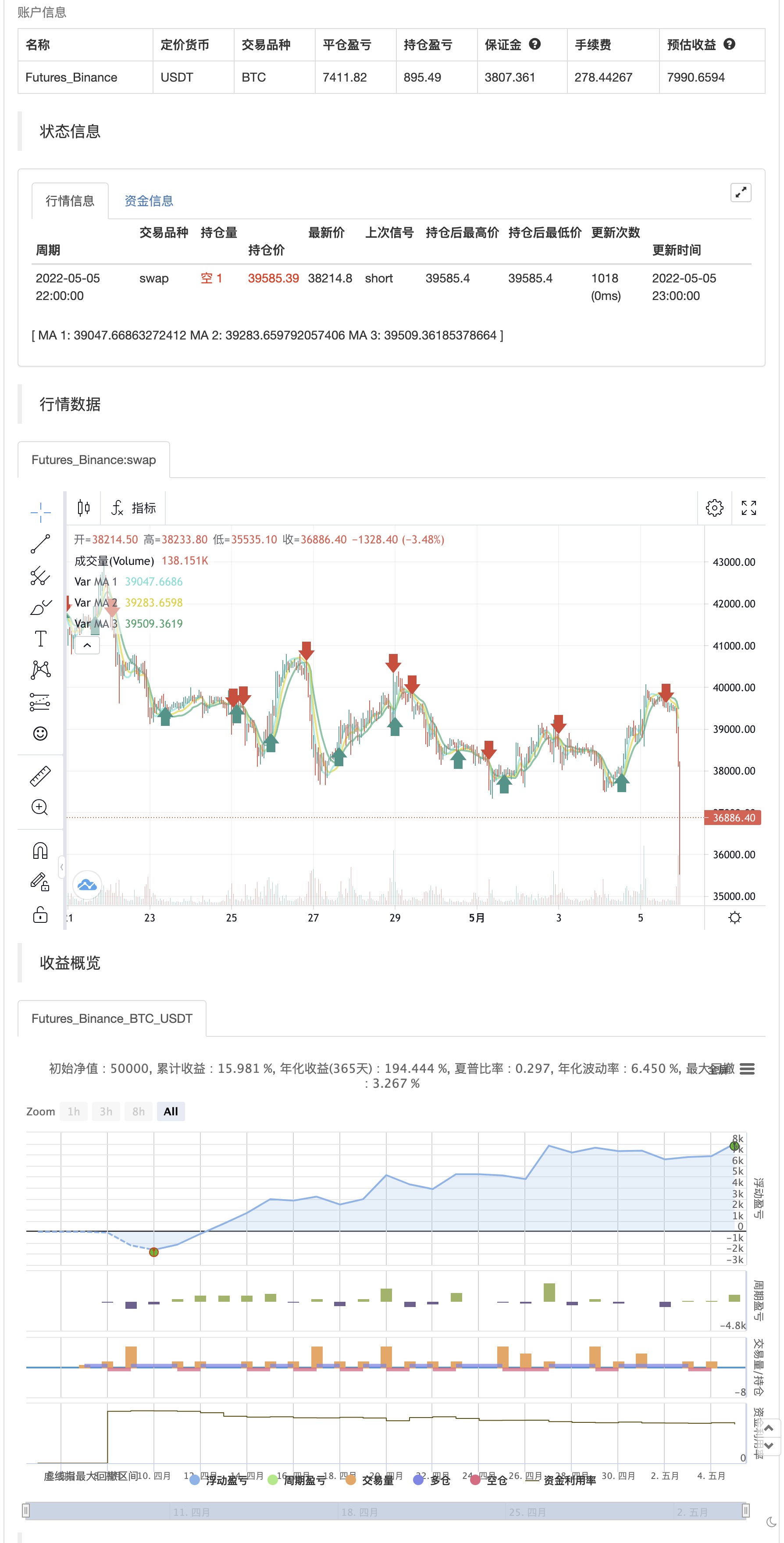
backtest
Parameters
| Name | Default | What it controls |
|---|---|---|
| v_input_1 | 0 | Type: LowPass | DEMA | EMA | Gaussian | Geometric_Mean | Butterworth_2Pole | McGuinley | SMA | Sine_WMA | Smoothed_MA | Super_Smoother | Triangular_MA | Wilders | Zero_Lag |
| v_input_2 | 8 | MA 1 |
| v_input_3 | 13 | MA 2 |
| v_input_4 | 21 | MA 3 |
| v_input_5 | 55 | MA 4 |
| v_input_6 | 89 | MA 5 |
| v_input_7 | 120 | IB |
| v_input_8 | 121 | 2B |
| v_input_9 | 200 | 21b |
| v_input_10 | 221 | 22b |
| v_input_11 | true | Enable 1 |
| v_input_12 | true | Enable 2 |
| v_input_13 | true | Enable 3 |
| v_input_14 | false | Enable 4 |
| v_input_15 | false | Enable 5 |
| v_input_16 | false | Enable 6 |
| v_input_17 | false | Enable 7 |
| v_input_18 | false | Enable x |
| v_input_19 | false | Enable x |
| v_input_20 | 3 | *** Gaussian poles *** |
Source Pine Script
/*backtest
start: 2022-04-06 00:00:00
end: 2022-05-05 23:59:00
period: 1h
basePeriod: 15m
exchanges: [{"eid":"Futures_Binance","currency":"BTC_USDT"}]
*/

//@version=3

study(title = "MA Emperor insiliconot" , shorttitle = "MA Emperor insiliconot", overlay=true, precision=8)

haClose = close
haOpen  = open
haHigh  = high
haLow   = low

haClose := (open + high + low + close) / 4
haOpen  := (nz(haOpen[1]) + nz(haClose[1])) / 2
haHigh  := max(high, max(haOpen, haClose))
haLow   := min(low , min(haOpen, haClose))

ssrc = close
ha = false

o = ha ? haOpen : open
c = ha ? haClose : close
h = ha ? haHigh : high
l = ha ? haLow : low

ssrc := ssrc == close ? ha ? haClose : c : ssrc
ssrc := ssrc == open ? ha ? haOpen : o : ssrc
ssrc := ssrc == high ? ha ? haHigh : h : ssrc
ssrc := ssrc == low ? ha ? haLow : l : ssrc
ssrc := ssrc == hl2 ? ha ? (haHigh + haLow) / 2 : hl2 : ssrc
ssrc := ssrc == hlc3 ? ha ? (haHigh + haLow + haClose) / 3 : hlc3 : ssrc
ssrc := ssrc == ohlc4 ? ha ? (haHigh + haLow + haClose+ haOpen) / 4 : ohlc4 : ssrc

type = input(defval = "LowPass", title = "Type", options = ["Butterworth_2Pole", "DEMA", "EMA", "Gaussian", "Geometric_Mean", "LowPass", "McGuinley", "SMA", "Sine_WMA", "Smoothed_MA", "Super_Smoother",  "Triangular_MA", "Wilders", "Zero_Lag"])

len1=input(8, title ="MA 1")
len2=input(13, title = "MA 2")
len3=input(21, title = "MA 3")
len4=input(55, title = "MA 4")
len5=input(89, title = "MA 5")
lenrib=input(120, title = "IB")
lenrib2=input(121, title = "2B")
lenrib3=input(200, title = "21b")
lenrib4=input(221, title = "22b")

onOff1  = input(defval=true, title="Enable 1")
onOff2  = input(defval=true, title="Enable 2")
onOff3  = input(defval=true, title="Enable 3")
onOff4  = input(defval=false, title="Enable 4")
onOff5  = input(defval=false, title="Enable 5")
onOff6  = input(defval=false, title="Enable 6")
onOff7  = input(defval=false, title="Enable 7")
onOff8  = input(defval=false, title="Enable x")
onOff9  = input(defval=false, title="Enable x")


gauss_poles = input(3, "*** Gaussian poles ***",  minval = 1, maxval = 14)
linew = 2
shapes = false


variant_supersmoother(src,len) =>
    Pi = 2 * asin(1)
    a1 = exp(-1.414* Pi / len)
    b1 = 2*a1*cos(1.414* Pi / len)
    c2 = b1
    c3 = (-a1)*a1
    c1 = 1 - c2 - c3
    v9 = 0.0
    v9 := c1*(src + nz(src[1])) / 2 + c2*nz(v9[1]) + c3*nz(v9[2])
    v9

variant_smoothed(src,len) =>
    v5 = 0.0
    v5 := na(v5[1]) ? sma(src, len) : (v5[1] * (len - 1) + src) / len
    v5

variant_zerolagema(src, len) =>
    price = src
    l = (len - 1) / 2
    d = (price + (price - price[l]))
    z = ema(d, len)
    z

variant_doubleema(src,len) =>
    v2 = ema(src, len)
    v6 = 2 * v2 - ema(v2, len)
    v6

variant_WiMA(src, length) =>
    MA_s= nz(src)
    MA_s:=(src + nz(MA_s[1] * (length-1)))/length
    MA_s

fact(num)=>
    a = 1
    nn = num <= 1 ? 1 : num
    for i = 1 to nn
        a := a * i
    a

getPoles(f, Poles, alfa)=>
    filt = f
    sign = 1
    results = 0 + n//tv series spoofing
    for r = 1 to max(min(Poles, n),1)
	    mult  = fact(Poles) / (fact(Poles - r) * fact(r))
	    matPo = pow(1 - alfa, r)
        prev  = nz(filt[r-1],0)
        sum   =  sign * mult * matPo * prev
        results := results + sum
        sign  := sign * -1
    results := results - n
    results

variant_gauss(Price, Lag, Poles)=>
    Pi = 2 * asin(1)
    beta = (1 - cos(2 * Pi / Lag)) / ( pow (sqrt(2), 2.0 / Poles) - 1)
    alfa = -beta + sqrt(beta * beta +  2 * beta)
    pre = nz(Price, 0) * pow(alfa, Poles)
    filter = pre
    result = n > 0 ?  getPoles(nz(filter[1]), Poles, alfa) : 0
    filter := pre + result

variant_mg(src, len)=>
    mg = 0.0
    mg := na(mg[1]) ? ema(src, len) : mg[1] + (src - mg[1]) / (len * pow(src/mg[1], 4))
    mg

variant_sinewma(src, length) =>
    PI = 2 * asin(1)
    sum = 0.0
    weightSum = 0.0
    for i = 0 to length - 1
        weight = sin(i * PI / (length + 1))
        sum := sum + nz(src[i]) * weight
        weightSum := weightSum + weight
    sinewma = sum / weightSum
    sinewma

variant_geoMean(price, per)=>
    gmean = pow(price, 1.0/per)
    gx = for i = 1 to per-1
        gmean := gmean * pow(price[i], 1.0/per)
        gmean
    ggx = n > per? gx : price
    ggx


variant_butt2pole(pr, p1)=>
    Pi = 2 * asin(1)
    DTR = Pi / 180
    a1 = exp(-sqrt(2) * Pi / p1)
    b1 = 2 * a1 * cos(DTR * (sqrt(2) * 180 / p1))
    cf1 = (1 - b1 + a1 * a1) / 4
    cf2 = b1
    cf3 = -a1 * a1
    butt_filt = pr
    butt_filt := cf1 * (pr + 2 * nz(pr[1]) + nz(pr[2])) + cf2 * nz(butt_filt[1]) + cf3 * nz(butt_filt[2])

variant_lowPass(src, len)=>
    LP = src
    sr = src
    a = 2.0 / (1.0 + len)
    LP := (a - 0.25 * a * a) * sr + 0.5 * a * a * nz(sr[1]) - (a - 0.75 * a * a) * nz(sr[2]) + 2.0 * (1.0 - a) * nz(LP[1]) - (1.0 - a) * (1.0 - a) * nz(LP[2])
    LP


variant_sma(src, len) =>
    sum = 0.0
    for i = 0 to len - 1
        sum := sum + src[i] / len
    sum

variant_trima(src, length) =>
    len = ceil((length + 1) * 0.5)
    trima =  sum(sma(src, len), len)/len
    trima


variant(type, src, len) =>
      type=="EMA"   ? ema(src, len) :
      type=="LowPass" ? variant_lowPass(src, len) :
      type=="Linreg"  ? linreg(src, len, 0) :
      type=="Gaussian"  ? variant_gauss(src, len, gauss_poles) :
      type=="Sine_WMA"  ? variant_sinewma(src, len) :

      type=="Geometric_Mean"  ? variant_geoMean(src, len) :

      type=="Butterworth_2Pole" ? variant_butt2pole(src, len) :
      type=="Smoothed_MA"  ? variant_smoothed(src, len) :
      type=="Triangular_MA"  ? variant_trima(src, len) :
      type=="McGuinley" ? variant_mg(src, len) :
      type=="DEMA"  ? variant_doubleema(src, len):
      type=="Super_Smoother"  ? variant_supersmoother(src, len) :
      type=="Zero_Lag"  ? variant_zerolagema(src, len) :
      type=="Wilders"? variant_WiMA(src, len) : variant_sma(src, len)


c1=#44E2D6
c2=#DDD10D
c3=#0AA368
c4=#E0670E
c5=#AB40B2

cRed = #F93A00


ma1 =  variant(type, ssrc, len1)
ma2 =  variant(type, ssrc, len2)
ma3 =  variant(type, ssrc, len3)
ma4 =  variant(type, ssrc, len4)
ma5 =  variant(type, ssrc, len5)
ma6 =  variant(type, ssrc, lenrib)
ma7 =  variant(type, ssrc, lenrib2)
ma8 =  variant(type, ssrc, lenrib3)
ma9 =  variant(type, ssrc, lenrib4)

col1 = c1
col2 = c2
col3 = c3
col4 = c4
col5 = c5

p1 = plot(onOff1 ? ma1 : na, title = "MA 1",  color = col1,  linewidth = linew, style = linebr)
p2 = plot(onOff2 ? ma2 : na, title = "MA 2",  color = col2,  linewidth = linew, style = linebr)
p3 = plot(onOff3 ? ma3 : na, title = "MA 3",  color = col3,  linewidth = linew, style = linebr)
p4 = plot(onOff4 ? ma4 : na, title = "MA 4",  color = col4,  linewidth = linew, style = linebr)
p5 = plot(onOff5 ? ma5 : na, title = "MA 5",  color = col5,  linewidth = linew, style = linebr)
p6 = plot(onOff6 ? ma6 : na, title = "MA 6",  color = col5,  linewidth = linew, style = linebr)
p7 = plot(onOff7 ? ma7 : na, title = "MA 7",  color = col5,  linewidth = linew, style = linebr)
p8 = plot(onOff8 ? ma8 : na, title = "MA 8",  color = col5,  linewidth = linew, style = linebr)
p9 = plot(onOff9 ? ma9 : na, title = "MA 9",  color = col5,  linewidth = linew, style = linebr)

longCond = crossover(ma2, ma3)
shortCond = crossunder(ma2, ma3)

plotshape(series=longCond, title="P", style=shape.triangleup, location=location.belowbar, color=green, text="P", size=size.small)
plotshape(series=shortCond, title="N", style=shape.triangledown, location=location.abovebar, color=red, text="N", size=size.small)


if longCond
    strategy.entry("Enter Long", strategy.long)
else if shortCond
strategy.entry("Enter Short", strategy.short)Published by ChaoZhang on the FMZ strategy square · last modified 2022-05-08. Collected in the Quant Trading Vault. Unvalidated research: re-test with your own data and costs before trusting it.
Build this with AgenKit
A spec is not a trading system. Paste this into your coding agent and AgenKit runs a specialist team — architecture, test-first build, risk gates, review — with paper trading on by default.
/agenkit build a production-grade trading bot with a backtest engine, risk controls and paper trading by default from strategies/MA-Emperor-insiliconot.md- npx agenkit install engineering-kit in your project
- Paste the command into your agent and approve each phase
- Get tests, backtest, risk controls and a paper-trading switch
Understand it first
Before you run this, read the lesson behind the idea and how to backtest it honestly. Specs like this one are the survivors of an unknown number of trials; deflate their results accordingly.
Related specs
- Incremental Order Size Fibonacci Retracement Trend Following StrategyPine Script · Trend following · 1d
- Volatility Trend Tracking StrategyPine Script · Trend following · 1h
- DPO EMA Trend Crossover Quantitative Strategy ResearchPine Script · Trend following · 1d
- Dynamic ATR Trailing Stop with EMA Cross Combination StrategyPine Script · Trend following · 2h
- Dynamic Moving Average Tracking Strategy 433137Pine Script · Trend following · 1d
- Fibonacci Moving Averages Input StrategyPine Script · Trend following · 1d