MACD Crossover Momentum Strategy with Dynamic Take Profit and Stop Loss Optimization
The MACD Crossover Momentum Strategy with Dynamic Take Profit and Stop Loss Optimization is a quantitative trading approach that combines the Moving Average Convergence Divergence (MACD) indicator with a flexible…
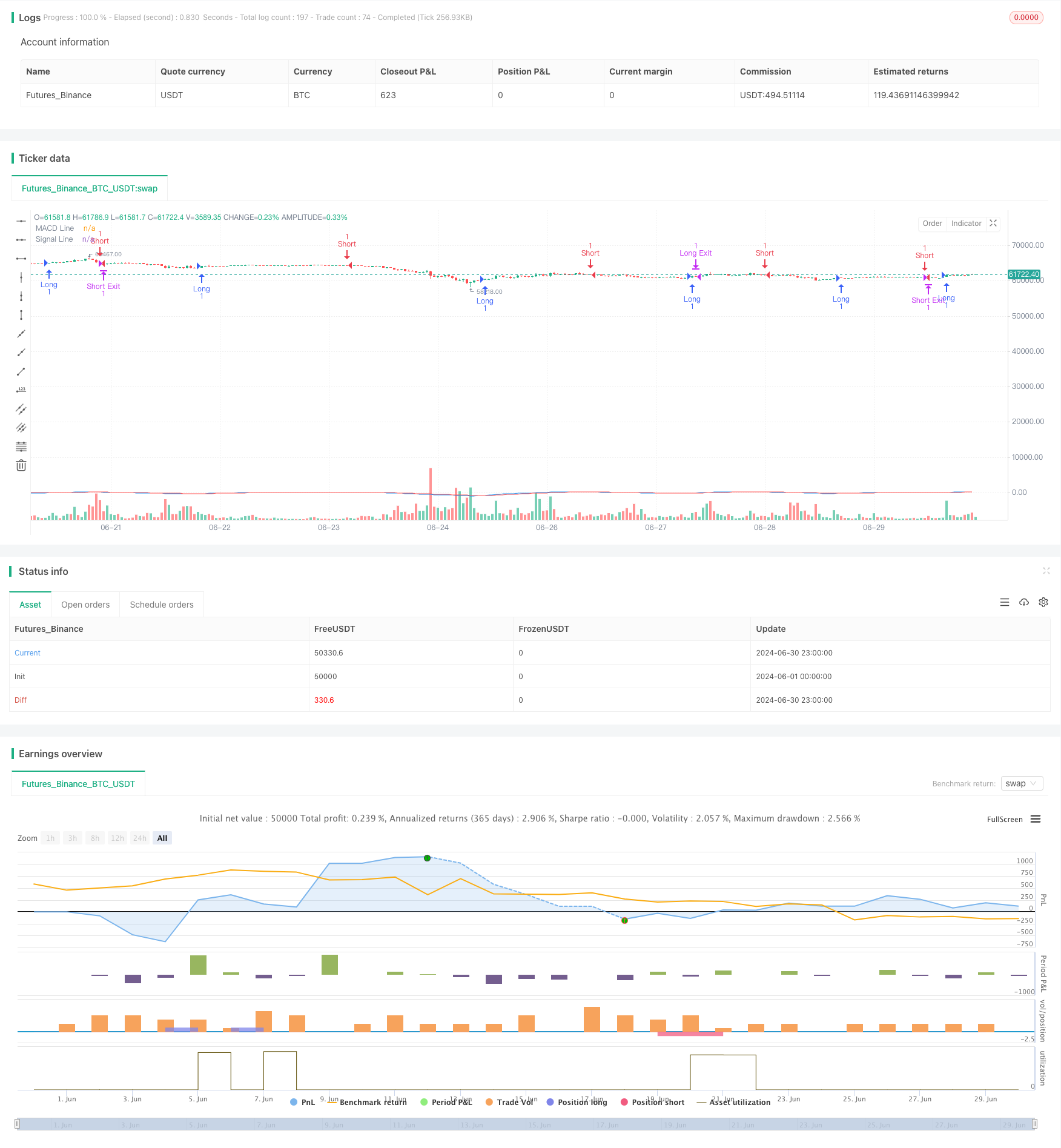
Overview
The MACD Crossover Momentum Strategy with Dynamic Take Profit and Stop Loss Optimization is a quantitative trading approach that combines the Moving Average Convergence Divergence (MACD) indicator with a flexible risk management mechanism. This strategy utilizes MACD crossover signals to identify potential trend changes while implementing dynamic take profit and stop loss points to optimize the risk-reward ratio of trades. The approach aims to capture market momentum while providing clear exit strategies for each trade.
Strategy Principles
The core principle of this strategy is based on MACD signal line crossovers:
MACD Calculation:
- Uses a 12-period fast Exponential Moving Average (EMA) and a 26-period slow EMA
- MACD Line = Fast EMA - Slow EMA
- Signal Line = 9-period EMA of the MACD Line
Entry Signals:
- Long Entry: MACD Line crosses above the Signal Line
- Short Entry: MACD Line crosses below the Signal Line
Exit Strategy:
- Sets fixed point take profit and stop loss levels
- For Long Trades: Take Profit = Entry Price + 100 points; Stop Loss = Entry Price - 50 points
- For Short Trades: Take Profit = Entry Price - 100 points; Stop Loss = Entry Price + 50 points
The strategy uses the ta.macd() function to calculate the MACD indicator, and ta.crossover() and ta.crossunder() functions to detect crossover signals. Trade execution is handled through strategy.entry() and strategy.exit() functions.
Strategy Advantages
Trend Following: The MACD indicator helps identify and follow market trends, increasing the probability of capturing major moves.
Momentum Capture: Through MACD crossover signals, the strategy can promptly enter emerging market momentum.
Risk Management: Preset take profit and stop loss points provide clear risk control for each trade.
Flexibility: Strategy parameters can be adjusted for different markets and timeframes.
Automation: The strategy can be executed automatically on trading platforms, reducing emotional interference.
Objectivity: Signal generation based on technical indicators eliminates subjective judgment, improving trading consistency.
Strategy Risks
False Breakouts: In ranging markets, MACD may produce frequent false breakout signals, leading to overtrading.
Lag: As a lagging indicator, MACD may react too slowly in fast-reversing markets.
Fixed Stop Loss: Using fixed point values for stop losses may not be suitable for all market conditions, especially when volatility changes.
Parameter Sensitivity: Strategy performance is highly dependent on the chosen EMA and signal line parameters.
Market Adaptability: The strategy may perform well in certain market environments but poorly in others.
Over-optimization: There's a risk of overfitting to historical data during backtesting.
Strategy Optimization Directions
Dynamic Stop Loss: Implement ATR (Average True Range) to adjust stop loss points, adapting to current market volatility.
Multi-Timeframe Analysis: Incorporate longer-term trend analysis to improve the reliability of entry signals.
Filters: Add additional technical indicators or price action patterns as filters to reduce false signals.
Position Sizing: Implement dynamic position sizing, adjusting trade size based on market volatility and account risk.
Market State Recognition: Develop algorithms to identify trending/ranging markets and adjust strategy parameters accordingly.
Machine Learning Optimization: Use machine learning algorithms to dynamically optimize MACD parameters, improving strategy adaptability.
Conclusion
The MACD Crossover Momentum Strategy with Dynamic Take Profit and Stop Loss Optimization is a quantitative trading approach that combines technical analysis with risk management. By leveraging the trend-following and momentum-capturing capabilities of the MACD indicator while implementing clear take profit and stop loss rules, the strategy aims to capture market opportunities while controlling risk. However, like all trading strategies, it is not without flaws. Traders need to be aware of potential risks such as false breakouts, lag, and market adaptability. By introducing optimizations like dynamic stop losses, multi-timeframe analysis, and market state recognition, the strategy's robustness and adaptability can be further enhanced. Overall, this strategy framework provides a solid starting point for quantitative traders, worthy of in-depth research and continuous optimization.
Source Pine Script
/*backtest
start: 2024-06-01 00:00:00
end: 2024-06-30 23:59:59
period: 1h
basePeriod: 15m
exchanges: [{"eid":"Futures_Binance","currency":"BTC_USDT"}]
*/

//@version=5
strategy("MACD Strategy", overlay=true)

// Input parameters
fast_length = input.int(12, title="Fast EMA Length")
slow_length = input.int(26, title="Slow EMA Length")
signal_length = input.int(9, title="Signal Line Length")

target_points = input.int(100, title="Target Points")
stop_loss_points = input.int(50, title="Stop Loss Points")

// Calculate MACD
[macd_line, signal_line, _] = ta.macd(close, fast_length, slow_length, signal_length)

// Strategy logic
long_condition = ta.crossover(macd_line, signal_line)
short_condition = ta.crossunder(macd_line, signal_line)

// Plot MACD
plot(macd_line, color=color.blue, title="MACD Line")
plot(signal_line, color=color.red, title="Signal Line")

// Strategy entry and exit
if long_condition
    strategy.entry("Long", strategy.long)
if short_condition
    strategy.entry("Short", strategy.short)

// Calculate target and stop loss levels
long_target = strategy.position_avg_price + target_points
long_stop_loss = strategy.position_avg_price - stop_loss_points
short_target = strategy.position_avg_price - target_points
short_stop_loss = strategy.position_avg_price + stop_loss_points

// Strategy exit
strategy.exit("Long Exit", "Long", limit=long_target, stop=long_stop_loss)
strategy.exit("Short Exit", "Short", limit=short_target, stop=short_stop_loss)
Published by ChaoZhang on the FMZ strategy square · last modified 2024-07-29. Collected in the Quant Trading Vault. Unvalidated research: re-test with your own data and costs before trusting it.
Build this with AgenKit
A spec is not a trading system. Paste this into your coding agent and AgenKit runs a specialist team — architecture, test-first build, risk gates, review — with paper trading on by default.
/agenkit build a production-grade trading bot with a backtest engine, risk controls and paper trading by default from strategies/MACD-Crossover-Momentum-Strategy-with-Dynamic-Take-Profit-and-Stop-Loss-Optimization.md- npx agenkit install engineering-kit in your project
- Paste the command into your agent and approve each phase
- Get tests, backtest, risk controls and a paper-trading switch
Understand it first
Before you run this, read the lesson behind the idea and how to backtest it honestly. Specs like this one are the survivors of an unknown number of trials; deflate their results accordingly.
Related specs
- Advanced Multi Indicator Trend Following and Momentum Quantitative Trading StrategyPine Script · Momentum · 1h
- KST EMA Momentum Trend Following StrategyPine Script · Momentum · 1d
- MACD Indicator Driven OBV Quant Trading StrategyPine Script · Momentum · 1h
- MACD Momentum Indicator Backtest StrategyPine Script · Momentum · 1h
- MACD of Relative Strength StrategyPine Script · Momentum · 1d
- Momentum Exponential Moving Average Crossover Trading StrategyPine Script · Momentum · 1d