Strategy vault / Mean reversion
MACD Strategy Two Way Exit Trading
This strategy uses the Moving Average Convergence Divergence (MACD) indicator to generate long and short signals and makes reversal trades under good trend conditions by dynamically setting exit points to capture…
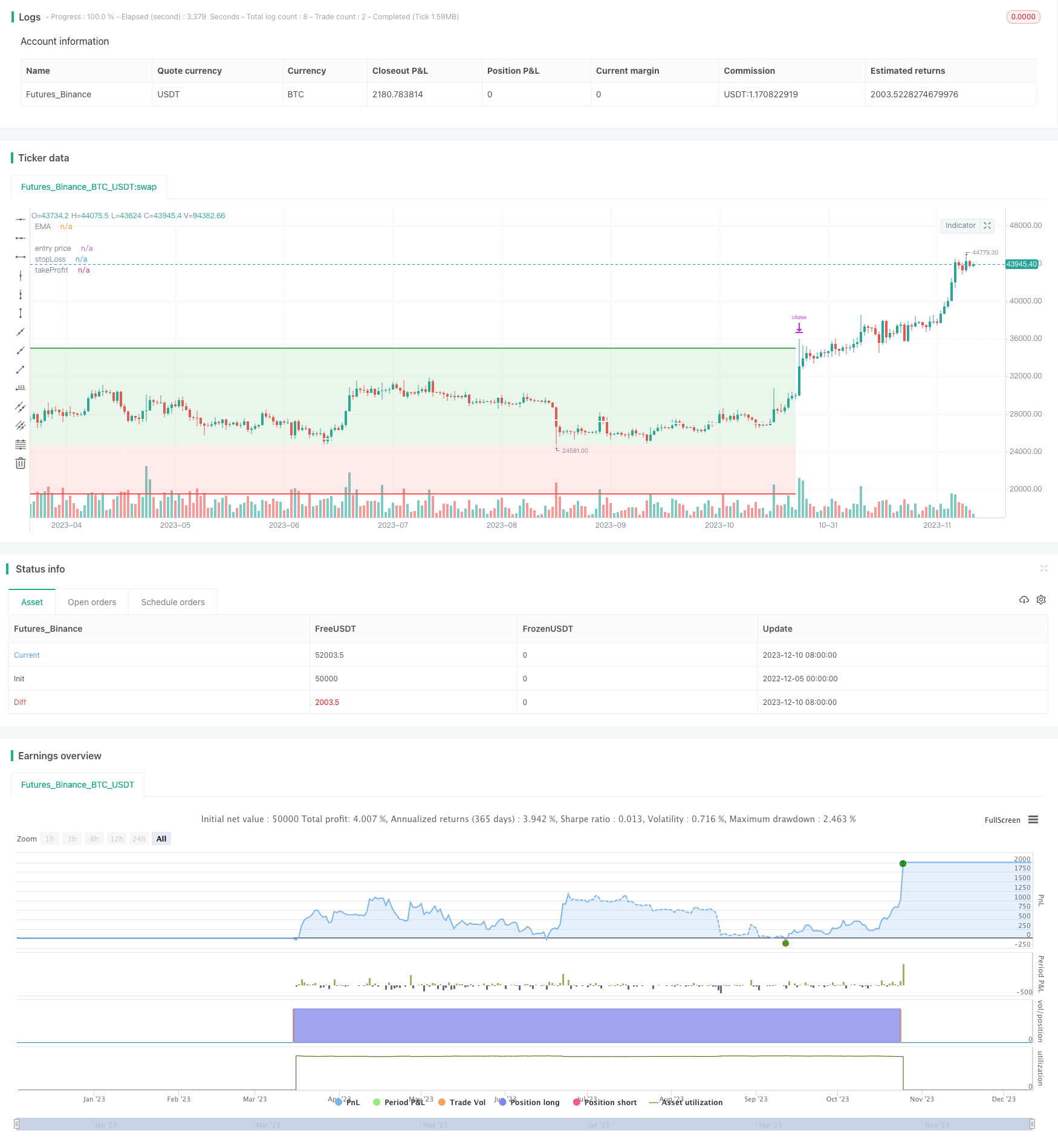
Overview
This strategy uses the Moving Average Convergence Divergence (MACD) indicator to generate long and short signals and makes reversal trades under good trend conditions by dynamically setting exit points to capture profits.
Strategy Principles
The core of this strategy is based on the MACD golden cross for long signals and death cross for short signals. Specifically, when the MACD line crosses above the signal line from below, a golden cross is generated as a long signal; when the MACD line crosses below the signal line from above, a death cross is generated as a short signal.
On golden cross signals, go long if the close price is above the EMA; on death cross signals, go short if the close price is below the EMA. This ensures reversal trades under an upward trend.
After entering positions, the strategy utilizes stop loss and take profit to dynamically control exits. Specifically, the stop loss for long positions is set at entry price * (1 - max drawdown); take profit is set at entry price * (1 + TARGET_STOP_RATIO * max drawdown). Vice versa for short positions. Here max drawdown is dynamically calculated as the percentage of price decline from swing low to close; TARGET_STOP_RATIO is default to 2, meaning a risk/reward ratio of 2.
The advantage of this dynamic stop strategy is that it can adjust stop loss and risk/reward ratio based on market volatility. It exits fast with a tight stop loss during high volatility while tracks profit with loose stop during low volatility environments.
Advantages
MACD is an effective indicator for identifying reversal opportunities.
The EMA filter ensures long trades happen only in an upward trend market.
The dynamic exit control system maximizes profit while effectively manages risk.
Fast exist speed reduces required monitoring time, making it suitable for busy investors.
Risks and Solutions
MACD oscillates frequently during sideways markets, generating fake signals. This is solved by adding EMA filter to avoid counter-trend trades.
Extreme volatility can cause DYNAMIC STOP to be too loose. Consider fixed risk/reward ratio when facing extreme market moves.
Limited profit margin per trade requires frequent trading. Investors need certain psychological endurance and time commitment. Can switch to higher time frames if too busy.
Optimization Directions
Fine tune MACD parameters based on symbol characteristics to optimize signal quality.
Test different moving averages as trend filter to find the optimal one.
Test TARGET_STOP_RATIO calculation and max drawdown definition to optimize the exit strategy.
Add other factors like volume, volatility etc. to improve signal quality.
Explore machine learning models to extract more features and build adaptive multifactor models for smarter exits.
Conclusion
This strategy has strong practical value overall. With MACD as core trading signal, the add-on modules of trend filter and dynamic exit control can significantly improve MACD performance itself. Exit control is essential for strategy optimization and this strategy innovates substantially in this area. Well worth further research and application.
Parameters
| Name | Default | What it controls |
|---|---|---|
| v_input_1_close | 0 | Source: close | high | low | open | hl2 | hlc3 | hlcc4 | ohlc4 |
| v_input_float_1 | 2 | Risk/Reward |
| v_input_float_2 | 2 | Risk per Trade % |
| v_input_bool_1 | true | (?Backtest Time Period)Filter Date Range of Backtest |
| v_input_2 | timestamp(5 June 2022) | Start Date |
| v_input_3 | timestamp(5 July 2022) | End Date |
| v_input_int_1 | 200 | (?EMA)Length |
| v_input_int_2 | 7 | (?number of past candles)Swing High |
| v_input_int_3 | 7 | Swing Low |
| v_input_4 | 12 | (?MACD)Fast Length |
| v_input_5 | 26 | Slow Length |
| v_input_int_4 | 9 | Signal Smoothing |
| v_input_string_1 | 0 | Oscillator MA Type: EMA | SMA |
| v_input_string_2 | 0 | Signal Line MA Type: EMA | SMA |
Source Pine Script
/*backtest
start: 2022-12-05 00:00:00
end: 2023-12-11 00:00:00
period: 1d
basePeriod: 1h
exchanges: [{"eid":"Futures_Binance","currency":"BTC_USDT"}]
*/

// This source code is subject to the terms of the Mozilla Public License 2.0 at https://mozilla.org/MPL/2.0/
// © maxencetajet

//@version=5
strategy("MACD Strategy", overlay=true, initial_capital=1000, slippage=25)

src = input(title="Source", defval=close)
target_stop_ratio = input.float(title='Risk/Reward', defval=2, minval=0.5, maxval=100)
risk = input.float(2, title="Risk per Trade %")

riskt = risk / 100 + 1

useDateFilter = input.bool(true, title="Filter Date Range of Backtest",
     group="Backtest Time Period")
backtestStartDate = input(timestamp("5 June 2022"),
     title="Start Date", group="Backtest Time Period",
     tooltip="This start date is in the time zone of the exchange " +
     "where the chart's instrument trades. It doesn't use the time " +
     "zone of the chart or of your computer.")
backtestEndDate = input(timestamp("5 July 2022"),
     title="End Date", group="Backtest Time Period",
     tooltip="This end date is in the time zone of the exchange " +
     "where the chart's instrument trades. It doesn't use the time " +
     "zone of the chart or of your computer.")

inTradeWindow =  true
emaV = input.int(200, title="Length", group="EMA")
swingHighV = input.int(7, title="Swing High", group="number of past candles")
swingLowV = input.int(7, title="Swing Low", group="number of past candles")

ema = ta.ema(src, emaV)

fast_length = input(title="Fast Length", defval=12, group="MACD")
slow_length = input(title="Slow Length", defval=26, group="MACD")
signal_length = input.int(title="Signal Smoothing",  minval = 1, maxval = 50, defval = 9, group="MACD")
sma_source = input.string(title="Oscillator MA Type",  defval="EMA", options=["SMA", "EMA"], group="MACD")
sma_signal = input.string(title="Signal Line MA Type", defval="EMA", options=["SMA", "EMA"], group="MACD")

fast_ma = sma_source == "SMA" ? ta.sma(src, fast_length) : ta.ema(src, fast_length)
slow_ma = sma_source == "SMA" ? ta.sma(src, slow_length) : ta.ema(src, slow_length)
macd = fast_ma - slow_ma
signal = sma_signal == "SMA" ? ta.sma(macd, signal_length) : ta.ema(macd, signal_length)
hist = macd - signal

longcondition = close > ema and ta.crossover(macd, signal) and macd < 0
shortcondition = close < ema and ta.crossunder(macd, signal) and macd > 0

float risk_long = na
float risk_short = na
float stopLoss = na
float takeProfit = na
float entry_price = na

risk_long := risk_long[1]
risk_short := risk_short[1]

swingHigh = ta.highest(high, swingHighV)
swingLow = ta.lowest(low, swingLowV)

lotB = (strategy.equity*riskt-strategy.equity)/(close - swingLow)
lotS = (strategy.equity*riskt-strategy.equity)/(swingHigh - close)

if strategy.position_size == 0 and longcondition and inTradeWindow
    risk_long := (close - swingLow) / close
    strategy.entry("long", strategy.long, qty=lotB)

if strategy.position_size == 0 and shortcondition and inTradeWindow
    risk_short := (swingHigh - close) / close
    strategy.entry("short", strategy.short, qty=lotS)

if strategy.position_size > 0

    stopLoss := strategy.position_avg_price * (1 - risk_long)
    takeProfit := strategy.position_avg_price * (1 + target_stop_ratio * risk_long)
    entry_price := strategy.position_avg_price
    strategy.exit("long exit", "long", stop = stopLoss, limit = takeProfit)

if strategy.position_size < 0

    stopLoss := strategy.position_avg_price * (1 + risk_short)
    takeProfit := strategy.position_avg_price * (1 - target_stop_ratio * risk_short)
    entry_price := strategy.position_avg_price
    strategy.exit("short exit", "short", stop = stopLoss, limit = takeProfit)

plot(ema, color=color.white, linewidth=2, title="EMA")
p_ep = plot(entry_price, color=color.new(color.white, 0), linewidth=2, style=plot.style_linebr, title='entry price')
p_sl = plot(stopLoss, color=color.new(color.red, 0), linewidth=2, style=plot.style_linebr, title='stopLoss')
p_tp = plot(takeProfit, color=color.new(color.green, 0), linewidth=2, style=plot.style_linebr, title='takeProfit')
fill(p_sl, p_ep, color.new(color.red, transp=85))
fill(p_tp, p_ep, color.new(color.green, transp=85))
Published by ChaoZhang on the FMZ strategy square · last modified 2023-12-12. Collected in the Quant Trading Vault. Unvalidated research: re-test with your own data and costs before trusting it.
Build this with AgenKit
A spec is not a trading system. Paste this into your coding agent and AgenKit runs a specialist team — architecture, test-first build, risk gates, review — with paper trading on by default.
/agenkit build a production-grade trading bot with a backtest engine, risk controls and paper trading by default from strategies/MACD-Strategy-Two-Way-Exit-Trading.md- npx agenkit install engineering-kit in your project
- Paste the command into your agent and approve each phase
- Get tests, backtest, risk controls and a paper-trading switch
Understand it first
Before you run this, read the lesson behind the idea and how to backtest it honestly. Specs like this one are the survivors of an unknown number of trials; deflate their results accordingly.
Related specs
- Advanced 15 Minute Chart Trading Signal StrategyPine Script · Mean reversion · 3h
- BONK Multi Factor Trading StrategyPine Script · Mean reversion · 1d
- Customizable Non Repainting HTF MACD MFI Scalable Bot StrategyPine Script · Mean reversion · 1d
- Dynamic Adaptive Multi Timeframe Trend Following and Range Reversal Hybrid StrategyPine Script · Mean reversion · 2d
- MACD Cross Period Trading StrategyPine Script · Mean reversion · 1d
- MACD Double Optimization Trading StrategyPine Script · Mean reversion · 1d