Martingale Strategy with Expanded Moving Average Range for Stock Trading
This strategy identifies trends by expanding the interval between moving averages. When an upward trend is identified, it gradually builds up long positions to profit from the trend. At the same time, stop loss…
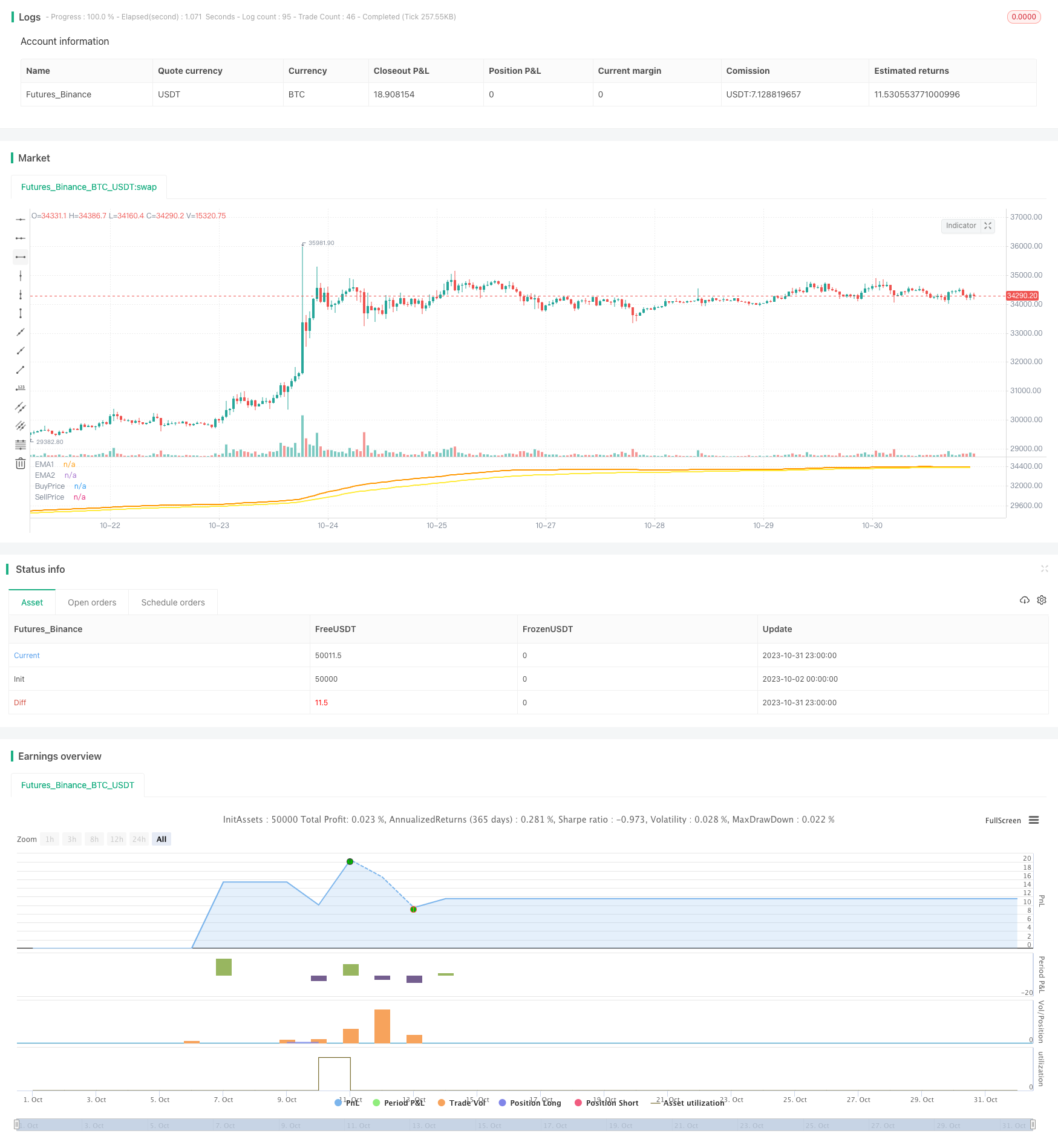
Overview
This strategy identifies trends by expanding the interval between moving averages. When an upward trend is identified, it gradually builds up long positions to profit from the trend. At the same time, stop loss points are set to control risks.
Strategy Logic
Set two moving averages, EMA1 and EMA2, with slightly different periods, e.g. 55 and 89. This creates a wider range between the MAs.
When price breaks above the MAs, it signals an upward trend. Long positions can then be gradually built up.
After taking a position, continue pyramiding when price keeps rising. This allows higher profits from the trend.
Set a stop loss point below the MAs. When price drops below the MA, close longs to stop loss. The stop loss floats up with entry price.
This allows pyramiding positions to profit from a trend, while setting a stop loss to control risks.
Advantage Analysis
The wider MA range helps clearly identify trends.
Pyramiding creates higher returns from trends.
Dynamic stop loss takes profits from trends while limiting losses.
Suitable for long-term trend trading.
Risk Analysis
Trend must be correctly identified, otherwise losses accelerate.
Pyramiding must be controlled to avoid margin call risks.
Stop loss must be reasonably set, too wide may expand losses, too tight may cause whipsaws.
Liquidity must be considered, low liquidity assets are unsuitable.
Optimization Suggestions
Add more indicators like RSI, KD to confirm trends and avoid false breakouts.
Optimize MA periods based on asset characteristics to find best combinations.
Research optimal pyramiding models to control position sizing risks.
Consider partial profit taking to lock in gains and reduce drawdowns.
Set stop loss based on asset volatility to balance protection and avoiding whipsaws.
Summary
This strategy identifies trends with wider MA range, pyramids positions to profit from trends, and sets a floating stop loss to control risks. It can achieve good returns in trends, but needs further optimization on entry signals, pyramiding, stop loss etc. to become more robust across different assets.
Parameters
| Name | Default | What it controls |
|---|---|---|
| v_input_1 | 55 | EMA1 |
| v_input_2 | 89 | EMA2 |
| v_input_3 | 6 | Max open Orders |
| v_input_4 | 2 | Multiplier |
| v_input_5 | true | BuyLvl |
| v_input_6 | 3 | Profit |
| v_input_7 | 2 | DoubleUpLimit |
| v_input_8 | true | From Day |
| v_input_9 | true | From Month |
| v_input_10 | 2019 | From Year |
| v_input_11 | true | To Day |
| v_input_12 | true | To Month |
| v_input_13 | 2020 | To Year |
| v_input_14 | false | RSIFilter |
| v_input_15 | 35 | RSI |
| v_input_16 | 14 | lengthRSI |
| v_input_17_close | 0 | RSI Source: close | high | low | open | hl2 | hlc3 | hlcc4 | ohlc4 |
| v_input_18 | false | StochRSIFilter |
| v_input_19 | 14 | lengthStoch |
| v_input_20 | 3 | smoothK |
| v_input_21 | 3 | smoothD |
Source Pine Script
/*backtest
start: 2023-10-02 00:00:00
end: 2023-11-01 00:00:00
period: 1h
basePeriod: 15m
exchanges: [{"eid":"Futures_Binance","currency":"BTC_USDT"}]
*/

//@version=2
// strategy(title='Super Simple Martingale Buying', shorttitle="Martingale v5",overlay=true, pyramiding = 10, initial_capital=1, calc_on_order_fills = true)


// Revision:        1
// Author:          @ToS_MavericK

// === INPUT SMA ===
EMA1  = input(55)
EMA2  = input(89)

Amount  = input(defval = 6, type = float, title = "Max open Orders", minval = 1, step = 1)
Multiplier  = input(defval = 2  , type = float, title = "Multiplier", minval = 1, step = 0.1)
BuyLvl  = input(defval = 1, type = float, title = "BuyLvl", minval = 0, step = 0.1)
Profit  = input(3)
DoubleUpLimit    = input(2)

// === INPUT BACKTEST RANGE ===
FromDay = input(defval = 1, title = "From Day", minval = 1, maxval = 31)
FromMonth   = input(defval = 1, title = "From Month", minval = 1, maxval = 12)
FromYear    = input(defval = 2019, title = "From Year", minval = 2012)
ToDay   = input(defval = 1, title = "To Day", minval = 1, maxval = 31)
ToMonth = input(defval = 1, title = "To Month", minval = 1, maxval = 12)
ToYear  = input(defval = 2020, title = "To Year", minval = 2012)

RSIFilter = input(false)
minRSI  = input(defval = 35,  title = "RSI", minval = 1, step = 1)
lengthRSI = input(14, minval=1)
src = input(close, title="RSI Source")

StochRSIFilter = input(false)
lengthStoch = input(14, minval=1)
smoothK = input(3, minval=1)
smoothD = input(3, minval=1)

rsi = rsi(src, lengthRSI)
k = sma(stoch(rsi, rsi, rsi, lengthStoch), smoothK)
d = sma(k, smoothD)

// === FUNCTION EXAMPLE ===
start     = timestamp(FromYear, FromMonth, FromDay, 00, 00)  // backtest start window
finish    = timestamp(ToYear, ToMonth, ToDay, 23, 59)        // backtest finish window
window()  => true // create function "within window of time"

// === SERIES SETUP ===
vEMA1 = ema(close, EMA1)
vEMA2 = ema(close, EMA2)

buy  =  (rsi < minRSI or RSIFilter == false) and ((crossover(k,d) and k < 20) or StochRSIFilter == false) and ((close < vEMA1 * (1 - BuyLvl/100) and vEMA1 < vEMA2) or (close < vEMA2 * (1 - BuyLvl/100) and vEMA2 < vEMA1))

BuyPrice = strategy.position_avg_price * (1 - DoubleUpLimit/50)
SellPrice = strategy.position_avg_price * (1 + Profit/(100*strategy.opentrades))

// Exit first, due to the limit orders, which can be hit on the same bar
strategy.exit("EMA1", limit = SellPrice, when = window() and strategy.opentrades > 0)
strategy.close("EMA1",when = time > finish) // close positions at the end of the specified time period

// Normal entry
strategy.entry("EMA1", strategy.long,qty = strategy.equity/ (close * pow(2,Amount - 1)), when = window() and strategy.opentrades == 0 and buy)
// Martingale
strategy.entry("EMA1", strategy.long,qty = strategy.position_size, limit = strategy.position_avg_price * (1 - DoubleUpLimit/100), when = window() and strategy.opentrades == 1)
strategy.entry("EMA1", strategy.long,qty = strategy.position_size, limit = BuyPrice, when = window() and strategy.opentrades > 1 and strategy.opentrades < Amount)

plot(vEMA1, title = 'EMA1', color = orange, linewidth = 2, style = line)
plot(vEMA2, title = 'EMA2', color = yellow, linewidth = 2, style = line)
plot(BuyPrice[1], title = 'BuyPrice', color = red, linewidth = 2, style = line)
plot(SellPrice[1], title = 'SellPrice', color = green, linewidth = 2, style = line)Published by ChaoZhang on the FMZ strategy square · last modified 2023-11-02. Collected in the Quant Trading Vault. Unvalidated research: re-test with your own data and costs before trusting it.
Build this with AgenKit
A spec is not a trading system. Paste this into your coding agent and AgenKit runs a specialist team — architecture, test-first build, risk gates, review — with paper trading on by default.
/agenkit build a production-grade trading bot with a backtest engine, risk controls and paper trading by default from strategies/Martingale-Strategy-with-Expanded-Moving-Average-Range-for-Stock-Trading.md- npx agenkit install engineering-kit in your project
- Paste the command into your agent and approve each phase
- Get tests, backtest, risk controls and a paper-trading switch
Understand it first
Before you run this, read the lesson behind the idea and how to backtest it honestly. Specs like this one are the survivors of an unknown number of trials; deflate their results accordingly.
Related specs
- Bollinger Bands and RSI indicators strategyPine Script · Martingale · 2h
- MACD KDJ Combined Martingale Pyramiding Quantitative Trading StrategyPine Script · Martingale · 1h
- Multiple Indicator Quantitative Trading StrategyPine Script · Martingale · 1h
- RSI and Moving Average Combination MT5 Martingale Scalping StrategyPine Script · Martingale · 1d
- Diversified Indicators Aggregation StrategyPine Script · Martingale · 1d
- 20Bitcoin and Gold 5 Minute Scalping Strategy 20Pine Script · Scalping · 1h