Strategy vault / Mean reversion
Mean Reversion Envelope Moving Average Strategy
The Mean Reversion Envelope Moving Average Strategy is a mean reversion trading strategy based on moving averages. It uses Double Exponential Moving Average (DEMA) as the base calculation and adds several envelopes…
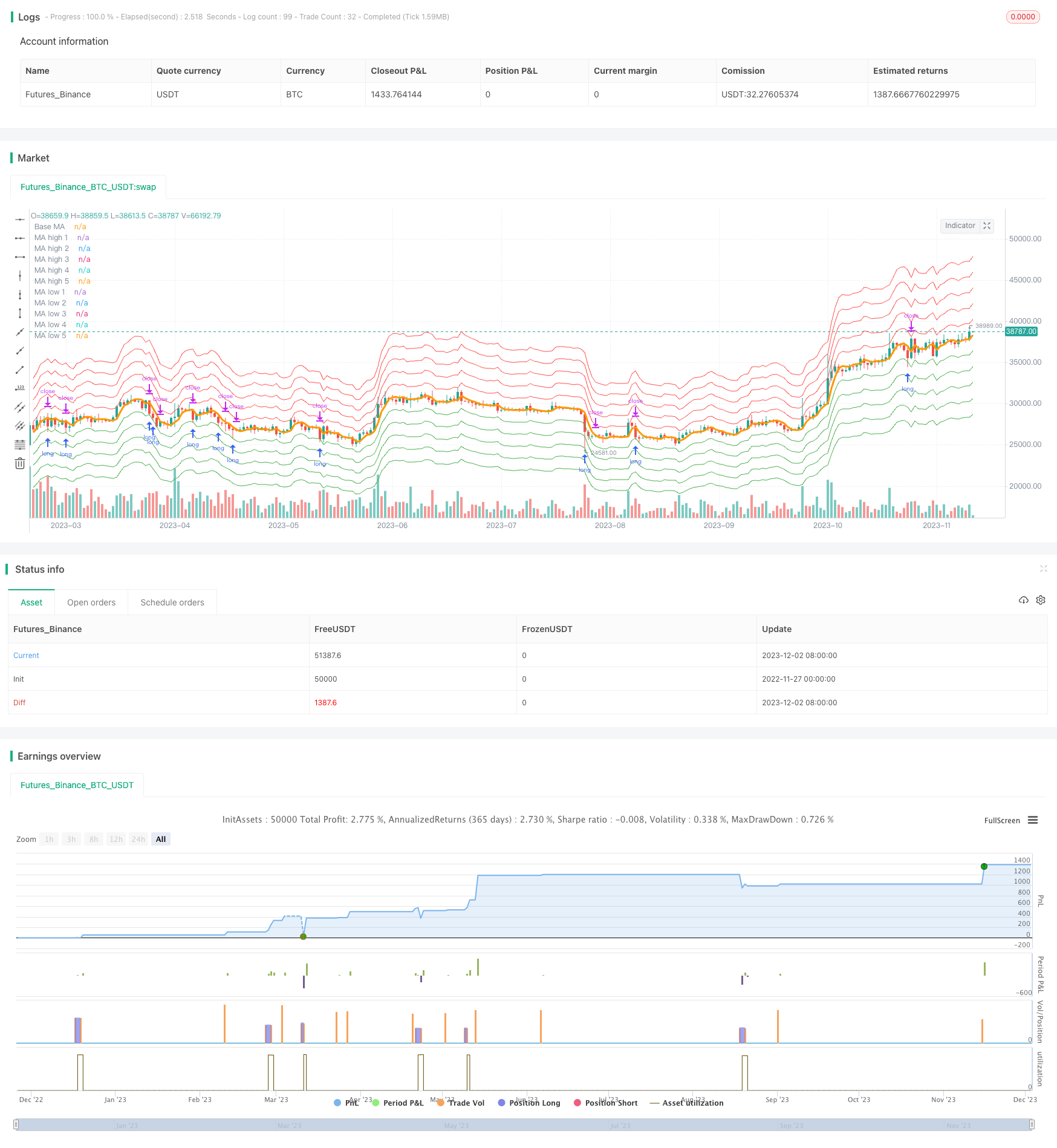
Overview
The Mean Reversion Envelope Moving Average Strategy is a mean reversion trading strategy based on moving averages. It uses Double Exponential Moving Average (DEMA) as the base calculation and adds several envelopes above and below it. When the price touches the envelope bands, it opens long or short positions based on the direction. When the price regresses to the moving average, it closes all positions.
Strategy Logic
The strategy uses Double Exponential Moving Average (DEMA) as the base indicator, which is a moving average that is more sensitive to recent price changes. Above and below the DEMA, several price bands are added to form an envelope zone. The range of the envelope is set by the user, with a fixed percentage interval between each band.
When the price rises and approaches the upper envelope band, the strategy opens a short position. When the price falls and hits the lower envelope band, it opens a long position. It adds a new position each time when a new price band is touched. When the price regresses close to the moving average, all positions are closed.
Through capturing excessive price fluctuations with the envelope bands and profiting from reversals, the strategy aims to buy low and sell high. It fits market cycles with obvious mean reversion tendencies, such as cryptocurrencies like Bitcoin.
Advantages
- Uses Double Exponential Moving Average, which is sensitive to short-term price changes for catching trend reversals.
- The envelope bands around moving average can accurately capture price reversals.
- Opens positions in batches, fully utilizing capital efficiency.
- Quickly switch directions after profiting to adapt to market changes.
- Parameters can be freely optimized.
Risks
- Unable to profit from strongly trending markets.
- Improper parameters may cause over-trading.
- Needs relatively stable markets, not suitable for highly volatile environments.
- Too narrow envelopes may prevent entering positions.
The risks can be reduced by appropriately expanding the envelope range to increase sensitivity and adjusting the moving average length to fit different market cycles.
Optimization Directions
The strategy can be optimized in the following aspects:
Test different moving average algorithms.
Adjust the moving average length parameter for better adapting to short-term fluctuations.
Optimize the envelope parameters by testing different percentage settings.
Add stop loss methods like trailing stop loss to limit single trade loss.
Add filtering conditions with other indicators to avoid invalid entries in irrational markets.
Conclusion
The Mean Reversion Envelope Moving Average Strategy effectively captures mean reversion opportunities by building a price channel around the moving average. It can be flexibly adapted to different market environments through parameter adjustments. With relatively low transaction costs and high returns, this is a recommended quantitative trading strategy.
Parameters
| Name | Default | What it controls |
|---|---|---|
| v_input_1_close | 0 | (?Moving Average)Moving Average Source: close | high | low | open | hl2 | hlc3 | hlcc4 | ohlc4 |
| v_input_int_1 | 5 | Moving Average Window |
| v_input_string_1 | 0 | Moving Average Type: 4. DEMA | 2. EMA | 3. RMA | 1. SMA |
| v_input_float_1 | 0.05 | (?Envelope)Delta Per Enveloppe |
| v_input_int_2 | 0 | Envelope count: 5 | 2 | 3 | 4 | 1 |
| v_input_bool_1 | true | (?Orders)Use Long Orders ? |
| v_input_bool_2 | false | Use Short Orders ? |
Source Pine Script
/*backtest
start: 2022-11-27 00:00:00
end: 2023-12-03 00:00:00
period: 1d
basePeriod: 1h
exchanges: [{"eid":"Futures_Binance","currency":"BTC_USDT"}]
*/

//@version=5
strategy("Mean Reversion - Envelope Strategy", overlay=true )

// ----------------------- DESCRIPTION -----------------------
// THIS SCRIPT IS A MEAN REVERSION SYSTEM THAT USES A MOVING AVERAGE AS BASE CALCULATION AND A % OF THIS MOVING AVERAGE TO CALCULATE THE ENVELOPE
// BY DEFAULT, THE SYSTEM WILL PLACE LONG ORDERS ON THE MOVING AVERAGE -5% PER ENVELOPE COUNT (5%, 10% AND SO ON...)
// YOU CAN ENABLE THE SHORT ORDERS THAT WILL FOLLOW THE SAME LOGIC ON THE OPPOSITE SIDE
// THE SYSTEM WILL CLOSE EVERY ONGOING TRADE WHEN THE PRICE RETURNS TO THE MEAN

// ---------------------------------------------
// ---------------- SETTINGS -------------------
src = input(close, "Moving Average Source", group = "Moving Average")
ma_window = input.int(5, "Moving Average Window", step = 1, group = "Moving Average")
ma_type = input.string('4. DEMA', "Moving Average Type", options=['1. SMA', '2. EMA', '3. RMA', '4. DEMA'], group = "Moving Average")
enveloppe_step = input.float(0.05, "Delta Per Enveloppe", step = 0.01, group = "Envelope")
envelope_count = input.int(5, "Envelope count", options = [1, 2, 3, 4, 5], group = "Envelope")
use_longs = input.bool(true, 'Use Long Orders ?', group = "Orders")
use_short = input.bool(false, 'Use Short Orders ?', group = "Orders")


// ---------------------------------------------
// -------------- INDICATORS -------------------
ma_funct() =>
    if(ma_type == '1. SMA')
        ta.sma(src, ma_window)
    if(ma_type == '2. EMA')
        ta.ema(src, ma_window)
    if(ma_type == '3. RMA')
        ta.rma(src, ma_window)
    if(ma_type == '4. DEMA')
        2 * ta.ema(src, ma_window) - ta.ema(ta.ema(src, ma_window), ma_window)

ma_base = ma_funct()

ma_high_1 = envelope_count > 0 ? ma_base * (1 + enveloppe_step) : na
ma_high_2 = envelope_count > 1 ? ma_base * (1 + enveloppe_step * 2) : na
ma_high_3 = envelope_count > 2 ? ma_base * (1 + enveloppe_step * 3) : na
ma_high_4 = envelope_count > 3 ? ma_base * (1 + enveloppe_step * 4) : na
ma_high_5 = envelope_count > 4 ? ma_base * (1 + enveloppe_step * 5) : na

ma_low_1 = envelope_count > 0 ? ma_base * (1 - enveloppe_step) : na
ma_low_2 = envelope_count > 0 ? ma_base * (1 - enveloppe_step * 2) : na
ma_low_3 = envelope_count > 0 ? ma_base * (1 - enveloppe_step * 3) : na
ma_low_4 = envelope_count > 0 ? ma_base * (1 - enveloppe_step * 4) : na
ma_low_5 = envelope_count > 0 ? ma_base * (1 - enveloppe_step * 5) : na


// ---------------------------------------------
// --------------- STRATEGY --------------------
if use_longs
    if envelope_count > 0 and strategy.opentrades < 1
        strategy.entry('long 1', strategy.long, limit=ma_low_1, qty=(strategy.equity / ma_low_1) * (1 / envelope_count))
    if envelope_count > 1 and strategy.opentrades < 2
        strategy.entry('long 2', strategy.long, limit=ma_low_2, qty=(strategy.equity / ma_low_2) * (1 / envelope_count))
    if envelope_count > 2 and strategy.opentrades < 3
        strategy.entry('long 3', strategy.long, limit=ma_low_3, qty=(strategy.equity / ma_low_3) * (1 / envelope_count))
    if envelope_count > 3 and strategy.opentrades < 4
        strategy.entry('long 4', strategy.long, limit=ma_low_4, qty=(strategy.equity / ma_low_4) * (1 / envelope_count))
    if envelope_count > 4 and strategy.opentrades < 5
        strategy.entry('long 5', strategy.long, limit=ma_low_5, qty=(strategy.equity / ma_low_5) * (1 / envelope_count))


if use_short
    if envelope_count > 0 and strategy.opentrades < 1
        strategy.entry('short 1', strategy.short, limit=ma_high_1, qty=(strategy.equity / ma_high_1) * (1 / envelope_count))
    if envelope_count > 1 and strategy.opentrades < 2
        strategy.entry('short 2', strategy.short, limit=ma_high_2, qty=(strategy.equity / ma_high_2) * (1 / envelope_count))
    if envelope_count > 2 and strategy.opentrades < 3
        strategy.entry('short 3', strategy.short, limit=ma_high_3, qty=(strategy.equity / ma_high_3) * (1 / envelope_count))
    if envelope_count > 3 and strategy.opentrades < 4
        strategy.entry('short 4', strategy.short, limit=ma_high_4, qty=(strategy.equity / ma_high_4) * (1 / envelope_count))
    if envelope_count > 4 and strategy.opentrades < 5
        strategy.entry('short 5', strategy.short, limit=ma_high_5, qty=(strategy.equity / ma_high_5) * (1 / envelope_count))

strategy.exit('close', limit=ma_base)


// ---------------------------------------------
// ------------------ PLOT ---------------------
ma_base_plot = plot(ma_base, title = "Base MA", color = color.orange, linewidth = 3, offset = 1)

ma_high_1_plot = plot(ma_high_1, title = "MA high 1", color = color.red, offset = 1)
ma_high_2_plot = plot(ma_high_2, title = "MA high 2", color = color.red, offset = 1)
ma_high_3_plot = plot(ma_high_3, title = "MA high 3", color = color.red, offset = 1)
ma_high_4_plot = plot(ma_high_4, title = "MA high 4", color = color.red, offset = 1)
ma_high_5_plot = plot(ma_high_5, title = "MA high 5", color = color.red, offset = 1)

ma_low_1_plot = plot(ma_low_1, title = "MA low 1", color = color.green, offset = 1)
ma_low_2_plot = plot(ma_low_2, title = "MA low 2", color = color.green, offset = 1)
ma_low_3_plot = plot(ma_low_3, title = "MA low 3", color = color.green, offset = 1)
ma_low_4_plot = plot(ma_low_4, title = "MA low 4", color = color.green, offset = 1)
ma_low_5_plot = plot(ma_low_5, title = "MA low 5", color = color.green, offset = 1)
Published by ChaoZhang on the FMZ strategy square · last modified 2023-12-04. Collected in the Quant Trading Vault. Unvalidated research: re-test with your own data and costs before trusting it.
Build this with AgenKit
A spec is not a trading system. Paste this into your coding agent and AgenKit runs a specialist team — architecture, test-first build, risk gates, review — with paper trading on by default.
/agenkit build a production-grade trading bot with a backtest engine, risk controls and paper trading by default from strategies/Mean-Reversion-Envelope-Moving-Average-Strategy.md- npx agenkit install engineering-kit in your project
- Paste the command into your agent and approve each phase
- Get tests, backtest, risk controls and a paper-trading switch
Understand it first
Before you run this, read the lesson behind the idea and how to backtest it honestly. Specs like this one are the survivors of an unknown number of trials; deflate their results accordingly.
Related specs
- Advanced 15 Minute Chart Trading Signal StrategyPine Script · Mean reversion · 3h
- Advanced Momentum EMA Trend Following with RSI Overbought Oversold Trading StrategyPine Script · Mean reversion · 1d
- Advanced Quantitative Trading Strategy Combining RSI Divergence and Moving AveragesPine Script · Mean reversion · 1h
- Advanced Quantitative Trend Following and Cloud Reversal Composite Trading StrategyPine Script · Mean reversion · 1d
- BONK Multi Factor Trading StrategyPine Script · Mean reversion · 1d
- Bidirectional Moving Average Reversion Trading StrategyPine Script · Mean reversion · 1h