Strategy vault / Mean reversion
Mean Reversion Reverse Strategy Based on Moving Average
The strategy is named "Mean Reversion Reverse Strategy Based on Moving Average". The main idea is to buy when price breaks through key moving averages and take profit when reaching preset targets. The main principle…
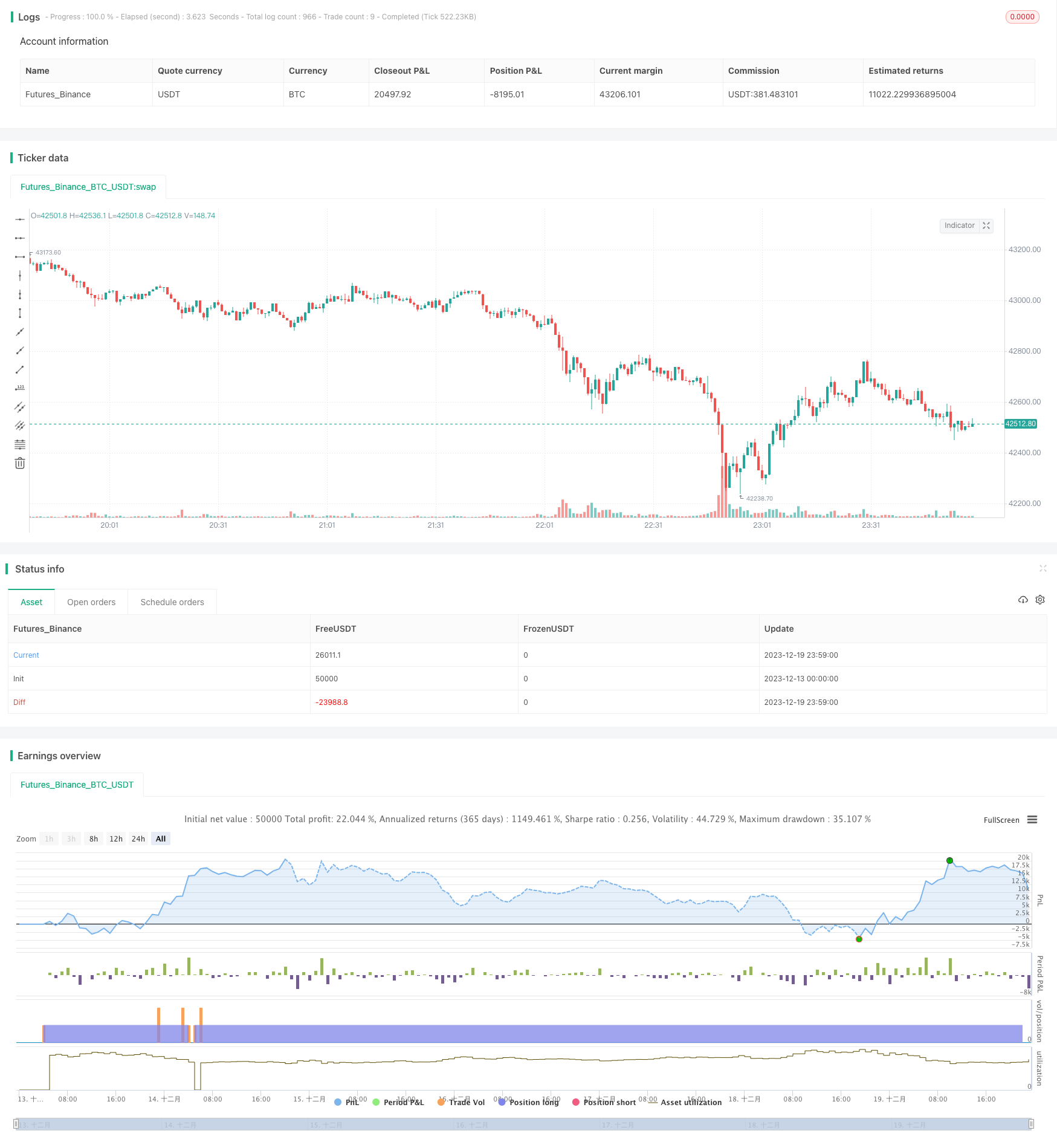
The strategy is named "Mean Reversion Reverse Strategy Based on Moving Average". The main idea is to buy when price breaks through key moving averages and take profit when reaching preset targets.
The main principle of this strategy is to capture rebound opportunities in range-bound markets by using the reversion of short-term moving averages. Specifically, when prices break through longer cycle moving averages (such as 20-day and 50-day MAs) and show signs of strong overselling, prices tend to rebound to some extent due to the mean reversion characteristic of market fluctuations. At this time, if shorter cycle moving averages (such as 10-day MA) show upward reversal signal, it would be a good timing to buy. In this strategy, it will buy when the close price is below 20-day MA while above 50-day MA, in order to capture its rebound with short-term MA reversal.
The specific entry logic is: Buy 1 lot when price breaks through 20-day MA, add 1 lot when breaking through 50-day MA, continue to add 1 lot when breaking through 100-day MA, and add up to 1 lot when breaking through 200-day MA, for a maximum of 4 lots. Take profit after reaching the preset targets. It also sets time and stop loss conditions.
Advantage Analysis
- Effectively identify short-term rebound opportunities by using the reversal characteristics of moving averages
- Reduce risks of single point by pyramiding orders
- Lock in profits by setting take profit targets
- Avoid false breakouts by using open price and previous low price filters
Risk Analysis
- May face reversal risks in long holding periods. Losses would expand if market continues to fall.
- MA signals may give false signals, leading to losses
- May fail to fully or partially take profits if profit target is not reached
Optimization Directions
- Test profitability and stability under different parameter settings
- Consider combining other indicators like MACD, KD to decide entries
- Choose suitable MA periods based on characteristics of different products
- Introduce machine learning algorithms to dynamically optimize parameters
Summary
In general, this is a classic and universal MA trading strategy. It correctly utilizes the smoothing feature of MAs, combined with multiple MAs to identify short-term buying opportunities. It controls risks by pyramiding orders and timely profit taking. But its response to market events like significant policy news may be more passive. This is something that can be further optimized. Overall, with appropriate improvements in parameter optimization and risk control, this strategy can obtain steady excess returns.
Parameters
| Name | Default | What it controls |
|---|---|---|
| v_input_int_1 | 5 | Quantity 1 |
| v_input_int_2 | 10 | Quantity 2 |
| v_input_int_3 | 15 | Quantity 3 |
| v_input_int_4 | 20 | Quantity 4 |
| v_input_1 | true | Profit Percentage |
| v_input_int_5 | 2 | Pyramiding |
Source Pine Script
/*backtest
start: 2023-12-13 00:00:00
end: 2023-12-20 00:00:00
period: 1m
basePeriod: 1m
exchanges: [{"eid":"Futures_Binance","currency":"BTC_USDT"}]
*/

//@version=5
strategy("EMA_zorba1", shorttitle="zorba_ema", overlay=true)

// Input parameters
qt1 = input.int(5, title="Quantity 1", minval=1)
qt2 = input.int(10, title="Quantity 2", minval=1)
qt3 = input.int(15, title="Quantity 3", minval=1)
qt4 = input.int(20, title="Quantity 4", minval=1)
ema10 = ta.ema(close, 10)
ema20 = ta.ema(close, 20)
ema50 = ta.ema(close, 50)
ema100 = ta.ema(close, 100)
ema200 = ta.ema(close, 200)

// Date range filter
start_date = timestamp(year=2021, month=1, day=1)
end_date = timestamp(year=2024, month=10, day=27)
in_date_range = true

// Profit condition
profit_percentage = input(1, title="Profit Percentage")  // Adjust this value as needed

// Pyramiding setting
pyramiding = input.int(2, title="Pyramiding", minval=1, maxval=10)

// Buy conditions
buy_condition_1 = in_date_range and close < ema20 and close > ema50 and close < open and close < low[1]
buy_condition_2 = in_date_range and close < ema50 and close > ema100 and close < open and close < low[1]
buy_condition_3 = in_date_range and close < ema100 and close > ema200 and close < open and close < low[1]
buy_condition_4 = in_date_range and close < ema200 and close < open and close < low[1]

// Exit conditions
profit_condition = strategy.position_avg_price * (1 + profit_percentage / 100) <= close
exit_condition_1 = in_date_range and (close > ema10 and ema10 > ema20 and ema10 > ema50 and ema10 > ema100 and ema10 > ema200 and close < open) and profit_condition and close < low[1] and close < low[2]
exit_condition_2 = in_date_range and (close < ema10 and close[1] > ema10 and close < close[1] and ema10 > ema20 and ema10 > ema50 and ema10 > ema100 and ema10 > ema200 and close < open) and profit_condition and close < low[1] and close < low[2]

// Exit condition for when today's close is less than the previous day's low
//exit_condition_3 = close < low[1]

// Strategy logic
strategy.entry("Buy1", strategy.long, qty=qt1 * pyramiding, when=buy_condition_1)
strategy.entry("Buy2", strategy.long, qty=qt2 * pyramiding, when=buy_condition_2)
strategy.entry("Buy3", strategy.long, qty=qt3 * pyramiding, when=buy_condition_3)
strategy.entry("Buy4", strategy.long, qty=qt4 * pyramiding, when=buy_condition_4)

strategy.close("Buy1", when=exit_condition_1 or exit_condition_2)
strategy.close("Buy2", when=exit_condition_1 or exit_condition_2)
strategy.close("Buy3", when=exit_condition_1 or exit_condition_2)
strategy.close("Buy4", when=exit_condition_1 or exit_condition_2)
Published by ChaoZhang on the FMZ strategy square · last modified 2023-12-21. Collected in the Quant Trading Vault. Unvalidated research: re-test with your own data and costs before trusting it.
Build this with AgenKit
A spec is not a trading system. Paste this into your coding agent and AgenKit runs a specialist team — architecture, test-first build, risk gates, review — with paper trading on by default.
/agenkit build a production-grade trading bot with a backtest engine, risk controls and paper trading by default from strategies/Mean-Reversion-Reverse-Strategy-Based-on-Moving-Average.md- npx agenkit install engineering-kit in your project
- Paste the command into your agent and approve each phase
- Get tests, backtest, risk controls and a paper-trading switch
Understand it first
Before you run this, read the lesson behind the idea and how to backtest it honestly. Specs like this one are the survivors of an unknown number of trials; deflate their results accordingly.
Related specs
- 1 2 3 Pattern Quantitative Trading Strategy with EMAs MACD and 4th Candle ExtensionPine Script · Mean reversion · 1h
- ATR and EMA based Dynamic Take Profit and Stop Loss Adaptive StrategyPine Script · Mean reversion · 1h
- Advanced 15 Minute Chart Trading Signal StrategyPine Script · Mean reversion · 3h
- BONK Multi Factor Trading StrategyPine Script · Mean reversion · 1d
- Chaikin Oscillator StrategyPine Script · Mean reversion · 3h
- Customizable Non Repainting HTF MACD MFI Scalable Bot StrategyPine Script · Mean reversion · 1d