Strategy vault / Mean reversion
Mean Reversion Strategy Based on ATR
This strategy uses hypothesis testing to determine if ATR deviates from its mean value. Combined with prediction of price trend, it implements a mean reversion strategy based on ATR. Significant deviation of ATR…
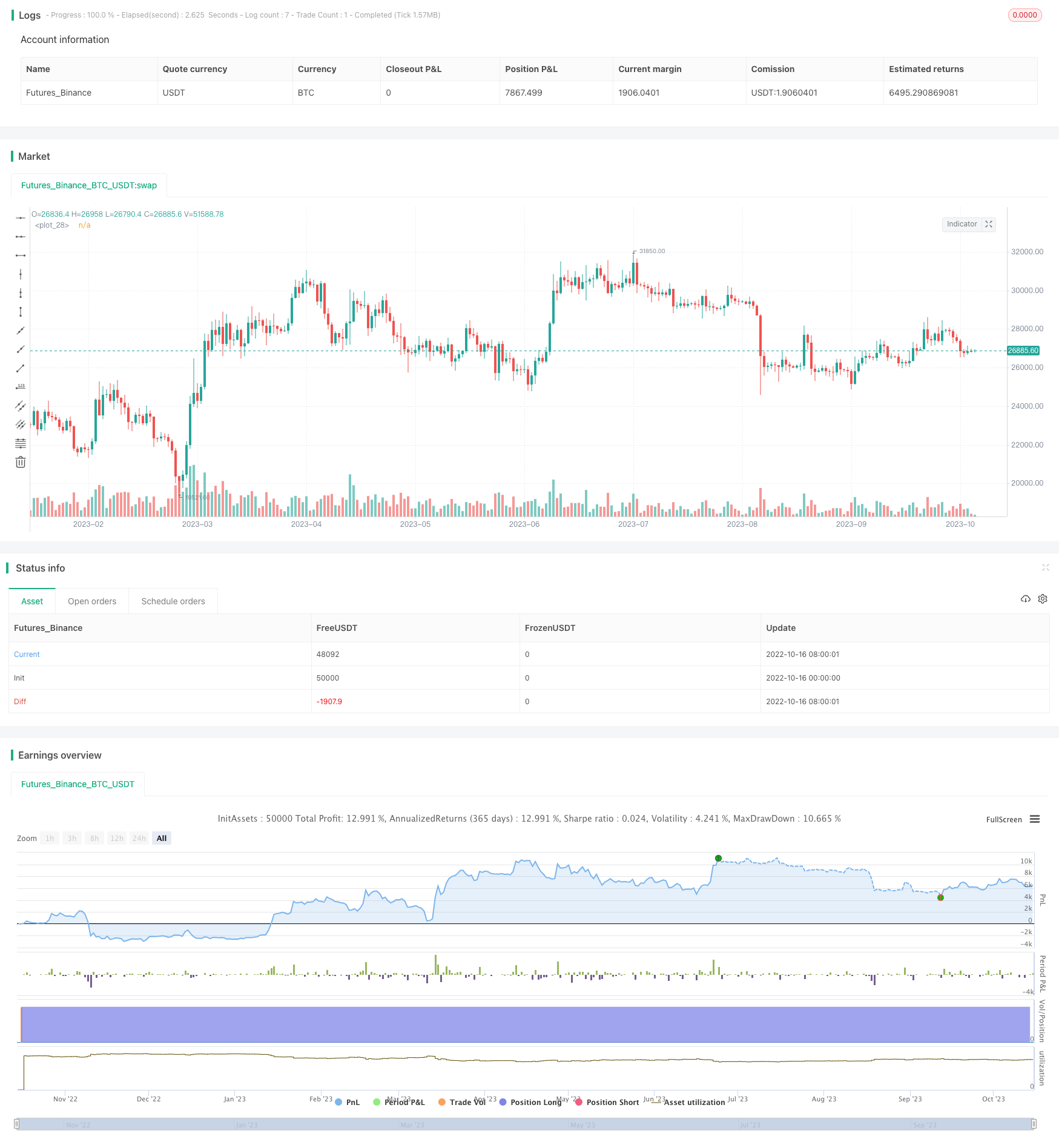
Overview
This strategy uses hypothesis testing to determine if ATR deviates from its mean value. Combined with prediction of price trend, it implements a mean reversion strategy based on ATR. Significant deviation of ATR indicates potential abnormal volatility in the market. If the price trend is predicted to be bullish, a long position can be established.
Strategy Logic
Hypothesis Testing
Conduct two-sample t-test between fast ATR period (atr_fast) and slow ATR period (atr_slow). Null hypothesis H0 is that there is no significant difference between the two sample means.
If test statistic exceeds threshold (confidence interval specified by reliability_factor), reject null hypothesis, i.e. fast ATR is considered to deviate significantly from slow ATR.
Price Trend Prediction
Moving average of logarithmic returns is calculated as expected drift rate (drift).
If drift is increasing, current trend is judged as bullish.
Entry and Stop Loss Exit
Go long when fast and slow ATR differs significantly and trend is bullish.
Continuously adjust stop loss using ATR. Exit position when price breaks below stop loss.
Advantage Analysis
Using hypothesis testing to determine ATR deviation is more scientific and adaptive.
Combining with price trend prediction avoids wrong trades based solely on ATR deviation.
Adjusting stop loss continually manages downside risk.
Risk Analysis
Unable to stop loss when price crashes.
Incorrect trend prediction may result in buying at the top.
Improper parameter settings may miss correct entry or add unnecessary trades.
Optimization Suggestions
Consider adding other indicators for multifactor confirmation to avoid mistakes.
Test different ATR parameter combinations to find more stable values.
Add criteria on breakthrough of key price levels to avoid false breakout.
Conclusion
The overall logic of this strategy is clear. Using hypothesis testing to detect abnormal volatility is reasonable. However, ATR deviation alone is insufficient to determine trend. More confirming factors are needed to improve accuracy. The stop loss rules are reliable but ineffective against cliff-style crashes. Future improvements can be made in areas like entry criteria, parameter selection, stop loss optimization.
Parameters
| Name | Default | What it controls |
|---|---|---|
| v_input_1 | timestamp(01 Apr 2000 13:30 +0000) | Backtest Start Time |
| v_input_2 | 14 | (?Stop loss)Length of ATR for trailing stop loss |
| v_input_3 | 2 | ATR Multiplier for trailing stop loss |
| v_input_4 | 14 | (?Hypothesis testing)Length of ATR (fast) for diversion test |
| v_input_5 | 28 | Length of ATR (slow) for diversion test |
| v_input_float_1 | 1.645 | Reliability factor |
| v_input_6 | 14 | (?Trend prediction)Length of drift |
Source Pine Script
/*backtest
start: 2022-10-16 00:00:00
end: 2023-10-16 00:00:00
period: 1d
basePeriod: 1h
exchanges: [{"eid":"Futures_Binance","currency":"BTC_USDT"}]
*/

// This source code is subject to the terms of the Mozilla Public License 2.0 at https://mozilla.org/MPL/2.0/
// © DojiEmoji

//@version=5
strategy("Mean Reversion (ATR) Strategy v2 [KL] ", overlay=true, pyramiding=1)
var string ENUM_LONG = "Long"
var string GROUP_TEST = "Hypothesis testing"
var string GROUP_TSL = "Stop loss"
var string GROUP_TREND = "Trend prediction"

backtest_timeframe_start = input(defval=timestamp("01 Apr 2000 13:30 +0000"), title="Backtest Start Time")
within_timeframe = true

// TSL: calculate the stop loss price. {
ATR_TSL      = ta.atr(input(14, title="Length of ATR for trailing stop loss", group=GROUP_TSL)) * input(2.0, title="ATR Multiplier for trailing stop loss", group=GROUP_TSL)
TSL_source      = low
TSL_line_color  = color.green
TSL_transp      = 100
var stop_loss_price = float(0)

if strategy.position_size == 0 or not within_timeframe
    TSL_line_color := color.black
    stop_loss_price := TSL_source - ATR_TSL
else if strategy.position_size > 0
    stop_loss_price := math.max(stop_loss_price, TSL_source - ATR_TSL)
    TSL_transp := 0

plot(stop_loss_price, color=color.new(TSL_line_color, TSL_transp))
// } end of "TSL" block

// Entry variables {
// ATR diversion test via Hypothesis testing (2-tailed):
//     H0 : atr_fast equals atr_slow
//     Ha : reject H0 if z_stat is above critical value, say reliability factor of 1.96 for a 95% confidence interval
len_fast    = input(14,title="Length of ATR (fast) for diversion test", group=GROUP_TEST)
atr_fast    = ta.atr(len_fast)
std_error   = ta.stdev(ta.tr, len_fast) / math.pow(len_fast, 0.5) // Standard Error (SE) = std / sq root(sample size)

atr_slow = ta.atr(input(28,title="Length of ATR (slow) for diversion test", group=GROUP_TEST))
test_stat = (atr_fast - atr_slow) / std_error
reject_H0 = math.abs(test_stat) > input.float(1.645,title="Reliability factor", tooltip="Strategy uses 2-tailed test; Confidence Interval = Point Estimate (avg ATR) +/- Reliability Factor x Standard Error; i.e use 1.645 for a 90% confidence interval", group=GROUP_TEST)

// main entry signal, subject to confirmation(s), gets passed onto the next bar
var _signal_diverted_ATR = false
if not _signal_diverted_ATR
    _signal_diverted_ATR := reject_H0


// confirmation: trend prediction; based on expected lognormal returns
_prcntge_chng = math.log(close / close[1])

// Expected return (drift) = average percentage change + half variance over the lookback period
len_drift = input(14, title="Length of drift", group=GROUP_TREND)
_drift = ta.sma(_prcntge_chng, len_drift) - math.pow(ta.stdev(_prcntge_chng, len_drift), 2) * 0.5
_signal_uptrend = _drift > _drift[1]

entry_signal_all = _signal_diverted_ATR and _signal_uptrend // main signal + confirmations
// } end of "Entry variables" block

// MAIN {
// Update the stop limit if strategy holds a position
if strategy.position_size > 0 and ta.change(stop_loss_price)
    strategy.exit(ENUM_LONG, comment="sl", stop=stop_loss_price)

// Entry
if within_timeframe and entry_signal_all
    strategy.entry(ENUM_LONG, strategy.long, comment=strategy.position_size > 0 ? "adding" : "initial")

// Alerts
_atr = ta.atr(14)
alert_helper(msg) =>
    prefix = "[" + syminfo.root + "] "
    suffix = "(P=" + str.tostring(close, "#.##") + "; atr=" + str.tostring(_atr, "#.##") + ")"
    alert(str.tostring(prefix) + str.tostring(msg) + str.tostring(suffix), alert.freq_once_per_bar)

if strategy.position_size > 0 and ta.change(strategy.position_size)
    if strategy.position_size > strategy.position_size[1]
        alert_helper("BUY")
    else if strategy.position_size < strategy.position_size[1]
        alert_helper("SELL")

// Clean up - set the variables back to default values once no longer in use
if strategy.position_size == 0
    stop_loss_price := float(0)
if ta.change(strategy.position_size)
    _signal_diverted_ATR := false
// } end of MAIN blockPublished by ChaoZhang on the FMZ strategy square · last modified 2023-10-17. Collected in the Quant Trading Vault. Unvalidated research: re-test with your own data and costs before trusting it.
Build this with AgenKit
A spec is not a trading system. Paste this into your coding agent and AgenKit runs a specialist team — architecture, test-first build, risk gates, review — with paper trading on by default.
/agenkit build a production-grade trading bot with a backtest engine, risk controls and paper trading by default from strategies/Mean-Reversion-Strategy-Based-on-ATR.md- npx agenkit install engineering-kit in your project
- Paste the command into your agent and approve each phase
- Get tests, backtest, risk controls and a paper-trading switch
Understand it first
Before you run this, read the lesson behind the idea and how to backtest it honestly. Specs like this one are the survivors of an unknown number of trials; deflate their results accordingly.
Related specs
- Adaptive Trading Strategy Combining Dynamic Trend Reversal and Stochastic IndicatorPine Script · Mean reversion · 1d
- Advanced Momentum EMA Trend Following with RSI Overbought Oversold Trading StrategyPine Script · Mean reversion · 1d
- Advanced Quantitative Trend Following and Cloud Reversal Composite Trading StrategyPine Script · Mean reversion · 1d
- Advanced Strategy with Volume and Price Pullback Multiple Take ProfitPine Script · Mean reversion · 1h
- Bidirectional Moving Average Reversion Trading StrategyPine Script · Mean reversion · 1h
- Bollinger Bands ATR Risk Reward Trading StrategyPine Script · Mean reversion · 1d