Momentum Index ETF Trend Following Strategy
This is a momentum index ETF trend following strategy based on moving averages. It uses the crossover and slope of fast and slow moving averages to determine the trend direction for low-risk momentum trend following…
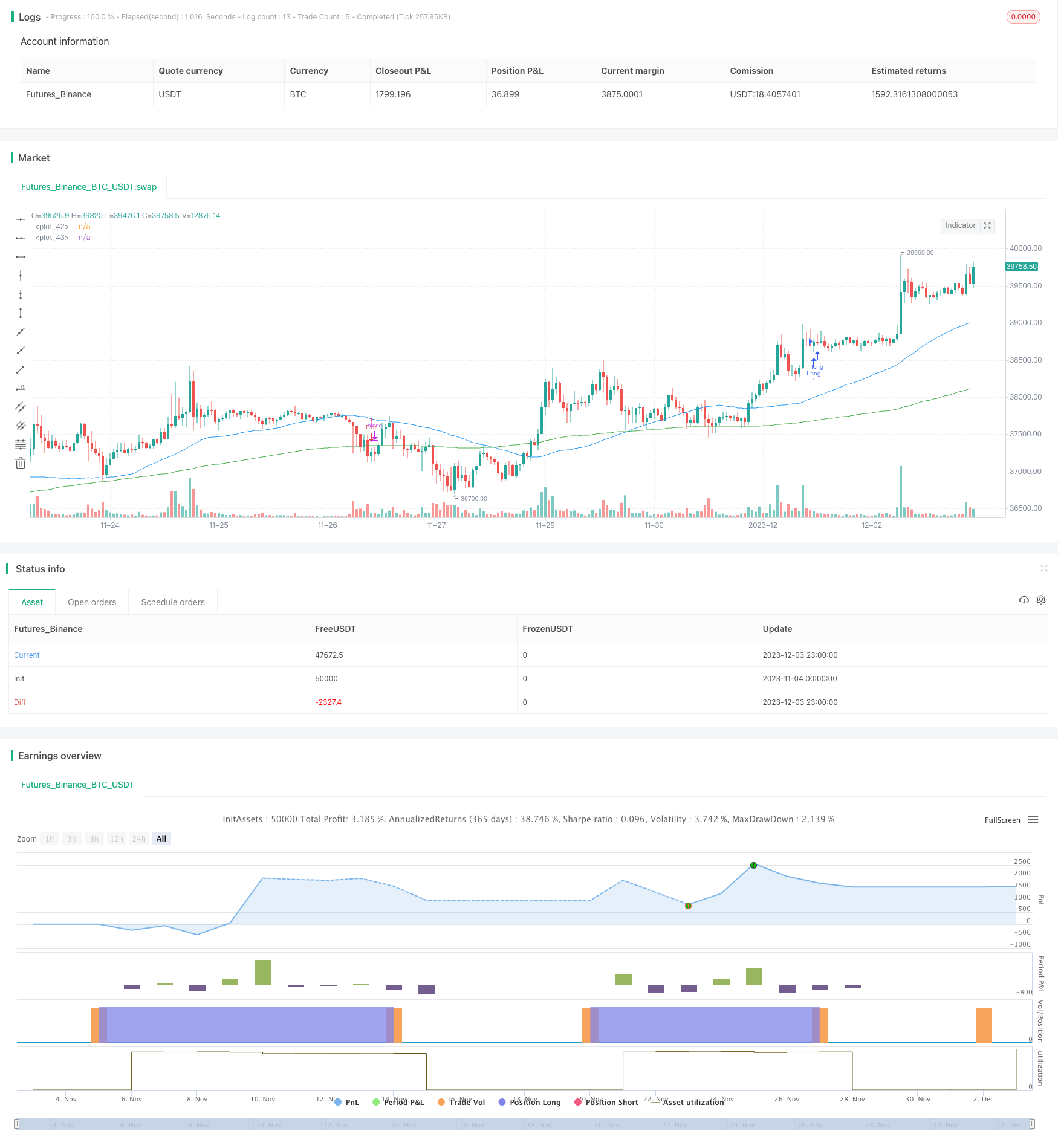
Overview
This is a momentum index ETF trend following strategy based on moving averages. It uses the crossover and slope of fast and slow moving averages to determine the trend direction for low-risk momentum trend following of index ETF assets.
Strategy Logic
The strategy uses 50-period and 150-period moving averages. When the fast moving average crosses over the slow moving average, and the slope of the fast moving average is greater than the threshold, it signals an upside trend reversal for long entry. When the fast moving average crosses below the slow moving average, or the slope of the fast moving average is less than the threshold, it signals a downside trend reversal for exiting positions.
The strategy simply utilizes the direction and slope of moving averages to determine market trend, avoiding overfitting and effectively controlling risks. Meanwhile, moving averages inherently have the ability to filter out market noise for robust signals.
Advantage Analysis
This is a low-risk momentum index ETF trend following strategy with the following advantages:
- Strong risk control ability. Moving averages filter market noise for effective risk control.
- Low implementation cost. Only simple moving averages are used, resulting in low cost and easy implementation.
- Stable profits. Index ETFs themselves have low volatility, combined with trend following, stable excess returns can be achieved.
- High adaptability. Many adjustable parameters allow optimizations for different index ETFs.
Risk Analysis
There are also some risks:
- Potentially missing quick reversals. Using moving averages to determine trends may miss out quick reversals.
- Parameter sensitive. Improper parameter settings may result in overtrading or missing opportunities.
- Performance dependence on market conditions. May underperform in choppy/sideway markets.
Solutions:
- Incorporate other indicators to determine quick reversals.
- Test and optimize parameters.
- Dynamically adjust parameters based on changing market conditions.
Optimization Directions
There are a few areas this strategy can be further optimized:
- Utilize other indicators like MACD, KD to complement the strategy.
- Incorporate stop loss logic to further control risks.
- Optimize moving average periods to adapt more index ETFs.
- Dynamically adjust parameters to suit different market environments.
Conclusion
In conclusion, this is a low-risk, easy-to-implement momentum index ETF trend following strategy. It determines trend directions using moving average crossovers and has advantages like strong risk control, low implementation cost and stable profits. Although some flaws exist, the strategy can be further improved in many aspects to become an effective tool for index ETF asset allocation.
Parameters
| Name | Default | What it controls |
|---|---|---|
| v_input_1 | 50 | Fast Moving Average (Int) |
| v_input_2 | 150 | Slow Moving Average (Int) |
| v_input_3 | 5 | Bullish Slope Angle (Deg) |
| v_input_4 | -5 | Bearish Slope Angle (Deg) |
| v_input_5 | 14 | Average True Range (Int) |
| v_input_6 | 100 | Risk (%) |
Source Pine Script
/*backtest
start: 2023-11-04 00:00:00
end: 2023-12-04 00:00:00
period: 1h
basePeriod: 15m
exchanges: [{"eid":"Futures_Binance","currency":"BTC_USDT"}]
*/

//@version=4
//please use on daily SPY, or other indexes only
strategy("50-150 INDEX TREND FOLLOWING", overlay=true)

//user input
fastSMA = input(title="Fast Moving Average (Int)",type=input.integer,minval=1,maxval=1000,step=1,defval=50,confirm=false)
slowSMA = input(title="Slow Moving Average (Int)",type=input.integer,minval=1,maxval=1000,step=1,defval=150,confirm=false)
longSlopeThreshold = input(title="Bullish Slope Angle (Deg)",type=input.integer,minval=-90,maxval=90,step=1,defval=5,confirm=false)
shortSlopeThreshold = input(title="Bearish Slope Angle (Deg)",type=input.integer,minval=-90,maxval=90,step=1,defval=-5,confirm=false)
atrValue = input(title="Average True Range (Int)",type=input.integer,minval=1,maxval=100,step=1,defval=14,confirm=false)
risk = input(title="Risk (%)",type=input.integer,minval=1,maxval=100,step=1,defval=100,confirm=false)

//create indicator
shortSMA = sma(close, fastSMA)
longSMA = sma(close, slowSMA)

//calculate ma slope
angle(_source) =>
    rad2degree=180/3.14159265359
    ang=rad2degree*atan((_source[0] - _source[1])/atr(atrValue))

shortSlope=angle(shortSMA)
longSlope=angle(longSMA)

//specify crossover conditions
longCondition = (crossover(shortSMA, longSMA) and (shortSlope > longSlopeThreshold)) or ((close > shortSMA) and (shortSMA > longSMA) and (shortSlope > longSlopeThreshold))
exitCondition = crossunder(shortSMA, longSMA) or (shortSlope < shortSlopeThreshold)
strategy.initial_capital = 50000
//units to buy
amount = (risk / 100) * (strategy.initial_capital + strategy.netprofit)
units = floor(amount / close)

//long trade
if (longCondition and strategy.position_size == 0)
    strategy.order("Long", strategy.long, units)

//close long trade
if (exitCondition and strategy.position_size > 0)
    strategy.order("Exit", strategy.short, strategy.position_size)

// Plot Moving Average's to chart
plot(shortSMA, color=color.blue)
plot(longSMA, color=color.green)
Published by ChaoZhang on the FMZ strategy square · last modified 2023-12-05. Collected in the Quant Trading Vault. Unvalidated research: re-test with your own data and costs before trusting it.
Build this with AgenKit
A spec is not a trading system. Paste this into your coding agent and AgenKit runs a specialist team — architecture, test-first build, risk gates, review — with paper trading on by default.
/agenkit build a production-grade trading bot with a backtest engine, risk controls and paper trading by default from strategies/Momentum-Index-ETF-Trend-Following-Strategy.md- npx agenkit install engineering-kit in your project
- Paste the command into your agent and approve each phase
- Get tests, backtest, risk controls and a paper-trading switch
Understand it first
Before you run this, read the lesson behind the idea and how to backtest it honestly. Specs like this one are the survivors of an unknown number of trials; deflate their results accordingly.
Related specs
- KST EMA Momentum Trend Following StrategyPine Script · Momentum · 1d
- Multi Indicator Trend Momentum Trading Strategy with Dynamic Risk Management SystemPine Script · Momentum · 1h
- Multi Indicator Trend Momentum Trading Strategy An Optimized Quantitative Trading System Based on Bollinger Bands Fibonacci and ATRPine Script · Momentum · 1h
- Multi MA Trend Strength Capture with Momentum Profit Taking StrategyPine Script · Momentum · 2h
- Multi Trend Momentum Crossover Strategy with Volatility Optimization SystemPine Script · Momentum · 1d
- AVMQTS Adaptive Volatility and Momentum Quantitative Trading System AVMQTSPine Script · Momentum · 1d