Strategy vault / Machine learning
Moving Average Rebound Strategy
The Moving Average Rebound Strategy is a strategy that combines technical indicators and price patterns to trade long and short around support and resistance levels. The strategy uses moving averages to identify…
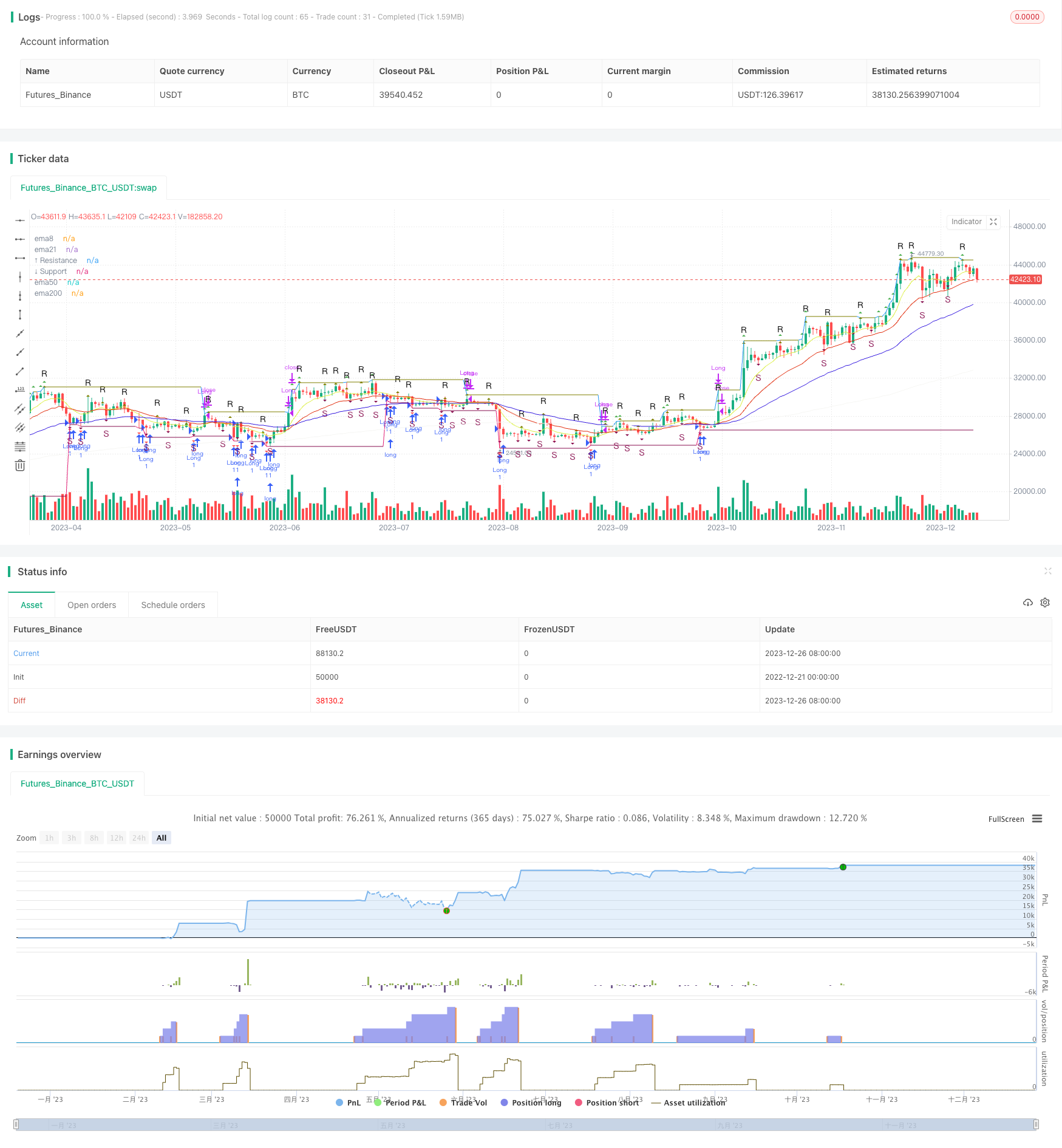
##Overview The Moving Average Rebound Strategy is a strategy that combines technical indicators and price patterns to trade long and short around support and resistance levels. The strategy uses moving averages to identify market trend direction, pattern indicators to assist in determining turning points, and previous swing highs/lows to spot key support and resistance levels for counter-trend trading.
Strategy Principles
The key steps for determining trade entries are:
Use the Alligator triple moving average indicator to judge trend direction. Crossing the Lip Lines signals strong momentum.
Identify potential reversal zones with Peak-Trough pattern indicator when in overbought/oversold areas. Breaking specific highs/lows indicates possible reversal.
Combine with support/resistance to pinpoint counter-trend trade entry points around key levels.
Use EMAS to assist in determining overall long term trend. Use mean reversion in range-bound and trend following in trending markets.
Employ trailing stop loss to control single trade loss amount.
Advantages
Advantages of the strategy:
Combining signals from multiple indicators improves accuracy.
Trading counter-trend from key support/resistance areas has high probability.
Trailing stop loss containing losses on single trades.
Risks
Risks involved:
More indicators can lead to higher trade frequency & needs transaction cost control.
Failed support/resistance levels are biggest risk. Price may not reverse as expected leading to large losses.
Stop loss can be taken out during huge volatile moves.
Enhancement Areas
Areas for improvement:
Optimize weights between indicators to find best performance combination.
Employ machine learning for improving key support/resistance level accuracy.
Add volume indicators to avoid trades when volatile but low volume environments.
Refine adaptive stop loss models to balance effectiveness and unnecessary stops.
Summary
In summary, the Moving Average Rebound Strategy utilizes a confluence of indicators including moving averages, price patterns and support/resistance for entries. A typical technical strategy with higher accuracy from multiple signals. Monitor risks around failure of key levels and stop loss slippage. Further optimization on indicator weights, machine learning and volume can enhance performance.
Parameters
| Name | Default | What it controls |
|---|---|---|
| v_input_1 | 5 | ? Lips Length |
| v_input_2 | 8 | ? Teeth Length |
| v_input_3 | 13 | ? Jaw Length |
| v_input_4 | 3 | ? Lips Offset |
| v_input_5 | 5 | ? Teeth Offset |
| v_input_6 | 8 | ? Jaw Offset |
| v_input_int_1 | 2 | ? Period |
| v_input_7 | true | ⤒⤓ Show Res-Sup |
| v_input_8 | 13 | ⤒⤓ Res-Sup Length |
Source Pine Script
/*backtest
start: 2022-12-21 00:00:00
end: 2023-12-27 00:00:00
period: 1d
basePeriod: 1h
exchanges: [{"eid":"Futures_Binance","currency":"BTC_USDT"}]
*/

// This source code is subject to the terms of the Mozilla Public License 2.0 at https://mozilla.org/MPL/2.0/
// © vhurtadocos


//@version=5
strategy('Estrategia EMA Resistencia Soporte', shorttitle='Estrategia EMA RESISTENCIA Y SOPORTE', overlay=true, margin_long=100, margin_short=100, pyramiding = 10 )

//INICIO DE CONDICIONES BASICAS
/// Alligator
smma(src, length) =>
    smma = 0.0
    sma_1 = ta.sma(src, length)
    smma := na(smma[1]) ? sma_1 : (smma[1] * (length - 1) + src) / length
    smma
lipsLength = input(title='? Lips Length', defval=5)
teethLength = input(title='? Teeth Length', defval=8)
jawLength = input(title='? Jaw Length', defval=13)
lipsOffset = input(title='? Lips Offset', defval=3)
teethOffset = input(title='? Teeth Offset', defval=5)
jawOffset = input(title='? Jaw Offset', defval=8)
lips = smma(hl2, lipsLength)
teeth = smma(hl2, teethLength)
jaw = smma(hl2, jawLength)


// Fractals
n = input.int(title='? Period', defval=2, minval=2)
upFractal = high[n + 2] < high[n] and high[n + 1] < high[n] and high[n - 1] < high[n] and high[n - 2] < high[n] or high[n + 3] < high[n] and high[n + 2] < high[n] and high[n + 1] == high[n] and high[n - 1] < high[n] and high[n - 2] < high[n] or high[n + 4] < high[n] and high[n + 3] < high[n] and high[n + 2] == high[n] and high[n + 1] <= high[n] and high[n - 1] < high[n] and high[n - 2] < high[n] or high[n + 5] < high[n] and high[n + 4] < high[n] and high[n + 3] == high[n] and high[n + 2] == high[n] and high[n + 1] <= high[n] and high[n - 1] < high[n] and high[n - 2] < high[n] or high[n + 6] < high[n] and high[n + 5] < high[n] and high[n + 4] == high[n] and high[n + 3] <= high[n] and high[n + 2] == high[n] and high[n + 1] <= high[n] and high[n - 1] < high[n] and high[n - 2] < high[n]
dnFractal = low[n + 2] > low[n] and low[n + 1] > low[n] and low[n - 1] > low[n] and low[n - 2] > low[n] or low[n + 3] > low[n] and low[n + 2] > low[n] and low[n + 1] == low[n] and low[n - 1] > low[n] and low[n - 2] > low[n] or low[n + 4] > low[n] and low[n + 3] > low[n] and low[n + 2] == low[n] and low[n + 1] >= low[n] and low[n - 1] > low[n] and low[n - 2] > low[n] or low[n + 5] > low[n] and low[n + 4] > low[n] and low[n + 3] == low[n] and low[n + 2] == low[n] and low[n + 1] >= low[n] and low[n - 1] > low[n] and low[n - 2] > low[n] or low[n + 6] > low[n] and low[n + 5] > low[n] and low[n + 4] == low[n] and low[n + 3] >= low[n] and low[n + 2] == low[n] and low[n + 1] >= low[n] and low[n - 1] > low[n] and low[n - 2] > low[n]
plotshape(title='? Up-Fractal', series=upFractal, style=shape.triangleup, location=location.abovebar, offset=-2, color=color.new(color.olive, 0), text="R")
plotshape(title='? Down-Fractal', series=dnFractal, style=shape.triangledown, location=location.belowbar, offset=-2, color=color.new(color.maroon, 0), text="S", textcolor = color.new(color.maroon,0))

// Resistance, Support
showRS = input(title='⤒⤓ Show Res-Sup', defval=true)
lengthRS = input(title='⤒⤓ Res-Sup Length', defval=13)
highRS = ta.valuewhen(high >= ta.highest(high, lengthRS), high, 0)
lowRS = ta.valuewhen(low <= ta.lowest(low, lengthRS), low, 0)
plot(title='⤒ Resistance', series=showRS and highRS ? highRS : na, color=highRS != highRS[1] ? na : color.olive, linewidth=1, offset=0)
plot(title='⤓ Support', series=showRS and lowRS ? lowRS : na, color=lowRS != lowRS[1] ? na : color.maroon, linewidth=1, offset=0)


// EMA de 8 períodos
ema8 = ta.ema(close, 8)
plot(title='ema8', series=ema8, color=color.new(#dbef41, 0), offset=0)

// EMA de 21 períodos
ema21 = ta.ema(close, 21)
plot(title='ema21', series=ema21, color=color.new(#e12c0c, 0), offset=0)

// EMA de 50 períodos
ema50 = ta.ema(close, 50)
plot(title='ema50', series=ema50, color=color.new(#3419de, 0), offset=0)

// EMA de 200 períodos
ema200 = ta.ema(close, 200)
plot(title='ema200', series=ema200, color=color.new(#f6f6f4, 0), offset=0)


// Definiciones originales...
// ... (incluyendo tus definiciones de Alligator, Fractals, etc.)

// Guardamos el último soporte y resistencia
var float lastSupport = na
var float lastResistance = na

// Detectando un nuevo soporte y resistencia
newSupportDetected = low == lowRS


if newSupportDetected
    lastSupport := low

// Lógica de entrada y salida

// Condiciones de entrada basadas en soportes recién formados
longCondition = low == lowRS
if longCondition
    strategy.entry("Long", strategy.long)

// Salida (take profit) cuando detectamos una nueva resistencia después de entrar en una posición long
newResistanceDetected = high == highRS
if newResistanceDetected and strategy.position_size > 0
    strategy.close("Long")

// Agregar una condición para el stop loss
longStopLossPrice = close * 0.95
if strategy.position_size > 0 and close <= longStopLossPrice
    strategy.close("Long")

// Pintamos los soportes y resistencias
plotshape(longCondition, style=shape.triangledown, location=location.belowbar, color=color.red)
plotshape(newResistanceDetected, style=shape.triangleup, location=location.abovebar, color=color.green)

// Resto del código para plotear las EMAs y fractales
// ...
Published by ChaoZhang on the FMZ strategy square · last modified 2023-12-28. Collected in the Quant Trading Vault. Unvalidated research: re-test with your own data and costs before trusting it.
Build this with AgenKit
A spec is not a trading system. Paste this into your coding agent and AgenKit runs a specialist team — architecture, test-first build, risk gates, review — with paper trading on by default.
/agenkit build a production-grade trading bot with a backtest engine, risk controls and paper trading by default from strategies/Moving-Average-Rebound-Strategy.md- npx agenkit install engineering-kit in your project
- Paste the command into your agent and approve each phase
- Get tests, backtest, risk controls and a paper-trading switch
Understand it first
Before you run this, read the lesson behind the idea and how to backtest it honestly. Specs like this one are the survivors of an unknown number of trials; deflate their results accordingly.
Related specs
- Out of the box Machine Learning Trading StrategyPine Script · Machine learning · 1d
- Hilo Activator Buy Sell Signals StrategyPine Script · Machine learning · 10m
- Multi Indicator Decision Tree Strategy IMACD EMA and IchimokuPine Script · Machine learning · 30m
- Multi indicator Assisted StrategyPine Script · Machine learning · 1d
- Quantitative Trading Strategy Based on SMA and EMAPine Script · Machine learning · 3m
- Dynamic Regression Channel StrategyPine Script · Machine learning · 2h