Strategy vault / Mean reversion
Moving Average System Trading Strategy
This article discusses a trading strategy based on a simple moving average. The strategy compares the closing price with a 17-period moving average, going long when the closing price crosses above the moving average…
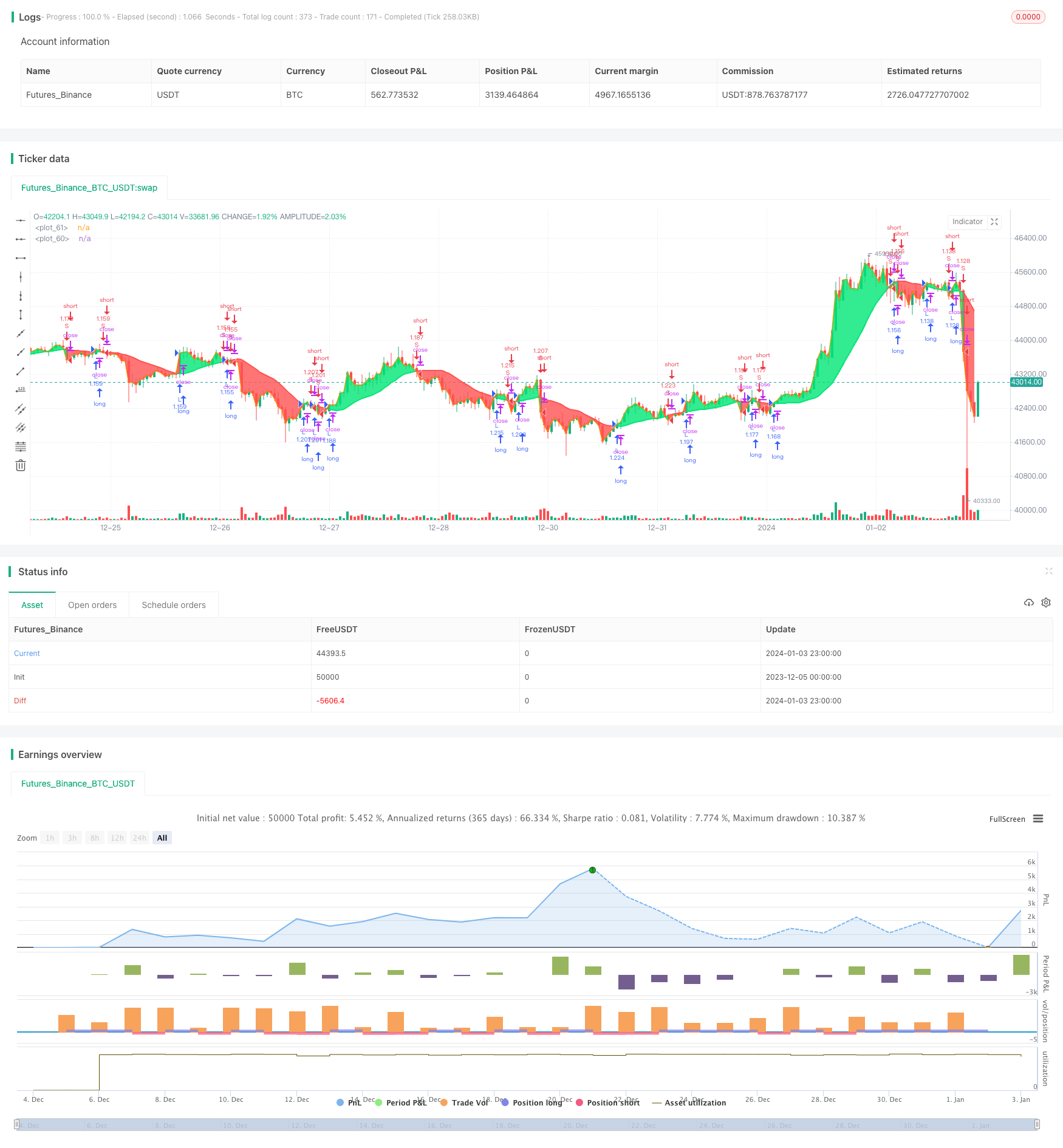
Overview
This article discusses a trading strategy based on a simple moving average. The strategy compares the closing price with a 17-period moving average, going long when the closing price crosses above the moving average and going short when it crosses below.
Strategy Logic
Moving Average Calculation
The strategy uses the following parameters to calculate the moving average:
- MA Source: Default to average of OHLC (OHLC4)
- MA Type: Default to Simple Moving Average (SMA)
- MA Length: Default to 17
Based on these parameters, the getMAType() function is called to calculate the 17-period SMA of closing prices.
Trading Signal Generation
Then compare the relationship between the closing price and the moving average:
- Close > Moving Average: Long signal
- Close < Moving Average: Short signal
When the closing price crosses above the moving average from below, a long signal is generated. When it crosses below from above, a short signal is generated.
Trade Execution
During the backtest period, open long positions when long signals appear and open short positions when short signals appear.
Advantage Analysis
The biggest advantage of this strategy is that the logic is very simple and clear. With just one indicator, it judges the trend reversal based on the direction change of the indicator. The strategy is easy to understand and implement, suitable for beginners to learn.
In addition, moving averages belong to trend-following indicators, which can effectively track trend changes and avoid interference from short-term market noise.
By adjusting parameters, it can adapt to different cycles and different products.
Risk Analysis
Firstly, this strategy relies solely on one indicator, so the judgment criteria are relatively single, which may generate more false signals.
Also, as a trend following system, it does not work well in range-bound and sideways markets.
Besides, without stop loss or take profit, there is a risk of expanding losses.
The solutions are to incorporate other indicators, optimize parameter combinations to reduce false signals. Add stop loss and take profit to control risks and optimize drawdowns.
Optimization Directions
Here are some ideas for optimizing the strategy:
Adjust moving average parameters, optimize period numbers, e.g. change to 30-period or 50-period.
Try different types of moving averages, like EMA, VIDYA etc. They have varying sensitivity to price changes.
Add other indicators in combination, e.g. MACD to judge strength; RSI to reduce false signals.
Add stop loss mechanisms. Set fixed percentage or ATR-based trailing stop loss to control single-trade loss amount.
Add take profit mechanisms. Set target profit percentage to maximize profits.
These optimizations can make the strategy performance more stable and avoid excessive drawdowns.
Summary
This article analyzes a simple trading strategy based on a 17-period moving average. The strategy has simple signal sources, easy to understand and implement, belonging to a typical trend following system. Through in-depth interpretation of the strategy, its pros and cons are analyzed, and multiple dimensions of optimization ideas are proposed. It is believed that through continuous optimization and enrichment, this strategy can gradually evolve and achieve stable returns in live trading as well.
Parameters
| Name | Default | What it controls |
|---|---|---|
| v_input_1 | 2012 | Backtest Start Year |
| v_input_2 | true | Backtest Start Month |
| v_input_3 | true | Backtest Start Day |
| v_input_4 | 2019 | Backtest Stop Year |
| v_input_5 | 12 | Backtest Stop Month |
| v_input_6 | 31 | Backtest Stop Day |
| v_input_7_ohlc4 | 0 | MA Source: ohlc4 | high | low | open | hl2 | hlc3 | hlcc4 | close |
| v_input_8 | 0 | MA Type: sma | ema | swma | wma | vwma | rma |
| v_input_9 | 17 | MA Length |
Source Pine Script
/*backtest
start: 2023-12-05 00:00:00
end: 2024-01-04 00:00:00
period: 1h
basePeriod: 15m
exchanges: [{"eid":"Futures_Binance","currency":"BTC_USDT"}]
*/

//@version=4
strategy("Simple 17 BF ?", overlay=true, initial_capital=10000, default_qty_type=strategy.percent_of_equity, default_qty_value=100, commission_type=strategy.commission.percent, commission_value=0.0)

/////////////// Time Frame ///////////////
testStartYear = input(2012, "Backtest Start Year")
testStartMonth = input(1, "Backtest Start Month")
testStartDay = input(1, "Backtest Start Day")
testPeriodStart = timestamp(testStartYear,testStartMonth,testStartDay, 0, 0)

testStopYear = input(2019, "Backtest Stop Year")
testStopMonth = input(12, "Backtest Stop Month")
testStopDay = input(31, "Backtest Stop Day")
testPeriodStop = timestamp(testStopYear,testStopMonth,testStopDay, 0, 0)

testPeriod() => true

///////////// Moving Average /////////////
source = input(title="MA Source", defval=ohlc4)
maType = input(title="MA Type", defval="sma", options=["sma", "ema", "swma", "wma", "vwma", "rma"])
length = input(title="MA Length", defval=17)

///////////// Get MA Function /////////////
getMAType(maType, sourceType, maLen) =>
    res = sma(close, 1)

    if maType == "ema"
        res := ema(sourceType, maLen)
    if maType == "sma"
        res := sma(sourceType, maLen)
    if maType == "swma"
        res := swma(sourceType)
    if maType == "wma"
        res := wma(sourceType, maLen)
    if maType == "vwma"
        res := vwma(sourceType, maLen)
    if maType == "rma"
        res := rma(sourceType, maLen)
    res

MA = getMAType(maType, source, length)

/////////////// Strategy ///////////////
long = close > MA
short = close < MA

last_long = 0.0
last_short = 0.0
last_long := long ? time : nz(last_long[1])
last_short := short ? time : nz(last_short[1])

long_signal = crossover(last_long, last_short)
short_signal = crossover(last_short, last_long)

/////////////// Execution ///////////////
if testPeriod()
    strategy.entry("L", strategy.long, when=long_signal)
    strategy.entry("S", strategy.short, when=short_signal)

/////////////// Plotting ///////////////
p1 = plot(MA, color = long ? color.lime : color.red, linewidth=2)
p2 = plot(close, linewidth=2)
fill(p1, p2, color=strategy.position_size > 0 ? color.lime : strategy.position_size < 0 ? color.red : color.white, transp=80)Published by ChaoZhang on the FMZ strategy square · last modified 2024-01-05. Collected in the Quant Trading Vault. Unvalidated research: re-test with your own data and costs before trusting it.
Build this with AgenKit
A spec is not a trading system. Paste this into your coding agent and AgenKit runs a specialist team — architecture, test-first build, risk gates, review — with paper trading on by default.
/agenkit build a production-grade trading bot with a backtest engine, risk controls and paper trading by default from strategies/Moving-Average-System-Trading-Strategy.md- npx agenkit install engineering-kit in your project
- Paste the command into your agent and approve each phase
- Get tests, backtest, risk controls and a paper-trading switch
Understand it first
Before you run this, read the lesson behind the idea and how to backtest it honestly. Specs like this one are the survivors of an unknown number of trials; deflate their results accordingly.
Related specs
- Customizable Non Repainting HTF MACD MFI Scalable Bot StrategyPine Script · Mean reversion · 1d
- Dynamic Adaptive Multi Timeframe Trend Following and Range Reversal Hybrid StrategyPine Script · Mean reversion · 2d
- MACD Cross Period Trading StrategyPine Script · Mean reversion · 1d
- CCTBBO Reversal Tracking StrategyPine Script · Mean reversion · 45m
- Multi Indicator Weighted Smart Trading StrategyPine Script · Mean reversion · 2d
- MACD RSI and EMA StrategyPine Script · Mean reversion · 1d