Multi Exchange Aggregated Market Order Strategy Example
JavaScript strategy by 发明者量化-小小梦.
JavaScriptOther
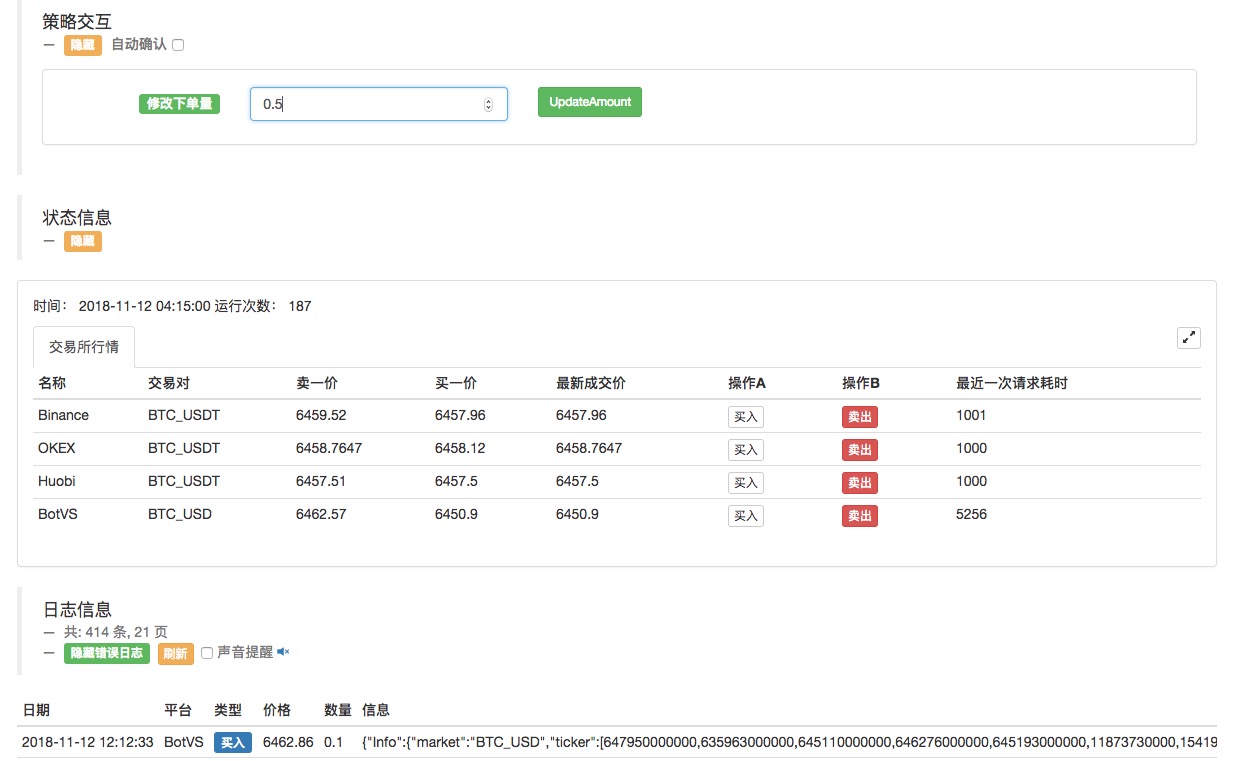
Parameters
| Name | Default | What it controls |
|---|---|---|
| StrProxy | socks5:// | Agent configuration |
| Button | Default | Description |
| ---- | ---- | ---- |
| UpdateAmount | 0.1 | Modify order volume |
Source JavaScript
// Parameters,Can be set on the interface.
var Interval = 100
var TickerInterval = 1000
var RecordsInterval = 1000

// Global Variables
var Amount = 0.1

function CreateExchanges(){
    var exs = {
        // Exchange object
        ex_objs : [],

        // exs 's attributes
        table : null,
        tickerInterval : 0,
        recordsInterval : 0,
        runCount : 0,
    }
    // Initialize
    exs.tickerInterval = TickerInterval
    exs.recordsInterval = RecordsInterval

    var funcDict = {
        "GetTicker" : ["routine_ticker", "ticker", "tickerPreTime"],
        "GetRecords" : ["routine_records", "records", "recordsPreTime"],
        "Trade" : ["routine_trade", "trade", "tradePreTime"],                   // Extensible pending orders, multi-threaded order issuance and other functions
    }

    // Initialize
    var timeStamp = new Date().getTime()
    for(var i = 0 ; i < exchanges.length ; i++){
        var obj = {
            name : exchanges[i].GetName(),
            currency : exchanges[i].GetCurrency(),
            index : i,
            routine_ticker : null,
            ticker : null,
            tickerPre : null,
            tickerPreTime : timeStamp,
            routine_trade : null,
            trade : null,
            tradePreTime : timeStamp,
            routine_records : null,
            records : null,
            recordsPre : null,
            recordsPreTime : timeStamp,
            recordsPreBarTime : 0,
            rows : null,

        }
        // Set proxy
        exchanges[i].SetProxy(StrProxy)

        exs.ex_objs.push(obj)
    }

    exs.Go = function(func, interval){
        var self = this
        if(typeof(func) == "undefined"){
            throw "error, no param func"
        }

        _.each(self.ex_objs, function(obj){
            if(typeof(obj[funcDict[func][1]]) !== "undefined"){
                obj[funcDict[func][0]] = exchanges[obj.index].Go(func)
                obj[funcDict[func][2]] = new Date().getTime()
            }
        })

        Sleep(interval)

        _.each(self.ex_objs, function(obj){
            obj[funcDict[func][1]] = obj[funcDict[func][0]].wait(10)
        })
    }

    exs.TableUpdate = function(){
        var self = this

        self.table = {
            type : "table",
            title : "Exchange market data",
            cols : ["Name", "Trading pair", "Sell price", "Buy price", "Latest transaction price", "Operation A", "Operation B", "Latest request time"],
            rows : [],
        }

        _.each(self.ex_objs, function(obj){
            var ticker = obj.ticker
            if(typeof(ticker) == "undefined" || !ticker){
                ticker = obj.tickerPre ? obj.tickerPre : {Buy : "Nan", Sell : "Nan", Last : "Nan", High : "Nan", Low : "Nan"}
            }
            self.table.rows.push([
                obj.name,
                obj.currency,
                ticker.Sell,
                ticker.Buy,
                ticker.Last,
                {
                    'type': 'button',
                    'cmd': "LogStatus" + "_" + obj.index + "_" + "Buy",
                    'name': 'buy'
                },
                {
                    'type': 'button',
                    'cmd': "LogStatus" + "_" + obj.index + "_" + "Sell",
                    'class': 'btn btn-xs btn-danger',
                    'name': 'sell'
                },
                (new Date().getTime() - obj.tickerPreTime),
            ])
        })

        self.runCount++
        LogStatus("Time:", _D(), "Number of Runs:", self.runCount, " ", "\n", '`' + JSON.stringify(self.table) + '`')
    }

    exs.Chart = function(chartObj, chartCfg){
        var self = this

        _.each(self.ex_objs, function(obj){
            if(typeof(obj.records) !== "undefined" && obj.records){
                if(obj.recordsPreBarTime == 0){                            // Initialize
                    for(var i = 0; i < obj.records.length; i++){
                        chartObj.add(obj.index, [obj.records[i].Time, obj.records[i].Open, obj.records[i].High, obj.records[i].Low, obj.records[i].Close])
                    }
                    obj.recordsPreBarTime = obj.records[obj.records.length - 1].Time
                } else {
                    if(obj.records[obj.records.length - 1].Time !== obj.recordsPreBarTime){
                        chartObj.add(obj.index, [obj.records[obj.records.length - 1].Time, obj.records[obj.records.length - 1].Open, obj.records[obj.records.length - 1].High, obj.records[obj.records.length - 1].Low, obj.records[obj.records.length - 1].Close])
                        obj.recordsPreBarTime = obj.records[obj.records.length - 1].Time
                    } else {
                        chartObj.add(obj.index, [obj.records[obj.records.length - 1].Time, obj.records[obj.records.length - 1].Open, obj.records[obj.records.length - 1].High, obj.records[obj.records.length - 1].Low, obj.records[obj.records.length - 1].Close], -1)
                    }
                }
            }
        })
        chartObj.update(chartCfg)
    }

    exs.Trade = function(){

    }

    exs.GetTicker = function(){
        var self = this
        self.Go("GetTicker", self.tickerInterval)
        _.each(self.ex_objs, function(obj){
            if(typeof(obj.ticker) !== "undefined" && obj.ticker){
                obj.tickerPre = obj.ticker
            }
        })
    }

    exs.GetRecords = function(){
        var self = this
        self.Go("GetRecords", self.recordsInterval)
        _.each(self.ex_objs, function(obj){
            if(typeof(obj.records) !== "undefined" && obj.records){
                obj.recordsPre = obj.records
            }
        })
    }


    return exs
}

function main(){
    // Initialize the exchange collection object
    var exs = CreateExchanges()

    // Chart initialization
    var arrCfg = []
    for(var i = 0 ; i < exchanges.length ; i++){
        var cfg = {
            title: {
                text: exchanges[i].GetName() + "-" + exchanges[i].GetCurrency()
            },
            xAxis: {
                type: 'datetime'
            },
            series: [{
                type: 'candlestick',
                name: 'KLine',
                id: "" + i,
                data: []
            }]
        }
        arrCfg.push(cfg)
    }
    var chart = Chart(arrCfg)
    chart.reset()

    while(true){
        // Handle Interaction
        var cmd = GetCommand()
        if(cmd){
            Log("cmd:", cmd)  // Test

            var arr = cmd.split("_")
            if(arr.length == 3){
                var idx = parseInt(arr[1])
                var type = arr[2]
                if(type == "Buy"){
                    $.Buy(exchanges[idx], Amount)
                } else if(type == "Sell"){
                    $.Sell(exchanges[idx], Amount)
                } else {
                    Log("Wrong command,type:", type, "#FF0000")
                }
            } else if(arr.length == 1) {
                var amount = arr[0].split(":")[1]
                Amount = parseInt(amount)
            }else {
                Log("Wrong command", "#FF0000")
            }
        }

        // Obtain records Data
        exs.GetRecords()
        // Obtain ticker Data
        exs.GetTicker()

        // Processing Interface
        exs.TableUpdate()
        exs.Chart(chart, arrCfg)

        Sleep(Interval)
    }
}Published by 发明者量化-小小梦 on the FMZ strategy square · last modified 2019-07-19. Collected in the Quant Trading Vault. Unvalidated research: re-test with your own data and costs before trusting it.
Build this with AgenKit
A spec is not a trading system. Paste this into your coding agent and AgenKit runs a specialist team — architecture, test-first build, risk gates, review — with paper trading on by default.
/agenkit build a production-grade trading bot with a backtest engine, risk controls and paper trading by default from strategies/Multi-Exchange-Aggregated-Market-Order-Strategy-Example.md- npx agenkit install engineering-kit in your project
- Paste the command into your agent and approve each phase
- Get tests, backtest, risk controls and a paper-trading switch
Understand it first
Before you run this, read the lesson behind the idea and how to backtest it honestly. Specs like this one are the survivors of an unknown number of trials; deflate their results accordingly.