Strategy vault / Mean reversion
Multi Frequency Momentum Reversal Quantitative Strategy System Multi Frequency Momentum Reversal Quantitative Strategy System
This strategy is a quantitative trading system based on market continuous movement characteristics, capturing market reversal opportunities by analyzing the frequency of consecutive price rises or falls. The core of…
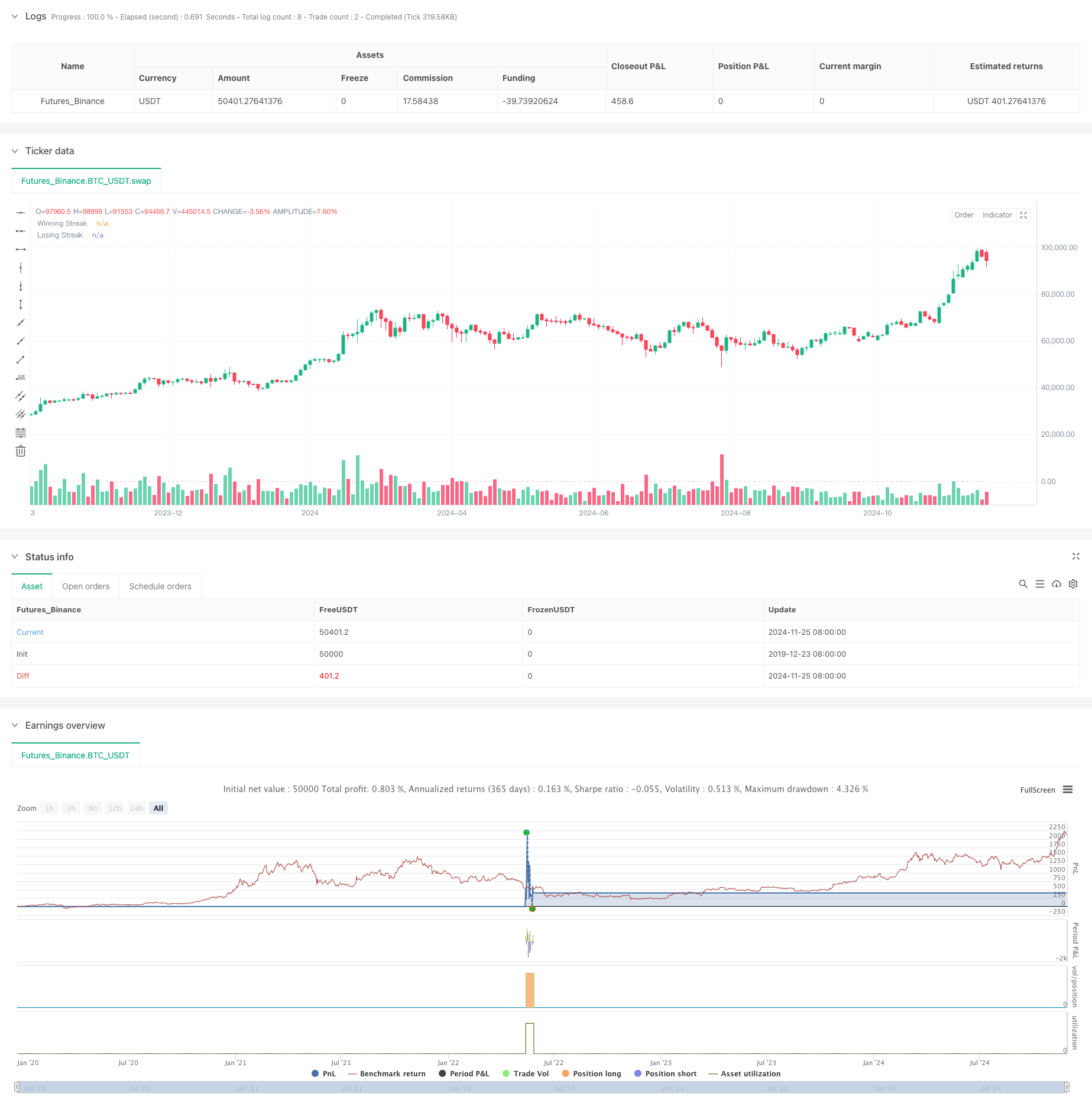
Overview
This strategy is a quantitative trading system based on market continuous movement characteristics, capturing market reversal opportunities by analyzing the frequency of consecutive price rises or falls. The core of the strategy is to take reverse actions when reaching preset thresholds for consecutive movements, combining multiple dimensions such as holding periods and candlestick patterns for trading decisions.
Strategy Principles
The core logic includes several key elements:
- Streak Counting: The system continuously tracks consecutive price increases and decreases, comparing them with preset thresholds.
- Trade Direction Selection: Users can choose between long or short positions, focusing on losing streaks for long positions and winning streaks for short positions.
- Holding Period Management: Fixed holding periods are set with automatic position closure to avoid over-holding.
- Doji Filtering: Incorporates Doji candlestick analysis to filter false signals during market fluctuations.
- Position Control: Utilizes single position trading without scaling or partial position building.
Strategy Advantages
- Clear Logic: Trading logic is intuitive and easy to understand and execute.
- Controlled Risk: Risk is managed through fixed holding periods and single position control.
- High Adaptability: Parameters can be adjusted according to different market characteristics.
- High Automation: Fully system-executed, reducing human intervention.
- Multi-dimensional Analysis: Combines price trends, candlestick patterns, and other dimensions.
Strategy Risks
- Trend Continuation Risk: Potential misjudgments in strong trend markets.
- Parameter Sensitivity: Strategy performance directly affected by threshold and holding period settings.
- Market Environment Dependency: Performs well in oscillating markets but may frequently lose in unidirectional markets.
- Slippage Impact: High-frequency trading may be affected by slippage.
- Cost Pressure: Frequent trading generates high transaction costs.
Strategy Optimization Directions
- Incorporate Volatility Indicators: Adjust thresholds using indicators like ATR.
- Add Trend Filtering: Improve win rate by incorporating long-term trend analysis.
- Dynamic Holding Periods: Adapt holding times based on market characteristics.
- Position Management Optimization: Introduce dynamic position management mechanisms.
- Multi-timeframe Analysis: Add multi-period signal confirmation mechanisms.
Conclusion
This strategy is a quantitative trading system based on market reversal characteristics, capturing reversal opportunities through analysis of continuous price movements. The strategy design is reasonable with controlled risks but requires parameter adjustment according to market conditions. Through continuous optimization and improvement, this strategy has the potential to achieve stable returns in actual trading. It is recommended to conduct thorough historical data backtesting and verify strategy effectiveness in demo trading before live implementation.
Source Pine Script
/*backtest
start: 2019-12-23 08:00:00
end: 2024-11-27 08:00:00
period: 2d
basePeriod: 2d
exchanges: [{"eid":"Futures_Binance","currency":"BTC_USDT"}]
*/

//@version=5
strategy("Streak-Based Trading Strategy", overlay=true)

// User Inputs
trade_direction = input.string(title="Trade Direction", defval="Long", options=["Long", "Short"]) // Option to choose Long or Short
streak_threshold = input.int(title="Streak Threshold", defval=8, minval=1) // Input for number of streaks before trade
hold_duration = input.int(title="Hold Duration (in periods)", defval=7, minval=1) // Input for holding the position
doji_threshold = input.float(0.01, title="Doji Threshold (%)", minval=0.001) / 100 // Doji sensitivity

// Calculate win or loss streak
is_doji = math.abs(close - open) / (high - low) < doji_threshold
win = close > close[1] and not is_doji
loss = close < close[1] and not is_doji

// Initialize variables for streak counting
var int win_streak = 0
var int loss_streak = 0
var bool in_position = false
var int hold_counter = 0

// Track streaks (only when not in a position)
if not in_position
    if win
        win_streak += 1
        loss_streak := 0
    else if loss
        loss_streak += 1
        win_streak := 0
    else
        win_streak := 0
        loss_streak := 0

// Logic for closing the position after the holding duration
if in_position
    hold_counter -= 1
    if hold_counter <= 0
        strategy.close_all() // Close all positions
        in_position := false // Reset position flag
        win_streak := 0 // Reset streaks after position is closed
        loss_streak := 0

// Trade condition (only when no position is open and streak is reached)
if not in_position
    if trade_direction == "Long" and loss_streak >= streak_threshold
        strategy.entry("Long", strategy.long) // Open a long position
        in_position := true
        hold_counter := hold_duration // Set holding period

    if trade_direction == "Short" and win_streak >= streak_threshold
        strategy.entry("Short", strategy.short) // Open a short position
        in_position := true
        hold_counter := hold_duration // Set holding period

// Plotting streaks for visualization
plot(win_streak, color=color.green, title="Winning Streak", style=plot.style_histogram, linewidth=2)
plot(loss_streak, color=color.red, title="Losing Streak", style=plot.style_histogram, linewidth=2)Published by ChaoZhang on the FMZ strategy square · last modified 2024-11-29. Collected in the Quant Trading Vault. Unvalidated research: re-test with your own data and costs before trusting it.
Build this with AgenKit
A spec is not a trading system. Paste this into your coding agent and AgenKit runs a specialist team — architecture, test-first build, risk gates, review — with paper trading on by default.
/agenkit build a production-grade trading bot with a backtest engine, risk controls and paper trading by default from strategies/Multi-Frequency-Momentum-Reversal-Quantitative-Strategy-System-Multi-Frequency-Momentum-Reversal-Quantitative-Strategy-System.md- npx agenkit install engineering-kit in your project
- Paste the command into your agent and approve each phase
- Get tests, backtest, risk controls and a paper-trading switch
Understand it first
Before you run this, read the lesson behind the idea and how to backtest it honestly. Specs like this one are the survivors of an unknown number of trials; deflate their results accordingly.
Related specs
- ATR and EMA based Dynamic Take Profit and Stop Loss Adaptive StrategyPine Script · Mean reversion · 1h
- Adaptive Trading Strategy Combining Dynamic Trend Reversal and Stochastic IndicatorPine Script · Mean reversion · 1d
- Advanced Fibonacci Retracement Trend Following and Reversal Trading StrategyPine Script · Mean reversion · 3h
- Advanced Momentum EMA Trend Following with RSI Overbought Oversold Trading StrategyPine Script · Mean reversion · 1d
- Advanced Quantitative Trend Following and Cloud Reversal Composite Trading StrategyPine Script · Mean reversion · 1d
- Advanced Strategy with Volume and Price Pullback Multiple Take ProfitPine Script · Mean reversion · 1h