Multi Mode Take Profit Stop Loss Trend Following Strategy Based on EMA Madrid Ribbon and Donchian Channel
This is a trend following strategy that combines Exponential Moving Average (EMA), Madrid Ribbon, and Donchian Channel. The strategy's uniqueness lies in its three switchable take-profit/stop-loss modes: tick-based…
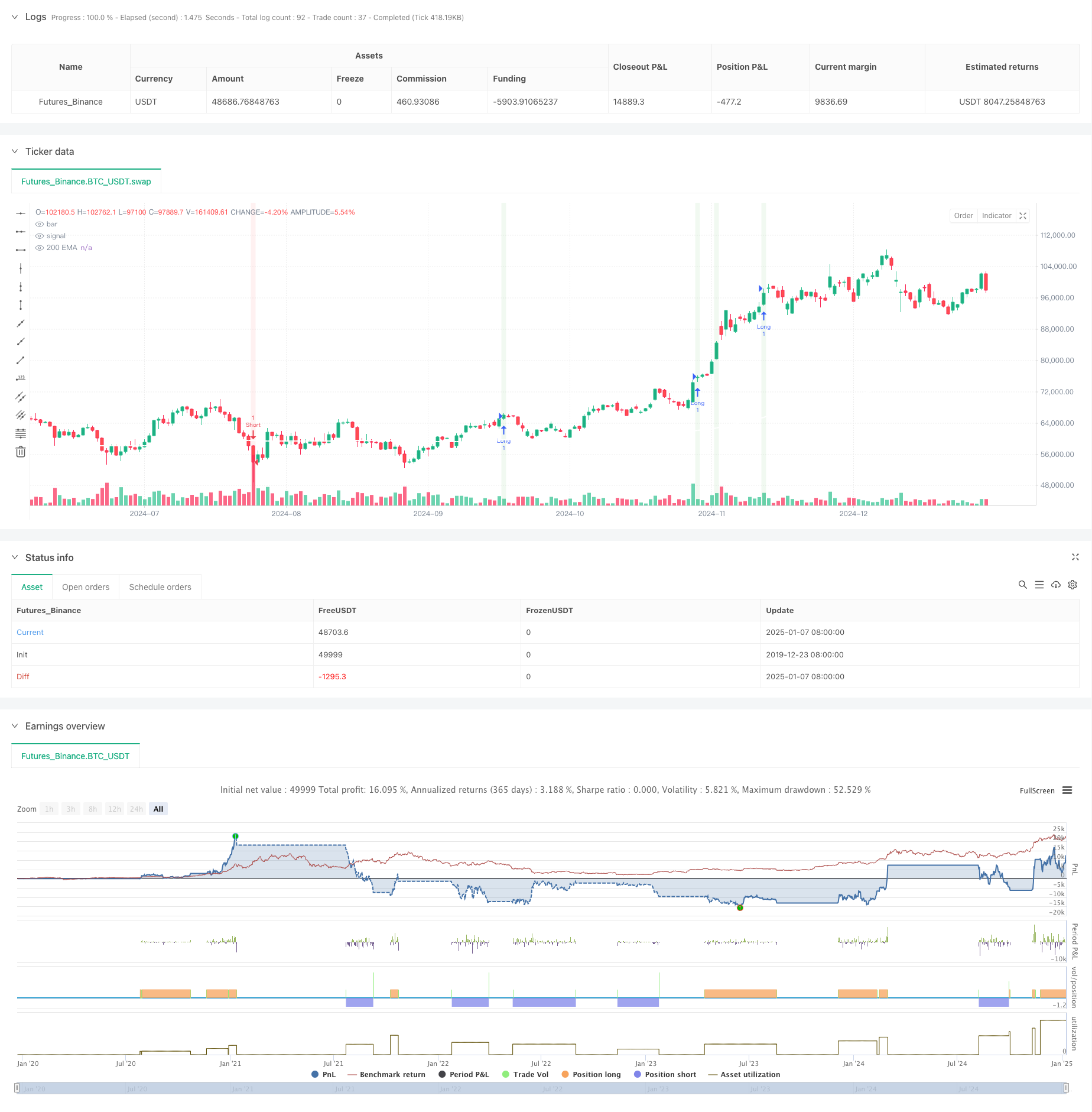
Overview
This is a trend following strategy that combines Exponential Moving Average (EMA), Madrid Ribbon, and Donchian Channel. The strategy's uniqueness lies in its three switchable take-profit/stop-loss modes: tick-based, dollar-based, and risk-reward ratio based. It enhances reliability through a double confirmation mechanism, only executing trades on the second valid signal.
Strategy Principles
The strategy employs a triple technical indicator combination to identify trading opportunities:
- 200-period EMA to determine overall trend direction
- Madrid Ribbon (crossover of 5-period and 100-period EMA) for medium-term trend judgment
- Donchian Channel breakout for specific entry timing
Long trade conditions: price above 200 EMA, bullish Madrid Ribbon, and price breaks above Donchian Channel. Short trade conditions: price below 200 EMA, bearish Madrid Ribbon, and price breaks below Donchian Channel. To reduce false signals, trades are only executed on the second valid signal occurrence.
Strategy Advantages
- Flexible TP/SL management system adaptable to different trading styles
- Multiple technical indicators combination provides more reliable signals
- Double confirmation mechanism effectively reduces false signals
- Strategy completely avoids look-ahead bias with no repainting
- Highly customizable for different market environments
Strategy Risks
- Potential significant drawdowns during trend reversals Solution: Adjust indicator parameters to increase strategy sensitivity
- Over-reliance on technical indicators may miss certain market opportunities Solution: Recommend combining with fundamental analysis
- Fixed TP/SL may not suit all market conditions Solution: Dynamically adjust TP/SL levels based on volatility
Strategy Optimization Directions
- Introduce volatility indicators for dynamic TP/SL adjustment
- Add volume analysis to improve signal reliability
- Incorporate more market sentiment indicators
- Develop adaptive parameter optimization system
- Add risk management module, such as maximum drawdown control
Summary
This is a trend following strategy that combines multiple classic technical indicators, enhancing trading stability through flexible TP/SL management and double confirmation mechanism. The strategy's high customizability allows it to adapt to different market environments and trading styles. It is recommended to conduct thorough historical data backtesting before live trading and adjust parameters according to specific market characteristics.
Source Pine Script
/*backtest
start: 2019-12-23 08:00:00
end: 2025-01-08 08:00:00
period: 1d
basePeriod: 1d
exchanges: [{"eid":"Futures_Binance","currency":"BTC_USDT","balance":49999}]
*/

//@version=6
strategy("Pamplona Enhanced TP/SL Toggleable", overlay=true, default_qty_type=strategy.fixed, default_qty_value=1)

// Input settings
use_tick_based = input.bool(false, title="Use Tick-Based TP/SL")
use_dollar_based = input.bool(false, title="Use Dollar-Based TP/SL")
use_risk_reward = input.bool(true, title="Use Risk-Reward TP/SL") // Default option

tick_size = input.float(0.1, title="Tick Size (for Tick-Based)", minval=0.0001, step=0.0001)
ticks = input.int(10, title="Ticks (for Tick-Based TP/SL)", minval=1)
dollar_tp = input.float(10.0, title="Dollar Take Profit (for Dollar-Based)", minval=0.01, step=0.01)
dollar_sl = input.float(10.0, title="Dollar Stop Loss (for Dollar-Based)", minval=0.01, step=0.01)
risk_reward_ratio = input.float(2.0, title="Risk-Reward Ratio (for Risk-Reward TP/SL)", minval=0.1, step=0.1)
contract_size = input.int(1, title="Contract Size", minval=1)

// Retrieve indicators
ema200 = ta.ema(close, 200)
src = close
ma05 = ta.ema(src, 5)
ma100 = ta.ema(src, 100)
madrid_green = ma05 > ma100
dlen = input.int(20, title="Donchian Channel Period")
highest_d = ta.highest(high, dlen)
lowest_d = ta.lowest(low, dlen)
donchian_green = close > highest_d[1]
donchian_red = close < lowest_d[1]

// Track signals
var int long_signal_count = 0
var int short_signal_count = 0

// Conditions
long_condition_raw = madrid_green and donchian_green and close > ema200
short_condition_raw = not madrid_green and donchian_red and close < ema200

// Update signal counters
if long_condition_raw
    long_signal_count += 1
else
    long_signal_count := 0

if short_condition_raw
    short_signal_count += 1
else
    short_signal_count := 0

// Final conditions to enter on the second signal
long_condition = long_signal_count == 2
short_condition = short_signal_count == 2

// Ensure exactly one TP/SL mode is enabled
tp_sl_mode_count = (use_tick_based ? 1 : 0) + (use_dollar_based ? 1 : 0) + (use_risk_reward ? 1 : 0)
if tp_sl_mode_count != 1
    runtime.error("Enable exactly ONE TP/SL mode (Tick-Based, Dollar-Based, or Risk-Reward).")

// Function to calculate TP/SL based on active mode
calc_tp_sl(entry_price, is_long) =>
    float tp = na
    float sl = na
    if use_tick_based
        tp := is_long ? entry_price + ticks * tick_size : entry_price - ticks * tick_size
        sl := is_long ? entry_price - ticks * tick_size : entry_price + ticks * tick_size
    else if use_dollar_based
        tp := is_long ? entry_price + (dollar_tp / contract_size) : entry_price - (dollar_tp / contract_size)
        sl := is_long ? entry_price - (dollar_sl / contract_size) : entry_price + (dollar_sl / contract_size)
    else if use_risk_reward
        risk = is_long ? close - low : high - close
        tp := is_long ? close + (risk * risk_reward_ratio) : close - (risk * risk_reward_ratio)
        sl := is_long ? close - risk : close + risk
    [tp, sl]

// Entry logic
if long_condition
    [take_profit, stop_loss] = calc_tp_sl(close, true)
    strategy.entry("Long", strategy.long, qty=contract_size)
    strategy.exit("Take Profit", from_entry="Long", limit=take_profit, stop=stop_loss)

if short_condition
    [take_profit, stop_loss] = calc_tp_sl(close, false)
    strategy.entry("Short", strategy.short, qty=contract_size)
    strategy.exit("Take Profit", from_entry="Short", limit=take_profit, stop=stop_loss)

// Plot indicators
plot(ema200, title="200 EMA", color=color.white, linewidth=2)
bgcolor(long_condition ? color.new(color.green, 90) : short_condition ? color.new(color.red, 90) : na)
Published by ChaoZhang on the FMZ strategy square · last modified 2025-01-10. Collected in the Quant Trading Vault. Unvalidated research: re-test with your own data and costs before trusting it.
Build this with AgenKit
A spec is not a trading system. Paste this into your coding agent and AgenKit runs a specialist team — architecture, test-first build, risk gates, review — with paper trading on by default.
/agenkit build a production-grade trading bot with a backtest engine, risk controls and paper trading by default from strategies/Multi-Mode-Take-Profit-Stop-Loss-Trend-Following-Strategy-Based-on-EMA-Madrid-Ribbon-and-Donchian-Channel.md- npx agenkit install engineering-kit in your project
- Paste the command into your agent and approve each phase
- Get tests, backtest, risk controls and a paper-trading switch
Understand it first
Before you run this, read the lesson behind the idea and how to backtest it honestly. Specs like this one are the survivors of an unknown number of trials; deflate their results accordingly.
Related specs
- Donchian Channel and Larry Williams Large Trade Index StrategyPine Script · Breakout · 1m
- Momentum Breakout Trading Strategy 435896Pine Script · Breakout · 1d
- Multi Indicator Short Term Algorithmic Trading StrategyPine Script · Breakout · 4h
- Multi Indicator Trend Breakout Strategy with Dynamic Stop LossPine Script · Breakout · 1d
- Trend Following Strategy with MACD and Donchian ChannelPine Script · Breakout · 1h
- Triple Dragon SystemPine Script · Breakout · 1h