Strategy vault / Trend following
Multi Period Moving Average Channel Trend Following Strategy
This is a swing strategy designed for trending markets such as crypto and stocks, using large timeframes like 8 hours. The strategy uses multiple moving averages including SMA, EMA, VWMA, ALMA, SMMA, LSMA and VWMA…
Overview
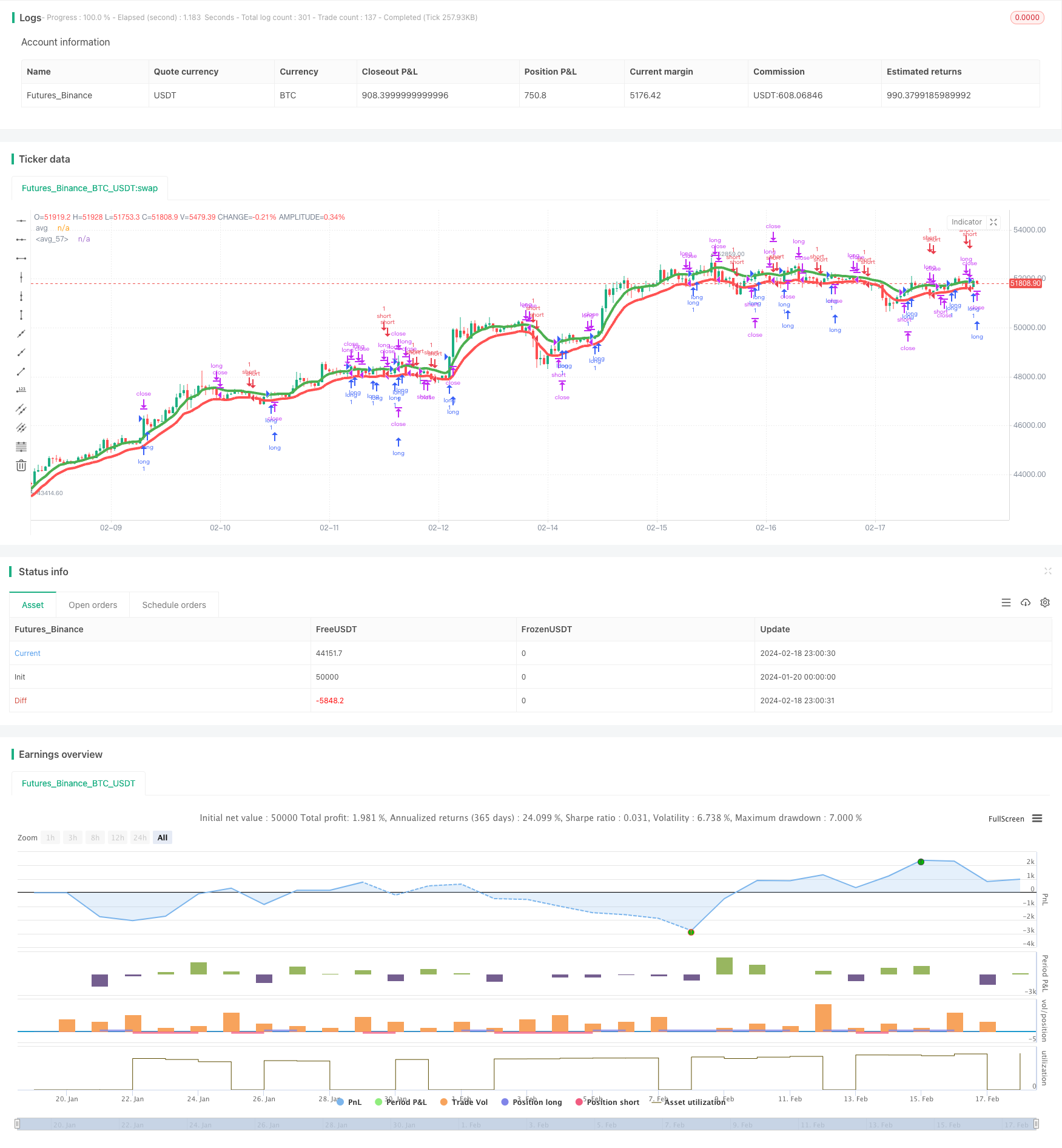
This is a swing strategy designed for trending markets such as crypto and stocks, using large timeframes like 8 hours. The strategy uses multiple moving averages including SMA, EMA, VWMA, ALMA, SMMA, LSMA and VWMA applied separately to high and low to form two average lines as a channel.
Go long when close is above the average line applied to high. Go short when close is below the average line applied to low.
Strategy Logic
The strategy uses 7 different types of moving averages including SMA, EMA, VWMA, ALMA, SMMA, LSMA and VWMA. These MAs are applied separately to the highest and lowest prices of candlesticks to generate two average lines.
The average line applied to high prices is called avg_high. The one applied to low prices is called avg_low. These two lines form a channel.
Go long when close is above avg_high. Go short when close is below avg_low.
The stop loss for long is avg_low. Take profit is entry price *(1 + tp_long). For short, stop loss is avg_high, take profit is entry price *(1 - tp_short).
Advantage Analysis
The biggest advantage of this strategy is utilizing multiple moving averages to improve profitability. Different MAs have different reaction speeds to price changes. Combining them forms more reliable trading signals.
Another advantage is the channel approach. The channel limits stop loss range and reduces risk suitable for swing trading.
Risk Analysis
The strategy has two main risks:
The combination of multiple MAs makes parameter tuning complex requiring lots of tests and optimization to find the best.
In sideways or non-trending markets, the strategy tends to generate losses and whipsaws.
To mitigate the risks, choose products with clear trends, and do extensive backtests and optimization to find parameters suitable for current market conditions.
Optimization Directions
Areas for further optimization:
Test more types of MAs to find better combinations, like SMA, EMA, KAMA, TEMA etc.
Optimize lengths of MAs and channel width to determine optimum parameters.
Test different take profit and stop loss mechanisms like trailing stops or dynamic stops.
Incorporate trend metrics like ADX, ATR to avoid whipsaws during choppy markets.
Optimize entry and exit logics with additional filters to reduce invalid trades.
Summary
This swing trend following strategy improves profitability using multiple MAs and reduces risk via channels. It works well for trending products after parameter optimization. But can suffer big losses at trend reversals. Further optimizations needed to mitigate downside risks.
Parameters
| Name | Default | What it controls |
|---|---|---|
| v_input_1 | true | From Day |
| v_input_2 | true | From Month |
| v_input_3 | 2000 | From Year |
| v_input_4 | 31 | To Day |
| v_input_5 | 12 | To Month |
| v_input_6 | 2021 | To Year |
| v_input_7 | 12 | Length Moving averages |
| v_input_8 | 0.06 | TP Long |
| v_input_9 | 0.05 | SL Long |
| v_input_10 | 0.045 | TP Short |
| v_input_11 | 0.05 | SL Short |
Source Pine Script
/*backtest
start: 2024-01-20 00:00:00
end: 2024-02-19 00:00:00
period: 1h
basePeriod: 15m
exchanges: [{"eid":"Futures_Binance","currency":"BTC_USDT"}]
*/

// This source code is subject to the terms of the Mozilla Public License 2.0 at https://mozilla.org/MPL/2.0/
// © exlux99

//@version=4

strategy(title="High/Low channel swing", shorttitle="Multi MA swing", overlay=true)


fromDay = input(defval = 1, title = "From Day", minval = 1, maxval = 31)
fromMonth = input(defval = 1, title = "From Month", minval = 1, maxval = 12)
fromYear = input(defval = 2000, title = "From Year", minval = 1970)
 //monday and session
// To Date Inputs
toDay = input(defval = 31, title = "To Day", minval = 1, maxval = 31)
toMonth = input(defval = 12, title = "To Month", minval = 1, maxval = 12)
toYear = input(defval = 2021, title = "To Year", minval = 1970)

startDate = timestamp(fromYear, fromMonth, fromDay, 00, 00)
finishDate = timestamp(toYear, toMonth, toDay, 00, 00)
time_cond = true

//////
length_ma= input(defval=12, title="Length Moving averages", minval=1)

////////////////////////////////SETUP///////////////////////////////////////////

sma_high   = sma(high, length_ma)
ema_high   = ema(high, length_ma)
wma_high   = wma(high, length_ma)
alma_high  = alma(high,length_ma, 0.85, 6)
smma_high = rma(high,length_ma)
lsma_high = linreg(high, length_ma, 0)
vwma_high = vwma(high,length_ma)


avg_high = (sma_high+ema_high+wma_high+alma_high+smma_high+lsma_high+vwma_high)/7

///////////////////////////////////////////

sma_low   = sma(low, length_ma)
ema_low   = ema(low, length_ma)
wma_low   = wma(low, length_ma)
alma_low  = alma(low,length_ma, 0.85, 6)
smma_low = rma(low,length_ma)
lsma_low = linreg(low, length_ma, 0)
vwma_low = vwma(low,length_ma)


avg_low = (sma_low+ema_low+wma_low+alma_low+smma_low+lsma_low+vwma_low)/7

////////////////////////////PLOTTING////////////////////////////////////////////


plot(avg_high , title="avg", color=color.green, linewidth = 4)
plot(avg_low , title="avg", color=color.red, linewidth = 4)

long= close > avg_high
short = close < avg_low

tplong=input(0.06, title="TP Long", step=0.01)
sllong=input(0.05, title="SL Long", step=0.01)

tpshort=input(0.045, title="TP Short", step=0.01)
slshort=input(0.05, title="SL Short", step=0.01)

if(time_cond)
    strategy.entry("long",1,when=long)
    strategy.exit("closelong", "long" , profit = close * tplong / syminfo.mintick, loss = close * sllong / syminfo.mintick, alert_message = "closelong")
    strategy.close("long", when=crossunder(low,avg_low))


    strategy.entry("short",0,when=short)
    strategy.exit("closeshort", "short" , profit = close * tpshort / syminfo.mintick, loss = close * slshort / syminfo.mintick, alert_message = "closeshort")
    strategy.close("short",when=crossover(high,avg_high))
Published by ChaoZhang on the FMZ strategy square · last modified 2024-02-20. Collected in the Quant Trading Vault. Unvalidated research: re-test with your own data and costs before trusting it.
Build this with AgenKit
A spec is not a trading system. Paste this into your coding agent and AgenKit runs a specialist team — architecture, test-first build, risk gates, review — with paper trading on by default.
/agenkit build a production-grade trading bot with a backtest engine, risk controls and paper trading by default from strategies/Multi-Period-Moving-Average-Channel-Trend-Following-Strategy.md- npx agenkit install engineering-kit in your project
- Paste the command into your agent and approve each phase
- Get tests, backtest, risk controls and a paper-trading switch
Understand it first
Before you run this, read the lesson behind the idea and how to backtest it honestly. Specs like this one are the survivors of an unknown number of trials; deflate their results accordingly.
Related specs
- Multi Factor Trend Price Action Strategy with Dynamic Risk Management SystemPine Script · Trend following · 2h
- Multi Indicator Dynamic Trend Following Strategy Based on EMA and SMAPine Script · Trend following · 1d
- Trend Tracking and Short term Trading Strategy Based on ADX IndicatorPine Script · Trend following · 1d
- DPO EMA Trend Crossover Quantitative Strategy ResearchPine Script · Trend following · 1d
- Dual EMA Crossover Trend Following Strategy with ATR and ADX FiltersPine Script · Trend following · 1d
- Multi Period Trend Confirmation Dynamic Risk Control Quantitative Trading StrategyPine Script · Trend following · 1h