Strategy vault / Multi-timeframe
Multi Timeframe Dynamic Backtesting Strategy
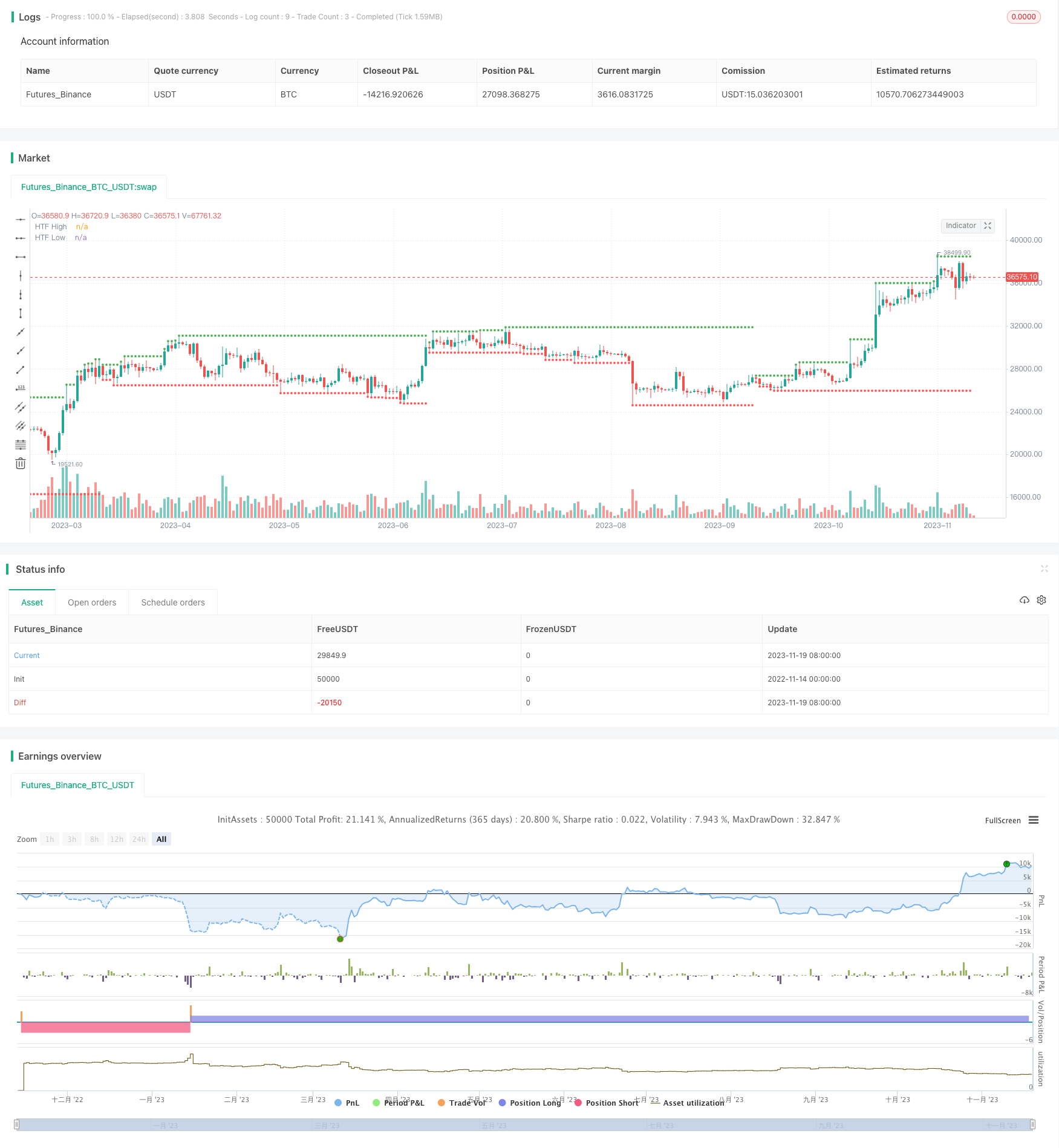
This strategy employs a multi timeframe dynamic backtesting mechanism to determine price trends by comparing the highest and lowest prices across different time periods, thereby achieving low-risk arbitrage.
Overview
This strategy employs a multi timeframe dynamic backtesting mechanism to determine price trends by comparing the highest and lowest prices across different time periods, thereby achieving low-risk arbitrage.
Strategy Logic
The strategy retrieves the highest price (nhigh) and lowest price (nlow) across different timeframes by calling the custom function f_get_htfHighLow. Specifically, based on user-defined inputs like time period resolution, time period multiplier HTFMultiplier, backtesting parameters lookahead and gaps, and offset, it invokes the security function to obtain the highest and lowest prices over different timeframes.
For example, an offset of 0 retrieves the highest and lowest prices of the current bar, while an offset of 1 retrieves those prices from the previous bar. By comparing price changes between bars, trend direction is determined.
If both highest and lowest prices rise, a bullish trend is identified. If both prices fall, a bearish trend is seen. Longing or shorting positions are taken based on the trend direction to implement arbitrage trades.
Advantages
- Enhanced accuracy through multi timeframe analysis
- Avoids repainting via dynamic backtesting
- Flexible parameters accommodate market changes
- Reduced risk with positions only in clear trends
Risks
- Multi timeframe misjudgements
- Repainting from improper backtesting parameters
- High costs and slippage from excessive trades
Solutions:
- Optimize time periods for accuracy
- Strictly test parameters to prevent repainting
- Moderate entry conditions to control frequency
Enhancement Opportunities
- Add ML to leverage AI for trends
- Incorporate volatility filters for dynamic position sizing
- Introduce stops to effectively limit losses
Conclusion
The strategy logic is clear, using multi timeframe dynamic backtesting to determine trends and minimize human bias. With refinement through parameter optimization and feature expansion, it demonstrates significant potential for improved stability and profitability worthy of further research and tracking.
Parameters
| Name | Default | What it controls |
|---|---|---|
| v_input_1 | timestamp(01 Jan 2010 00:00 +0000) | Start Time |
| v_input_2 | timestamp(01 Jan 2099 00:00 +0000) | End Time |
| v_input_3 | 3M | resolution |
| v_input_4 | 22 | HTFMultiplier |
| v_input_5 | false | offset |
| v_input_6 | true | lookahead |
Source Pine Script
/*backtest
start: 2022-11-14 00:00:00
end: 2023-11-20 00:00:00
period: 1d
basePeriod: 1h
exchanges: [{"eid":"Futures_Binance","currency":"BTC_USDT"}]
*/

// This source code is subject to the terms of the Mozilla Public License 2.0 at https://mozilla.org/MPL/2.0/
// © HeWhoMustNotBeNamed

//@version=4
strategy("HTF High/Low Repaint Strategy", overlay=true, initial_capital = 20000, default_qty_type = strategy.percent_of_equity, default_qty_value = 100, commission_type = strategy.commission.percent, pyramiding = 1, commission_value = 0.01)

i_startTime = input(defval = timestamp("01 Jan 2010 00:00 +0000"), title = "Start Time", type = input.time)
i_endTime = input(defval = timestamp("01 Jan 2099 00:00 +0000"), title = "End Time", type = input.time)
inDateRange = true

resolution = input("3M", type=input.resolution)
HTFMultiplier = input(22, minval=1, step=1)
offset = input(0, minval=0, step=1)
lookahead = input(true)
gaps = false

f_secureSecurity_on_on(_symbol, _res, _src, _offset) => security(_symbol, _res, _src[_offset], lookahead = barmerge.lookahead_on, gaps=barmerge.gaps_on)
f_secureSecurity_on_off(_symbol, _res, _src, _offset) => security(_symbol, _res, _src[_offset], lookahead = barmerge.lookahead_on, gaps=barmerge.gaps_off)
f_secureSecurity_off_on(_symbol, _res, _src, _offset) => security(_symbol, _res, _src[_offset], lookahead = barmerge.lookahead_off, gaps=barmerge.gaps_on)
f_secureSecurity_off_off(_symbol, _res, _src, _offset) => security(_symbol, _res, _src[_offset], lookahead = barmerge.lookahead_off, gaps=barmerge.gaps_off)

f_multiple_resolution(HTFMultiplier) =>
    target_Res_In_Min = timeframe.multiplier * HTFMultiplier * (
      timeframe.isseconds   ? 1. / 60. :
      timeframe.isminutes   ? 1. :
      timeframe.isdaily     ? 1440. :
      timeframe.isweekly    ? 7. * 24. * 60. :
      timeframe.ismonthly   ? 30.417 * 24. * 60. : na)

    target_Res_In_Min     <= 0.0417       ? "1S"  :
      target_Res_In_Min   <= 0.167        ? "5S"  :
      target_Res_In_Min   <= 0.376        ? "15S" :
      target_Res_In_Min   <= 0.751        ? "30S" :
      target_Res_In_Min   <= 1440         ? tostring(round(target_Res_In_Min)) :
      tostring(round(min(target_Res_In_Min / 1440, 365))) + "D"

f_get_htfHighLow(resolution, HTFMultiplier, lookahead, gaps, offset)=>
    derivedResolution = resolution == ""?f_multiple_resolution(HTFMultiplier):resolution
    nhigh_on_on = f_secureSecurity_on_on(syminfo.tickerid, derivedResolution, high, offset)
    nlow_on_on = f_secureSecurity_on_on(syminfo.tickerid, derivedResolution, low, offset)

    nhigh_on_off = f_secureSecurity_on_off(syminfo.tickerid, derivedResolution, high, offset)
    nlow_on_off = f_secureSecurity_on_off(syminfo.tickerid, derivedResolution, low, offset)

    nhigh_off_on = f_secureSecurity_off_on(syminfo.tickerid, derivedResolution, high, offset)
    nlow_off_on = f_secureSecurity_off_on(syminfo.tickerid, derivedResolution, low, offset)

    nhigh_off_off = f_secureSecurity_off_off(syminfo.tickerid, derivedResolution, high, offset)
    nlow_off_off = f_secureSecurity_off_off(syminfo.tickerid, derivedResolution, low, offset)

    nhigh = lookahead and gaps ? nhigh_on_on :
             lookahead and not gaps ? nhigh_on_off :
             not lookahead and gaps ? nhigh_off_on :
             not lookahead and not gaps ? nhigh_off_off : na
    nlow = lookahead and gaps ? nlow_on_on :
             lookahead and not gaps ? nlow_on_off :
             not lookahead and gaps ? nlow_off_on :
             not lookahead and not gaps ? nlow_off_off : na
    [nhigh, nlow]

[nhigh, nlow] = f_get_htfHighLow(resolution, HTFMultiplier, lookahead, gaps, offset)
[nhighlast, nlowlast] = f_get_htfHighLow(resolution, HTFMultiplier, lookahead, gaps, offset+1)
plot(nhigh , title="HTF High",style=plot.style_circles, color=color.green, linewidth=1)
plot(nlow , title="HTF Low",style=plot.style_circles, color=color.red, linewidth=1)

buyCondition = nhigh > nhighlast and nlow > nlowlast
sellCondition = nhigh < nhighlast and nlow < nlowlast

strategy.entry("Buy", strategy.long, when= buyCondition and inDateRange, oca_name="oca_buy")
strategy.entry("Sell", strategy.short, when= sellCondition and inDateRange, oca_name="oca_sell")
Published by ChaoZhang on the FMZ strategy square · last modified 2023-11-21. Collected in the Quant Trading Vault. Unvalidated research: re-test with your own data and costs before trusting it.
Build this with AgenKit
A spec is not a trading system. Paste this into your coding agent and AgenKit runs a specialist team — architecture, test-first build, risk gates, review — with paper trading on by default.
/agenkit build a production-grade trading bot with a backtest engine, risk controls and paper trading by default from strategies/Multi-Timeframe-Dynamic-Backtesting-Strategy.md- npx agenkit install engineering-kit in your project
- Paste the command into your agent and approve each phase
- Get tests, backtest, risk controls and a paper-trading switch
Understand it first
Before you run this, read the lesson behind the idea and how to backtest it honestly. Specs like this one are the survivors of an unknown number of trials; deflate their results accordingly.
Related specs
- EMA RSI and MACD Based Multi Timeframe Trading StrategyPine Script · Multi-timeframe · 1h
- Low Pyramid Risk Tracking StrategyPine Script · Multi-timeframe · 1d
- MacD Custom Indicator Multiple Time FrameAll Available OptionsPine Script · Multi-timeframe · 1h
- Multi Timeframe Adaptive Dynamic KDJ Indicator StrategyPine Script · Multi-timeframe · 1d
- Multi Timeframe Dynamic Stop Loss EMA Squeeze Trading StrategyPine Script · Multi-timeframe · 1h
- Multi Timeframe Ichimoku MACD and DMI Combined StrategyPine Script · Multi-timeframe · 1h