Strategy vault / Trend following
Multi timeframe MA Trend Following Strategy
This strategy is based on the multi-timeframe moving average crossover to track middle-long term trends. It adopts a pyramiding position to chase rises and achieve exponential capital growth. The biggest advantage is…
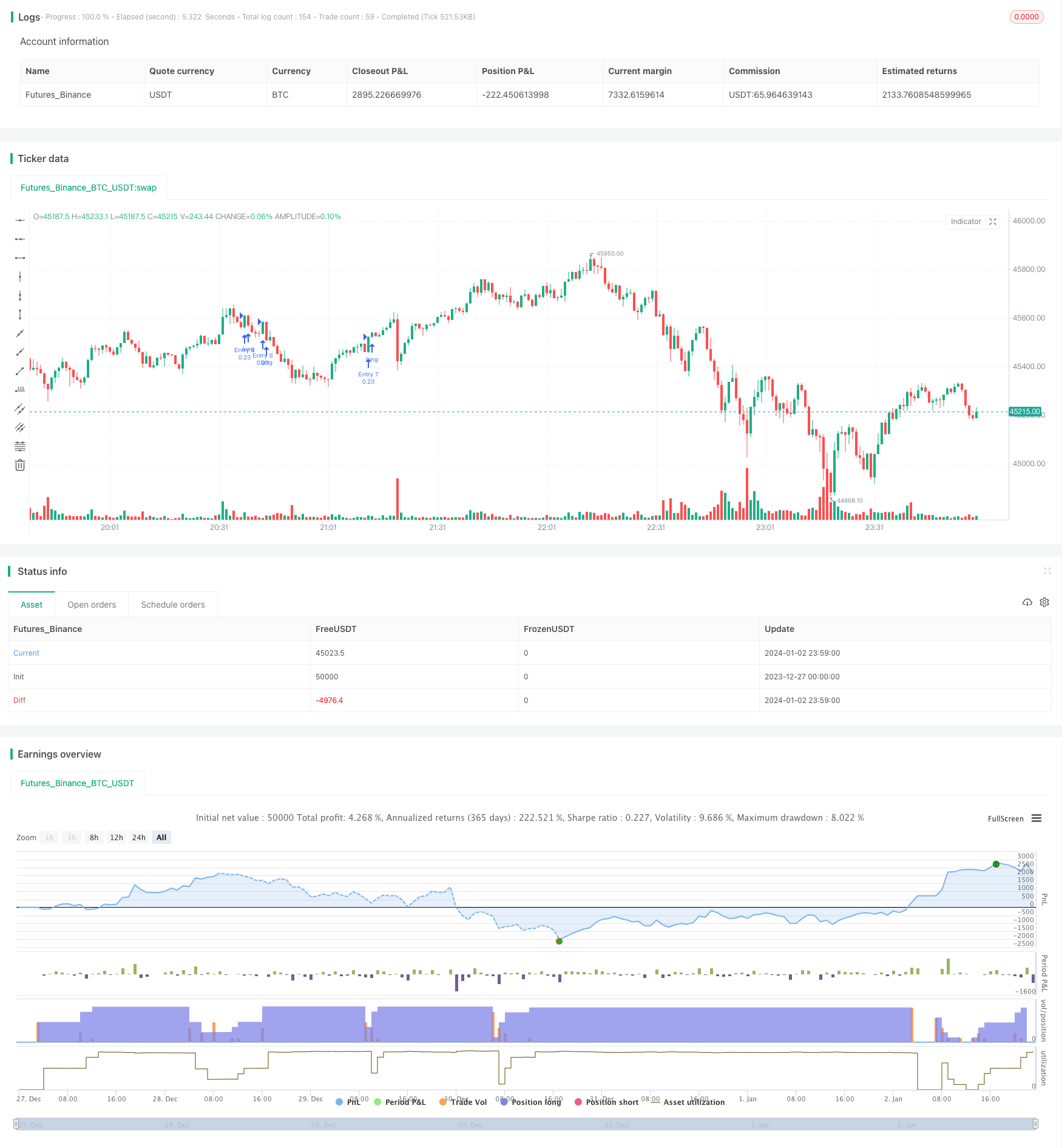
Overview
This strategy is based on the multi-timeframe moving average crossover to track middle-long term trends. It adopts a pyramiding position to chase rises and achieve exponential capital growth. The biggest advantage is being able to catch the mid-long term trends and pyramid entries in batches and stages to obtain excess returns.
Strategy Logic
- Build multiple timeframes based on 9-day MA, 100-day MA and 200-day MA.
- Generate buy signals when shorter period MA crosses above longer period MA.
- Adopt 7 staged pyramiding entries. Check existing positions before adding new entry, stop pyramiding when 6 positions already opened.
- Set fixed 3% TP/SL for risk control.
Above is the basic trading logic.
Advantages
- Effectively catch mid-long term trends and enjoy exponential growth.
- Multi-timeframe MA crossover avoids short-term noise.
- Fixed TP/SL controls risk for each position.
- Pyramid entries in batches to obtain excess returns.
Risks & Solutions
- Risk of huge loss if fail to cut loss in trend reversal. Solution is to shorten MA periods and quicken stop loss.
- Risk of margin call if loss beyond tolerance. Solution is to lower initial position size.
- Risk of over 700% loss if strong downtrend. Solution is to raise fixed stop loss percentage.
Optimization Directions
- Test different MA combinations to find optimal parameters.
- Optimize pyramiding stages quantity. Test to find best number.
- Test fixed TP/SL settings. Expand TP range for higher profitability.
Summary
The strategy is very suitable to catch mid-long term trends. Pyramid entries in batches can achieve very high risk-reward ratio. There are also some operation risks, which should be controlled by parameter tuning. Overall this is a promising strategy worth live trading verification and further optimization.
Parameters
| Name | Default | What it controls |
|---|---|---|
| v_input_1 | true | From Month |
| v_input_2 | 10 | From Day |
| v_input_3 | 2020 | From Year |
| v_input_4 | true | Thru Month |
| v_input_5 | true | Thru Day |
| v_input_6 | 2112 | Thru Year |
| v_input_7 | true | Show Date Range |
| v_input_8 | 9 | MAfast |
| v_input_9 | 100 | MAslow |
| v_input_10 | 200 | MAlong |
| v_input_11 | 3 | ProfitTarget_Percent |
| v_input_12 | 3 | LossTarget_Percent |
Source Pine Script
/*backtest
start: 2023-12-27 00:00:00
end: 2024-01-03 00:00:00
period: 1m
basePeriod: 1m
exchanges: [{"eid":"Futures_Binance","currency":"BTC_USDT"}]
*/

// This source code is subject to the terms of the Mozilla Public License 2.0 at https://mozilla.org/MPL/2.0/
    // © Coinrule

//@version=3
strategy(shorttitle='Pyramiding Entry On Early Trends',title='Pyramiding Entry On Early Trends (by Coinrule)', overlay=false, pyramiding= 7, initial_capital = 1000, default_qty_type = strategy.percent_of_equity, default_qty_value = 20, commission_type=strategy.commission.percent, commission_value=0.1)


//Backtest dates
fromMonth = input(defval = 1,  title = "From Month")
fromDay   = input(defval = 10,    title = "From Day")
fromYear  = input(defval = 2020, title = "From Year")
thruMonth = input(defval = 1,    title = "Thru Month")
thruDay   = input(defval = 1,    title = "Thru Day")
thruYear  = input(defval = 2112, title = "Thru Year")

showDate  = input(defval = true, title = "Show Date Range")

start     = timestamp(fromYear, fromMonth, fromDay, 00, 00)        // backtest start window
finish    = timestamp(thruYear, thruMonth, thruDay, 23, 59)        // backtest finish window
window()  => true       // create function "within window of time"


//MA inputs and calculations
inSignal=input(9, title='MAfast')
inlong1=input(100, title='MAslow')
inlong2=input(200, title='MAlong')

MAfast= sma(close, inSignal)
MAslow= sma(close, inlong1)
MAlong= sma(close, inlong2)


Bullish = crossover(close, MAfast)

longsignal = (Bullish and MAfast > MAslow and MAslow < MAlong and window())

//set take profit

ProfitTarget_Percent = input(3)
Profit_Ticks = (close * (ProfitTarget_Percent / 100)) / syminfo.mintick

//set take profit

LossTarget_Percent = input(3)
Loss_Ticks = (close * (LossTarget_Percent / 100)) / syminfo.mintick


//Order Placing

strategy.entry("Entry 1", strategy.long, when = (strategy.opentrades == 0) and longsignal)

strategy.entry("Entry 2", strategy.long, when = (strategy.opentrades == 1) and longsignal)

strategy.entry("Entry 3", strategy.long, when = (strategy.opentrades == 2) and longsignal)

strategy.entry("Entry 4", strategy.long, when = (strategy.opentrades == 3) and longsignal)

strategy.entry("Entry 5", strategy.long, when = (strategy.opentrades == 4) and longsignal)

strategy.entry("Entry 6", strategy.long, when = (strategy.opentrades == 5) and longsignal)

strategy.entry("Entry 7", strategy.long, when = (strategy.opentrades == 6) and longsignal)


if (strategy.position_size > 0)
    strategy.exit(id="Exit 1", from_entry = "Entry 1", profit = Profit_Ticks, loss = Loss_Ticks)
    strategy.exit(id="Exit 2", from_entry = "Entry 2", profit = Profit_Ticks, loss = Loss_Ticks)
    strategy.exit(id="Exit 3", from_entry = "Entry 3", profit = Profit_Ticks, loss = Loss_Ticks)
    strategy.exit(id="Exit 4", from_entry = "Entry 4", profit = Profit_Ticks, loss = Loss_Ticks)
    strategy.exit(id="Exit 5", from_entry = "Entry 5", profit = Profit_Ticks, loss = Loss_Ticks)
    strategy.exit(id="Exit 6", from_entry = "Entry 6", profit = Profit_Ticks, loss = Loss_Ticks)
    strategy.exit(id="Exit 7", from_entry = "Entry 7", profit = Profit_Ticks, loss = Loss_Ticks)
Published by ChaoZhang on the FMZ strategy square · last modified 2024-01-04. Collected in the Quant Trading Vault. Unvalidated research: re-test with your own data and costs before trusting it.
Build this with AgenKit
A spec is not a trading system. Paste this into your coding agent and AgenKit runs a specialist team — architecture, test-first build, risk gates, review — with paper trading on by default.
/agenkit build a production-grade trading bot with a backtest engine, risk controls and paper trading by default from strategies/Multi-timeframe-MA-Trend-Following-Strategy.md- npx agenkit install engineering-kit in your project
- Paste the command into your agent and approve each phase
- Get tests, backtest, risk controls and a paper-trading switch
Understand it first
Before you run this, read the lesson behind the idea and how to backtest it honestly. Specs like this one are the survivors of an unknown number of trials; deflate their results accordingly.
Related specs
- ADX MA and EMA Long Only Trend Tracking StrategyPine Script · Trend following · 1d
- ATR and Moving Average Crossover Hybrid StrategyPine Script · Trend following · 1h
- Adaptive FVG Detection and MA Trend Trading Strategy with Dynamic ResistancePine Script · Trend following · 1d
- Adaptive Risk Management Strategy Based on Dynamic ATR and Moving Average CrossoverPine Script · Trend following · 2h
- Adaptive Trading Strategy Based on Stochastic RSI Dual Line CrossoverPine Script · Trend following · 4h
- Adaptive Volatility Based Trend Following Short Strategy with Time Delay and Stop Loss ProtectionPine Script · Trend following · 2m