Strategy vault / Multi-timeframe
Multi Timeframe Stochastic Strategy
The Multi-Timeframe Stochastic Strategy is a quantitative trading strategy based on the Stochastic oscillator indicator. It utilizes stochastic moving averages across both the current and higher timeframes to combine…
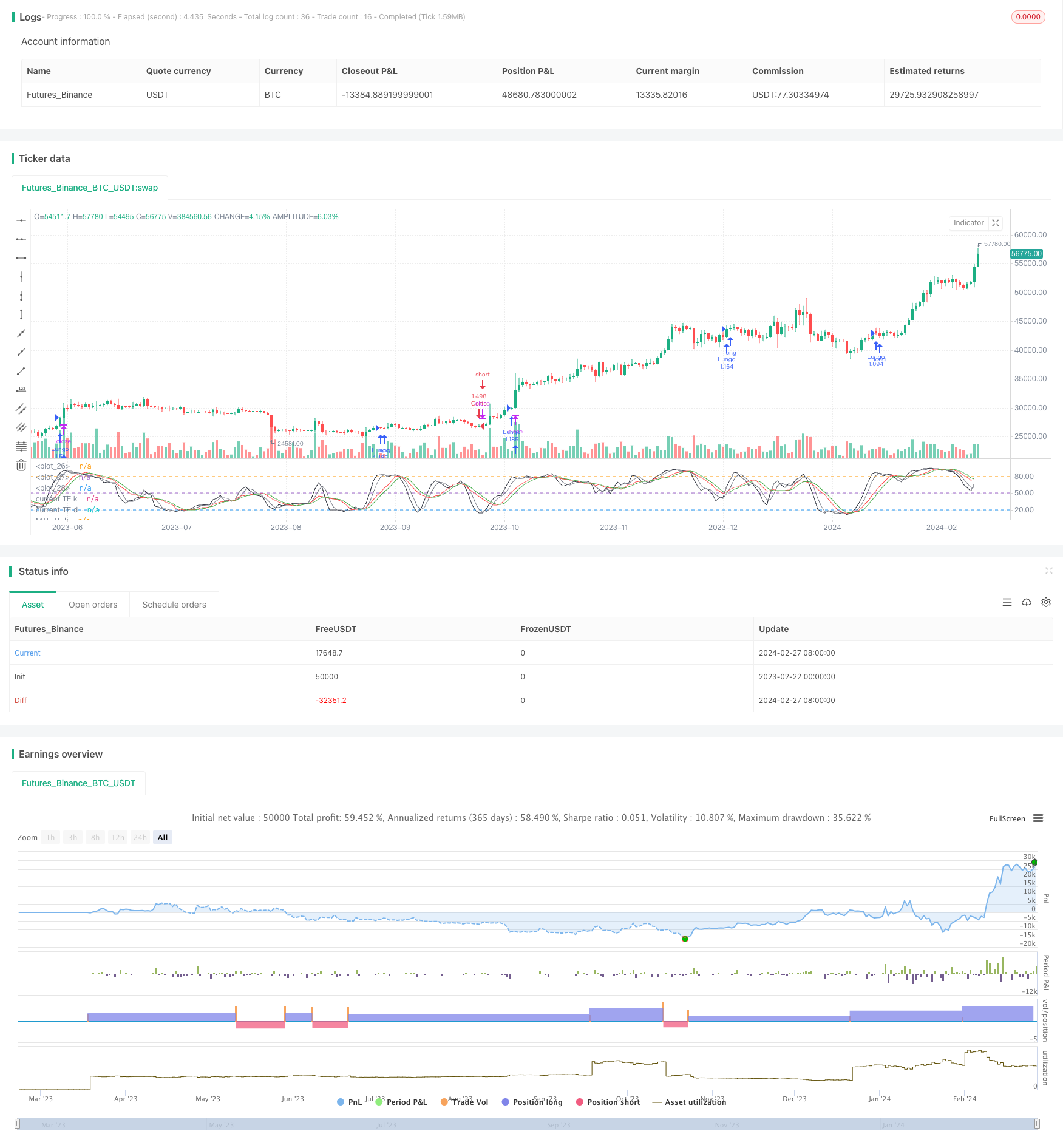
Overview
The Multi-Timeframe Stochastic Strategy is a quantitative trading strategy based on the Stochastic oscillator indicator. It utilizes stochastic moving averages across both the current and higher timeframes to combine trend following and mean reversion trading.
Strategy Logic
The core indicators of this strategy are the Stochastic K and D lines. The K line reflects recent price momentum while the D line is a moving average of the K line. Their relative position and direction can determine price trends and potential reversals.
Specifically, when the short-term K line crosses above the mid-term D line from below, it signals upward momentum in prices short-term. And when the K line crosses below the D line from above, it signals downside breakdown pressure short-term.
This strategy employs stochastic indicators across two timeframes to confirm signals and filter noise. The higher timeframe stochastic defines the overall trend while the current timeframe stochastic identifies short-term inflection points to time entries.
When the higher timeframe stochastic confirms an uptrend and the current timeframe stochastic shows an upside breakout, a long position is taken. When the higher timeframe stochastic indicates a downtrend and the current stochastic signals a downside breakdown, a short position is initiated.
Advantage Analysis
By combining multi-timeframe indicators and current momentum, this strategy can effectively filter out market noise and capture high-probability profitable trades. The main advantages are:
- Higher timeframe ensures trading with the trend to minimize unnecessary whipaws and losing trades.
- Current timeframe allows low-risk entries to capture short-term reversals within the trend.
- Dual stochastic indicators improve signal accuracy and reduce false signals.
Risk Analysis
There are some risks to consider with this strategy:
- Sudden trend reversals may not be captured early by the higher timeframe indicator, increasing losses from late directional switches. Timeframe parameters need to be optimized to get sufficiently timely market data.
- The current timeframe indicator can be too sensitive, increasing trade frequency and costs. Parameters need calibration to filter insignificant noise.
- Although the dual stochastic enhances accuracy, it also slows down reaction time. Fast market moves could lead to missing optimal entry points.
Optimization Directions
The main optimization directions include:
- Optimizing the higher timeframe stochastic smoothers to adapt faster to new trends.
- Adjusting the current timeframe parameters and breakout thresholds to reduce false signals.
- Testing timeframe combinations to find the optimal balance.
- Incorporating stop-loss strategies to control downside risk per trade.
Conclusion
The Multi-Timeframe Stochastic Strategy is a typical trend following system. By utilizing stochastic indicators across two timescales, it aims to precisely capture market movements. Further optimizations can enhance stability and profitability.
Parameters
| Name | Default | What it controls |
|---|---|---|
| v_input_1 | 11 | Length for Main Stochastic |
| v_input_2 | 3 | SmoothK for Main Stochastic |
| v_input_3 | 3 | SmoothD for Main Stochastic |
| v_input_4 | 80 | Upper Line Value? |
| v_input_5 | 20 | Lower Line Value? |
| v_input_6 | 50 | Trialing step value |
Source Pine Script
/*backtest
start: 2023-02-22 00:00:00
end: 2024-02-28 00:00:00
period: 1d
basePeriod: 1h
exchanges: [{"eid":"Futures_Binance","currency":"BTC_USDT"}]
*/

//@version=3
strategy("MTF stochastic strategy", overlay=false,pyramiding=3,default_qty_type=strategy.percent_of_equity,default_qty_value=100,currency=currency.USD)
//
//this strategy is inspired to bobby thread in forexfactory forum
//
len = input(11, minval=1, title="Length for Main Stochastic")
smoothK = input(3, minval=1, title="SmoothK for Main Stochastic")
smoothD = input(3, minval=1, title="SmoothD for Main Stochastic")
upLine = input(80, minval=50, maxval=90, title="Upper Line Value?")
lowLine = input(20, minval=10, maxval=50, title="Lower Line Value?")
trailStep=input(50,minval=10,title="Trialing step value")

// current stochastic calculation
k = sma(stoch(close, high, low, len), smoothK)
d = sma(k, smoothD)

//mtf stochastic calculation smoothed with period

mtfK= sma(stoch(close, high, low, len), smoothK*3)
mtfD= sma(k, smoothD*3)

plot(k,"current TF k",black,style=linebr)
plot(d,"current TF d",gray,style=linebr)
plot(mtfK,"MTF TF k",red,style=line)
plot(mtfD,"Multi TF d",green,style=line)
hline(upLine)
hline(50)
hline(lowLine)

longCondition = crossover(mtfK, 50) and k>50 and change(k,1)>0 and k>d and mtfK>mtfD
if (longCondition)
    strategy.entry("Lungo", strategy.long)

shortCondition = crossunder(mtfD, 50) and k<50 and change(k,1)<0 and k<d and mtfK<mtfD
if (shortCondition)
    strategy.entry("Corto", strategy.short)

exitlong=crossunder(mtfD, upLine)
exitshort=crossover(mtfK, lowLine)

if (exitlong)
    strategy.exit("Esci lungo","Lungo",trail_points=trailStep)
if (exitshort)
    strategy.exit("Esci corto","Corto",trail_points=trailStep)
Published by ChaoZhang on the FMZ strategy square · last modified 2024-02-29. Collected in the Quant Trading Vault. Unvalidated research: re-test with your own data and costs before trusting it.
Build this with AgenKit
A spec is not a trading system. Paste this into your coding agent and AgenKit runs a specialist team — architecture, test-first build, risk gates, review — with paper trading on by default.
/agenkit build a production-grade trading bot with a backtest engine, risk controls and paper trading by default from strategies/Multi-Timeframe-Stochastic-Strategy.md- npx agenkit install engineering-kit in your project
- Paste the command into your agent and approve each phase
- Get tests, backtest, risk controls and a paper-trading switch
Understand it first
Before you run this, read the lesson behind the idea and how to backtest it honestly. Specs like this one are the survivors of an unknown number of trials; deflate their results accordingly.
Related specs
- Low Pyramid Risk Tracking StrategyPine Script · Multi-timeframe · 1d
- Multi Timeframe RSI SRSI Trading StrategyPine Script · Multi-timeframe · 1d
- Multi timeframe RSI and Moving Average Trading StrategyPine Script · Multi-timeframe · 1h
- Aggregated Multi timeframe MACD RSI CCI StochRSI MA Linear Trading StrategyPine Script · Multi-timeframe · 1m
- Long and Short Opening Strategy Based on Multi Timeframe Moving Average and MACDPine Script · Multi-timeframe · 1h
- Parabolic SAR Stoch and Security Indicator Based Multi Timeframe Quantitative Trading StrategyPine Script · Multi-timeframe · 1d