Strategy vault / Multi-timeframe
Multi Timeframe Strategy
This strategy utilizes the agreement of indicators across multiple timeframes to track trends. It goes long or short when the daily, 10-day, 15-day and 30-day timeframes simultaneously give bullish or bearish…
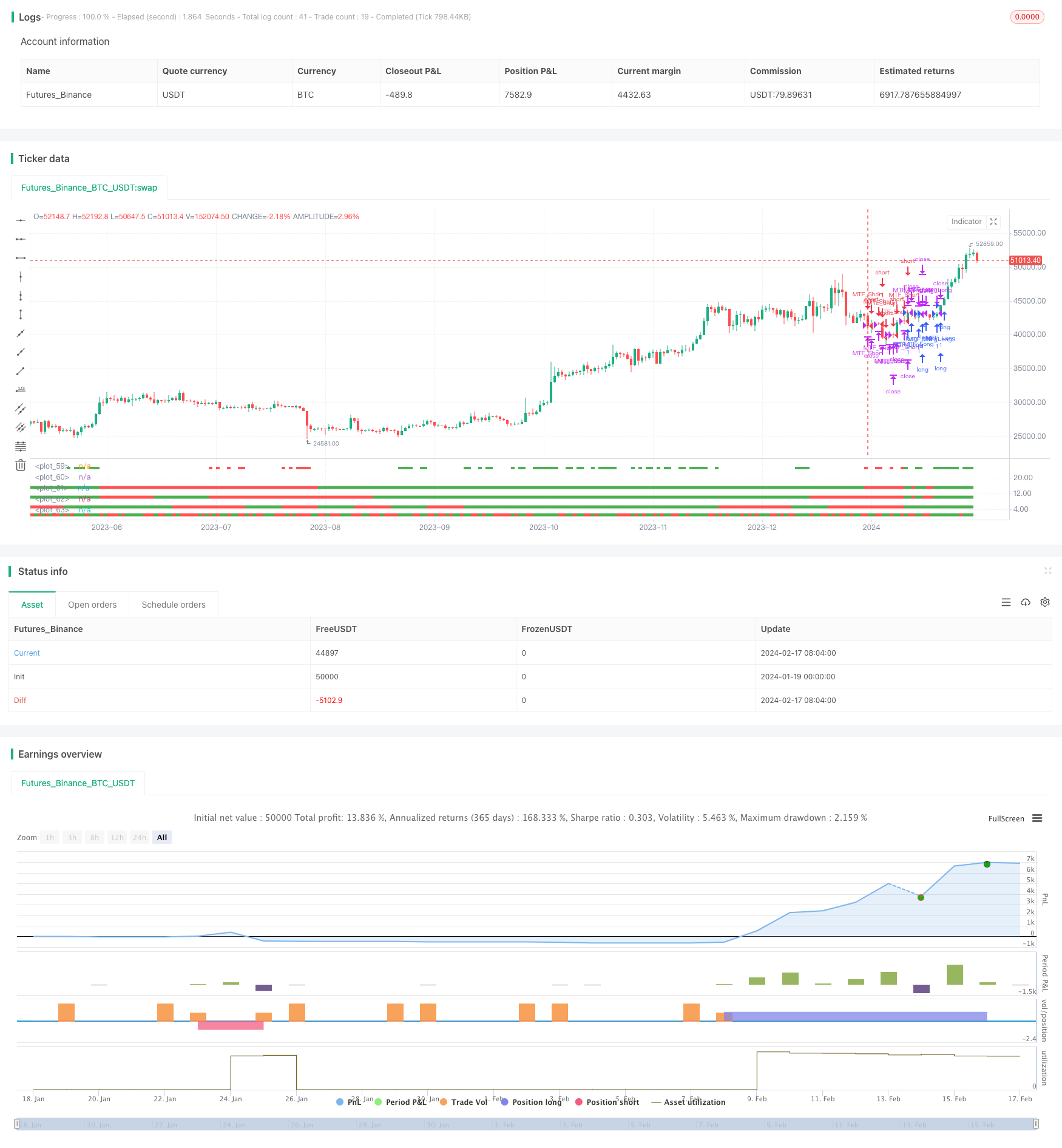
Overview
This strategy utilizes the agreement of indicators across multiple timeframes to track trends. It goes long or short when the daily, 10-day, 15-day and 30-day timeframes simultaneously give bullish or bearish signals, with dynamic stop loss.
Strategy Logic
The strategy judges trend direction using four timeframes - daily, 10-day, 15-day and 30-day. When the closing prices are higher than the opening prices across all four timeframes, it indicates a bullish signal. When the closing prices are lower than the opening prices across all four timeframes, it indicates a bearish signal.
When the signal is bullish, it goes long. When the signal is bearish, it goes short. After entering, KC channel is used for dynamic stop loss.
Specifically, the strategy compares the opening prices and closing prices across different timeframes to determine the trend direction. If closing price is higher than opening price, the timeframe is considered bullish and plotted in green. If closing price is lower than opening price, the timeframe is considered bearish and plotted in red.
When all four timeframes agree on a bullish signal, the strategy will open a long position. When all four timeframes agree on a bearish signal, the strategy will open a short position. It will exit when hit the stop loss or the trend reverses.
Advantages
Using multiple timeframes to confirm trends can effectively filter false breakouts and determine trend direction.
Dynamic stop loss can maximize capital protection.
Strict entry criteria reduces unnecessary trades and slippage costs.
Combining multiple timeframes balances profit speed and stability.
Risks
Entry criteria may be too strict, missing some opportunities.
Improper stop loss setting may be too aggressive or conservative.
Inappropriate timeframe selections may not align with longer or shorter term trends.
Sudden reversals from events may not trigger stop loss.
Enhancement Areas
Optimize timeframe selections to balance profit speed and stability.
Test different parameter settings to optimize stop loss levels.
Add machine learning algorithms to assist in judging reversal points.
Monitor significant events to avoid losses from sudden reversals.
Summary
This strategy integrates judgments across multiple timeframes, with strict entry criteria and dynamic stops, aiming for steady returns. It has the risk of missing opportunities and improper risk control. Next step is to continue optimizing parameters for higher stability.
Parameters
| Name | Default | What it controls |
|---|---|---|
| v_input_1 | D | Timeframe 1 |
| v_input_2 | 10D | Timeframe 2 |
| v_input_3 | 15D | Timeframe 3 |
| v_input_4 | 30D | Timeframe 4 |
| v_input_5 | 20 | KC Length |
| v_input_6 | 1.5 | KC MultFactor |
| v_input_7 | 20 | BB Length |
| v_input_8 | true | Contract/Share Amount |
Source Pine Script
/*backtest
start: 2024-01-19 00:00:00
end: 2024-02-18 00:00:00
period: 1d
basePeriod: 1h
exchanges: [{"eid":"Futures_Binance","currency":"BTC_USDT"}]
*/

//@version=2
strategy("[RichG] Easy MTF Strategy v1.1", overlay=false)

TF_1_time = input("D", "Timeframe 1")
TF_2_time = input("10D", "Timeframe 2")
TF_3_time = input("15D", "Timeframe 3")
TF_4_time = input("30D", "Timeframe 4")
lengthKC=input(20, title="KC Length")
multKC = input(1.5, title="KC MultFactor")
lengthBB=input(20, title="BB Length")
transaction_size = input(1, "Contract/Share Amount")

src = close, len = 20


out = sma(src, len)
width = 5
upcolor = green
downcolor = red
neutralcolor = blue
linestyle = line


kc() =>
    ma = sma(close, lengthKC)
    range = tr
    rangema = sma(range, lengthKC)
    upperKC = ma + rangema * multKC
    lowerKC = ma - rangema * multKC
    [lowerKC, upperKC]


bb() =>
    source = close
    basis = sma(source, lengthBB)
    dev = multKC * stdev(source, lengthBB)
    upperBB = basis + dev
    lowerBB = basis - dev
    [upperBB, lowerBB]

TF_1 = request.security(syminfo.tickerid, TF_1_time, open) < request.security(syminfo.tickerid, TF_1_time, close) ? true:false
TF_1_color = TF_1 ? upcolor:downcolor

TF_2 = request.security(syminfo.tickerid, TF_2_time, open) < request.security(syminfo.tickerid, TF_2_time, close) ? true:false
TF_2_color = TF_2 ? upcolor:downcolor

TF_3 = request.security(syminfo.tickerid, TF_3_time, open) < request.security(syminfo.tickerid, TF_3_time, close) ? true:false
TF_3_color = TF_3 ? upcolor:downcolor


TF_4 = request.security(syminfo.tickerid, TF_4_time, open) < request.security(syminfo.tickerid, TF_4_time, close) ? true:false
TF_4_color = TF_4 ? upcolor:downcolor

TF_global = TF_1 and TF_2 and TF_3 and TF_4
TF_global_bear = TF_1 == false and TF_2 == false and TF_3 == false and TF_4 == false
TF_global_color = TF_global ? green : TF_global_bear ? red : white
TF_trigger_width = TF_global ? 6 : width

plot(1, style=linestyle, linewidth=width, color=TF_1_color)
plot(5, style=linestyle, linewidth=width, color=TF_2_color)
plot(10, style=linestyle, linewidth=width, color=TF_3_color)
plot(15, style=linestyle, linewidth=width, color=TF_4_color)
plot(25, style=linestyle, linewidth=4, color=TF_global_color)

exitCondition_Long = TF_global_bear
exitCondition_Short = TF_global

longCondition = TF_global
if (longCondition)
    strategy.entry("MTF_Long", strategy.long, qty=transaction_size)

shortCondition = TF_global_bear
if (shortCondition)
    strategy.entry("MTF_Short", strategy.short, qty=transaction_size)

[kc_lower,kc_upper] = kc()

strategy.close("MTF_Long", when=close < kc_upper)
strategy.close("MTF_Short", when=close > kc_lower)
Published by ChaoZhang on the FMZ strategy square · last modified 2024-02-19. Collected in the Quant Trading Vault. Unvalidated research: re-test with your own data and costs before trusting it.
Build this with AgenKit
A spec is not a trading system. Paste this into your coding agent and AgenKit runs a specialist team — architecture, test-first build, risk gates, review — with paper trading on by default.
/agenkit build a production-grade trading bot with a backtest engine, risk controls and paper trading by default from strategies/Multi-Timeframe-Strategy.md- npx agenkit install engineering-kit in your project
- Paste the command into your agent and approve each phase
- Get tests, backtest, risk controls and a paper-trading switch
Understand it first
Before you run this, read the lesson behind the idea and how to backtest it honestly. Specs like this one are the survivors of an unknown number of trials; deflate their results accordingly.
Related specs
- EMA RSI and MACD Based Multi Timeframe Trading StrategyPine Script · Multi-timeframe · 1h
- Low Pyramid Risk Tracking StrategyPine Script · Multi-timeframe · 1d
- MacD Custom Indicator Multiple Time FrameAll Available OptionsPine Script · Multi-timeframe · 1h
- Multi Timeframe Adaptive Dynamic KDJ Indicator StrategyPine Script · Multi-timeframe · 1d
- Multi Timeframe Dynamic Stop Loss EMA Squeeze Trading StrategyPine Script · Multi-timeframe · 1h
- Multi Timeframe RSI SRSI Trading StrategyPine Script · Multi-timeframe · 1d