Strategy vault / Multi-timeframe
Multi Timeframe Trailing Stop Loss Strategy
This strategy is a multi-timeframe version of my previous simple trailing stop loss strategy. The previous strategy only used basic trailing stop loss to enter positions. It worked pretty well so I tried to improve…
Overview
This strategy is a multi-timeframe version of my previous simple trailing stop loss strategy. The previous strategy only used basic trailing stop loss to enter positions. It worked pretty well so I tried to improve it. I thought what would happen if I use the same ATR trailing stop loss on different timeframes and combine them into one signal.
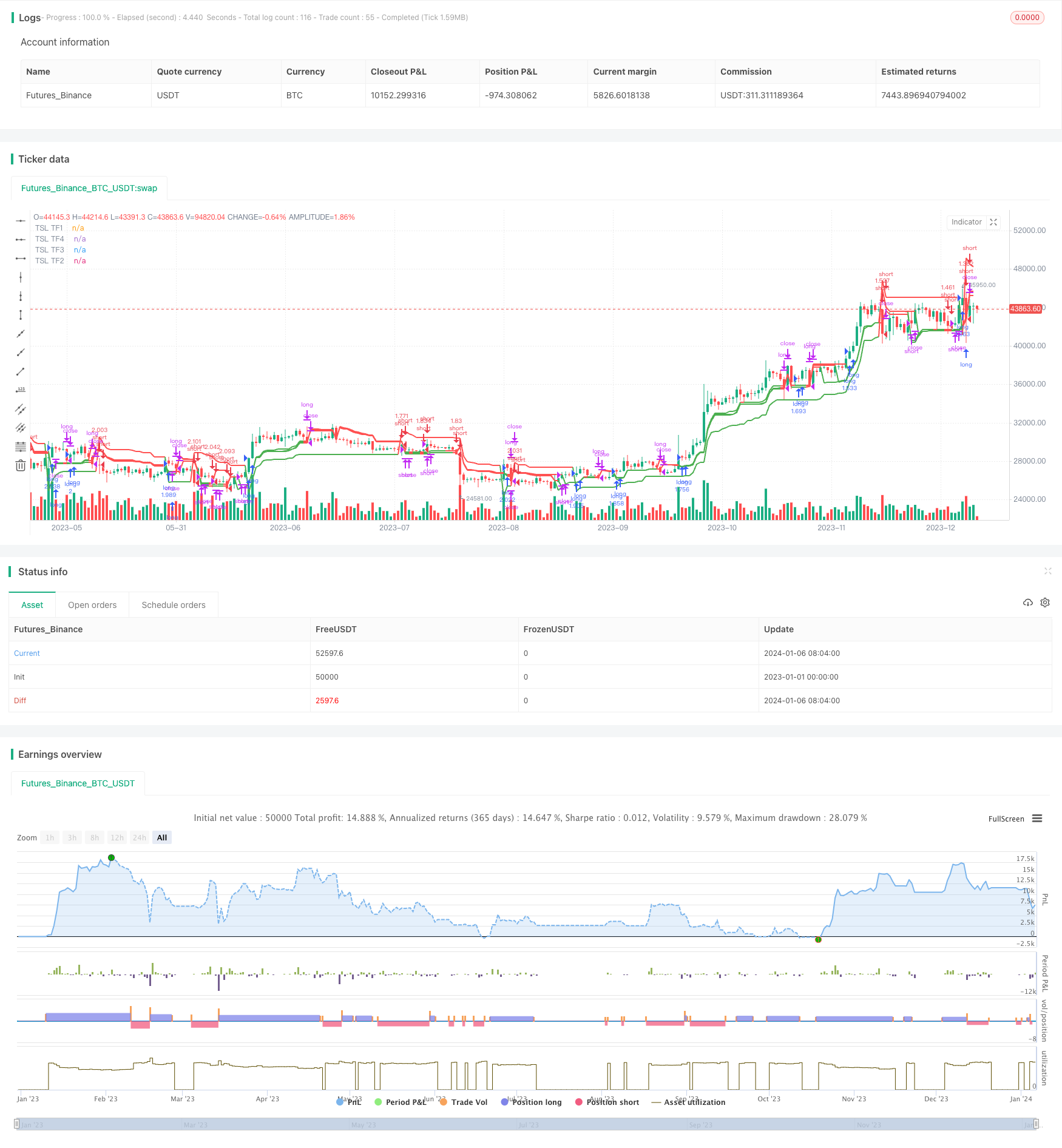
In this strategy you can only use ATR stops and choose 3 other higher timeframes in addition to your current timeframe. The trailing stop loss from all these timeframes will be plotted on the chart. Enter long position if all 4 timeframes agree on long signal. Close long positions when at least 2 timeframes disagree on long signal. The logic for short positions is the same.
Strategy Logic
The core of this strategy lies in trailing stop loss and trend following. Trailing stop loss is used to set stop loss level based on ATR value, which can effectively avoid stop loss from being hit. Trend following determines entry based on observing trend direction across different timeframes.
Specifically, the strategy first calculates ATR value on different timeframes and sets stop loss distance. It then generates long/short signals when price breaks through the stop loss level. If signals from multiple timeframes agree, position will be taken. After that, keep tracking the stop loss level per trend direction. If signals from a certain percentage of timeframes reverse, close position.
By combining trend judgment across different periods, fake breakouts can be filtered out effectively. At the same time, trailing stop locks in profits and controls risk.
Advantages
- Using multiple timeframes helps filter out noise and identify trend direction
- ATR trailing stop adjusts stop distance dynamically, lowering probability of being stopped out
- Combining trend following and stop loss management, you can follow the trend and stop out in time
- Few parameters, easy to understand and optimize
Risk Analysis
- ATR stop may be too close or too far if parameters not set properly, prone to being hit or stop distance too big
- Multiple timeframes combination may not work effectively or judge wrongly if parameters not set properly
- Need to configure both stop loss and timeframe parameters properly, otherwise may not achieve best results
Solutions:
- Test different parameter sets and products to find optimum
- Optimize ratio and number of timeframes to ensure reliable trend judgment
- Adjust ATR multiplier to balance between not being hit and proper distance
Optimization Directions
The strategy can be optimized in the following aspects:
- Add/reduce number of timeframes to find best combinations for trend judgment
- Test different ATR multipliers to determine optimum stop distance
- Add re-entry mechanism to build more positions as trend persists
- Incorporate other filters on entry signals e.g. volume indicators etc
- Parameter tuning for different products
Conclusion
This strategy combines trend following and risk control via multi-timeframe ATR trailing stops. Compared to single stop, it identifies trend direction more clearly; compared to single timeframe, it filters out lots of noise. Proper configuration on stop parameters and timeframes is key to achieve best results. It suits investors who can tolerate certain drawdowns and provides steady returns. There is also further room of enhancement and expansibility. It's a very promising strategy idea.
Parameters
| Name | Default | What it controls |
|---|---|---|
| v_input_1 | 14 | ATR Length |
| v_input_2 | 2 | ATR Mult |
| v_input_3 | 120 | TF2 |
| v_input_4 | 180 | TF3 |
| v_input_5 | 240 | TF4 |
| v_input_6 | true | From Day |
| v_input_7 | true | From Month |
| v_input_8 | 2016 | From Year |
| v_input_9 | true | To Day |
| v_input_10 | true | To Month |
| v_input_11 | 2100 | To Year |
Source Pine Script
/*backtest
start: 2023-01-01 00:00:00
end: 2024-01-07 00:00:00
period: 1d
basePeriod: 1h
exchanges: [{"eid":"Futures_Binance","currency":"BTC_USDT"}]
*/

//@version=4
strategy(title="MTF Trailing SL Strategy [QuantNomad]", shorttitle = "MTF TrailingSL [QN]", overlay = true, default_qty_type = strategy.percent_of_equity, default_qty_value = 100)

////////////
// Inputs //

atr_length = input(14,    title = "ATR Length")
atr_mult   = input(2,     title = "ATR Mult",    type = input.float)

tf2 = input('120', title = "TF2", type = input.string)
tf3 = input('180', title = "TF3", type = input.string)
tf4 = input('240', title = "TF4", type = input.string)

// BACKTESTING RANGE
// From Date Inputs
fromDay   = input(defval = 1,    title = "From Day",   minval = 1, maxval = 31)
fromMonth = input(defval = 1,    title = "From Month", minval = 1, maxval = 12)
fromYear  = input(defval = 2016, title = "From Year",  minval = 1970)

// To Date Inputs
toDay   = input(defval = 1,    title = "To Day",   minval = 1, maxval = 31)
toMonth = input(defval = 1,    title = "To Month", minval = 1, maxval = 12)
toYear  = input(defval = 2100, title = "To Year",  minval = 1970)

// Calculate start/end date and time condition
startDate  = timestamp(fromYear, fromMonth, fromDay, 00, 00)
finishDate = timestamp(toYear,   toMonth,   toDay,   00, 00)

time_cond = time >= startDate and time <= finishDate

//////////////////
// CALCULATIONS //


tsl() =>
    // SL values
    sl_val = atr_mult * atr(atr_length)

    // Init Variables
    pos         = 0
    trailing_sl = 0.0

    // Signals
    long_signal  = nz(pos[1]) !=  1 and high > nz(trailing_sl[1])
    short_signal = nz(pos[1]) != -1 and low  < nz(trailing_sl[1])

    // Calculate SL
    trailing_sl := short_signal     ? high + sl_val :
                   long_signal      ? low  - sl_val :
                   nz(pos[1]) ==  1 ? max(low  - sl_val, nz(trailing_sl[1])) :
                   nz(pos[1]) == -1 ? min(high + sl_val, nz(trailing_sl[1])) :
                   nz(trailing_sl[1])

    // Position var
    pos := long_signal  ? 1 : short_signal ? -1 : nz(pos[1])
    trailing_sl


trailing_sl1 = tsl()
trailing_sl2 = security(syminfo.tickerid, tf2, tsl())
trailing_sl3 = security(syminfo.tickerid, tf3, tsl())
trailing_sl4 = security(syminfo.tickerid, tf4, tsl())

pos1 = 0
pos1 := low <= trailing_sl1 ? -1 : high >= trailing_sl1 ? 1 : nz(pos1[1])

pos2 = 0
pos2 := low <= trailing_sl2 ? -1 : high >= trailing_sl2 ? 1 : nz(pos2[1])

pos3 = 0
pos3 := low <= trailing_sl3 ? -1 : high >= trailing_sl3 ? 1 : nz(pos3[1])

pos4 = 0
pos4 := low <= trailing_sl4 ? -1 : high >= trailing_sl4 ? 1 : nz(pos4[1])

total_pos = pos1 + pos2 + pos3 + pos4

//////////////
// PLOTINGS //

plot(trailing_sl1, linewidth = 2 , color = pos1 == 1 ? color.green : color.red, title = "TSL TF1")
plot(trailing_sl2, linewidth = 2 , color = pos2 == 1 ? color.green : color.red, title = "TSL TF2", transp = 25)
plot(trailing_sl3, linewidth = 2 , color = pos3 == 1 ? color.green : color.red, title = "TSL TF3", transp = 50)
plot(trailing_sl4, linewidth = 2 , color = pos4 == 1 ? color.green : color.red, title = "TSL TF4", transp = 75)

//////////////
// STRATEGY //

//strategy.entry("long",  true,  stop = trailing_sl1)
//strategy.entry("short", false, stop = trailing_sl1)

strategy.entry("long",    true, when = total_pos ==  4)
strategy.entry("short",  false, when = total_pos == -4)

strategy.close("long",  when = total_pos <= 0)
strategy.close("short", when = total_pos >= 0)
Published by ChaoZhang on the FMZ strategy square · last modified 2024-01-08. Collected in the Quant Trading Vault. Unvalidated research: re-test with your own data and costs before trusting it.
Build this with AgenKit
A spec is not a trading system. Paste this into your coding agent and AgenKit runs a specialist team — architecture, test-first build, risk gates, review — with paper trading on by default.
/agenkit build a production-grade trading bot with a backtest engine, risk controls and paper trading by default from strategies/Multi-Timeframe-Trailing-Stop-Loss-Strategy.md- npx agenkit install engineering-kit in your project
- Paste the command into your agent and approve each phase
- Get tests, backtest, risk controls and a paper-trading switch
Understand it first
Before you run this, read the lesson behind the idea and how to backtest it honestly. Specs like this one are the survivors of an unknown number of trials; deflate their results accordingly.
Related specs
- EMA RSI and MACD Based Multi Timeframe Trading StrategyPine Script · Multi-timeframe · 1h
- Multi Timeframe Adaptive Dynamic KDJ Indicator StrategyPine Script · Multi-timeframe · 1d
- Multi Timeframe Dynamic Stop Loss EMA Squeeze Trading StrategyPine Script · Multi-timeframe · 1h
- Multi timeframe RSI and Moving Average Trading StrategyPine Script · Multi-timeframe · 1h
- Multi Timeframe Adaptive Market Regime Quantitative Trading StrategyPine Script · Multi-timeframe · 1m
- Multi Timeframe Quantitative Trading Strategy Based on EMA Smoothed RSI and ATR Dynamic Stop Loss Take ProfitPine Script · Multi-timeframe · 1d