Strategy vault / Mean reversion
P Signal Reversal Strategy
The P-Signal reversal strategy is a quantitative trading strategy built based on statistical parameters and error functions to construct a probabilistic signal space. It dynamically acquires trading signals by…
Overview
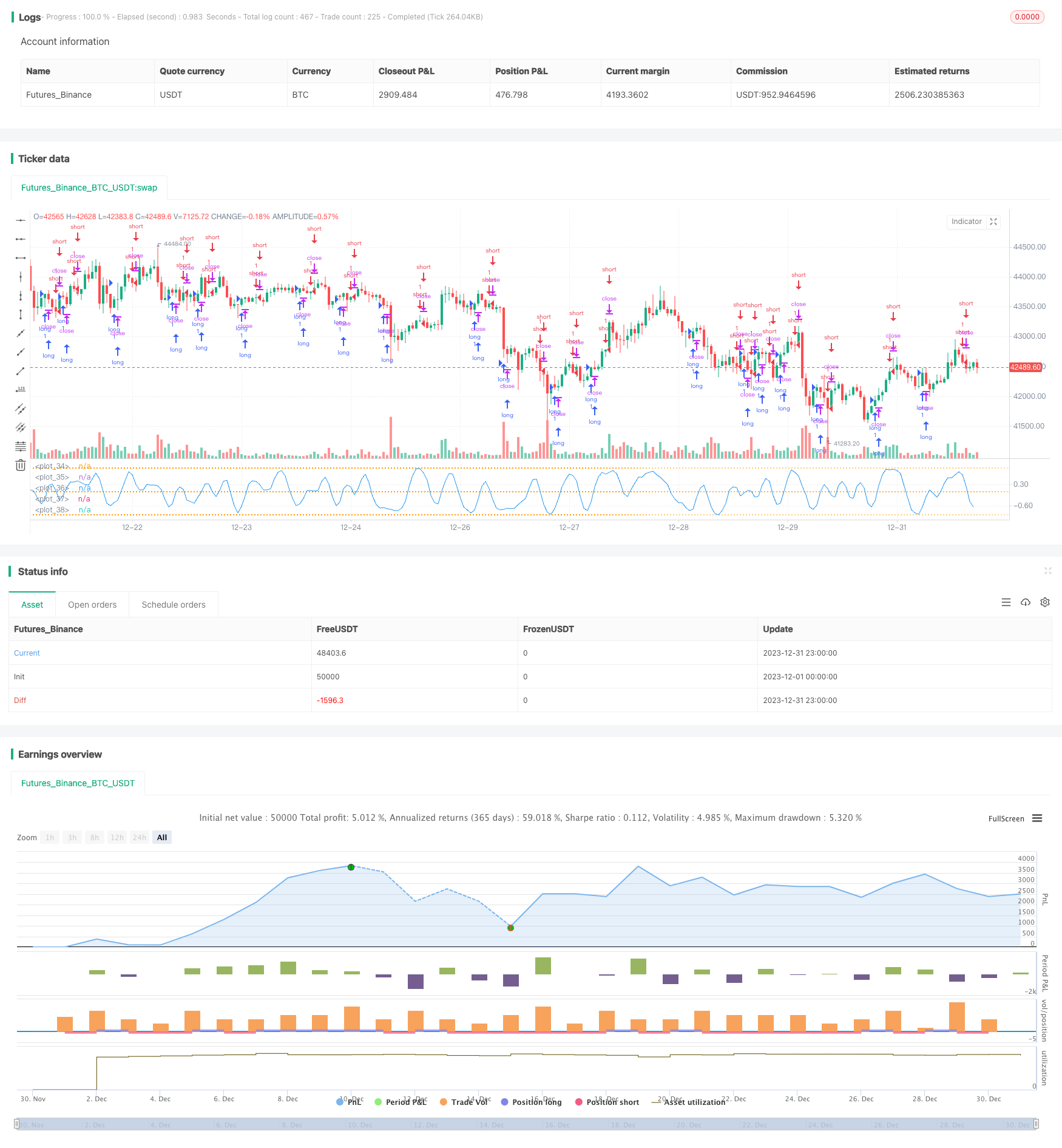
The P-Signal reversal strategy is a quantitative trading strategy built based on statistical parameters and error functions to construct a probabilistic signal space. It dynamically acquires trading signals by tracking the extreme value distributions of a series of K-lines to capture market reversal points.
Strategy Principles
The core indicator of this strategy is the P-signal, which combines the statistical parameters of moving averages and standard deviations and maps them to the range of -1 to 1 through the Gaussian error function to form a quantified judgment indicator. It goes short when the P-signal reverses from positive to negative, and goes long when it reverses from negative to positive, forming a reversal strategy logic.
Strategy parameters include Cardinality, ΔErf and Observation Time. Cardinality controls the sample size, ΔErf controls the dead band of the error function to reduce trading frequency. Observation time controls the start time of the strategy.
Advantage Analysis
The biggest advantage of the P-signal reversal strategy is that it is built on the probability distributions of statistical parameters, which can effectively judge the characteristic points of the market and capture reversal opportunities. Compared with a single technical indicator, it incorporates more market information and makes more comprehensive and reliable judgements.
In addition, the parameterized design of the strategy is well regulated, allowing users to adjust the parameter space according to their own needs to find the optimal combination. This ensures the adaptability and flexibility of the strategy.
Risk Analysis
The main risk of the P-signal reversal strategy is that it relies too much on the parameters of the probability distribution, which is easily affected by abnormal data resulting in misjudgements. In addition, the risk-reward ratio of reversal strategies is generally low, with limited single profit.
Increasing the Cardinality parameter to increase the sample size can reduce the impact of data anomalies. Appropriately expanding the ΔErf range to reduce trading frequency helps control risks.
Optimization Directions
The P-signal reversal strategy can be optimized in the following aspects:
Incorporate other indicators to filter out abnormal signals, such as sharp increases in volume.
Validate signals across multiple timeframes to enhance judgment stability.
Increase stop loss strategies to reduce single losses.
Optimize parameters to find the best combination and improve profitability.
Incorporate machine learning for dynamic parameter adjustment.
Summary
The P-signal reversal strategy establishes a quantitative trading framework based on probability distributions with flexible parameter designs and user friendliness. It effectively judges the statistical characteristics of markets and captures reversal opportunities. The strategy can be further enhanced in stability and profitability through multi-indicator validation, stop loss optimization and other means. It provides an efficient and reliable paradigm for algorithmic trading using quantitative techniques.
Parameters
| Name | Default | What it controls |
|---|---|---|
| v_input_int_1 | 4 | (?Parameters of strategy.)Cardinality: |
| v_input_float_1 | false | | ΔErf | : |
| v_input_1 | timestamp(30 Dec 1957 00:00 +0300) | (?Observation time.)Start date: |
Source Pine Script
/*backtest
start: 2023-12-01 00:00:00
end: 2023-12-31 23:59:59
period: 1h
basePeriod: 15m
exchanges: [{"eid":"Futures_Binance","currency":"BTC_USDT"}]
*/

//@version=5
// **********************************************************************************************************
// This source code is subject to the terms of the Mozilla Public License 2.0 at https://mozilla.org/MPL/2.0/
// P-Signal Strategy RVS © Kharevsky
// **********************************************************************************************************
strategy('P-Signal Strategy RVS.', precision=3, process_orders_on_close=true, pyramiding=0,
     commission_type=strategy.commission.percent,
     commission_value=0.2)
// Parameters and const of P-Signal.
nPoints = input.int(title='Cardinality:', defval=4, minval=4, maxval=200, group='Parameters of strategy.')
ndErf = input.float(title='|ΔErf|:', defval=0, minval=0, maxval=1, step=0.01, group='Parameters of strategy.')
tStartDate = input(title='Start date:', defval=timestamp('30 Dec 1957 00:00 +0300'), group='Observation time.')
int nIntr = nPoints - 1
// Horner's method for the error (Gauss) & P-Signal functions.
fErf(x) =>
    nT = 1.0 / (1.0 + 0.5 * math.abs(x))
    nAns = 1.0 - nT * math.exp(-x * x - 1.26551223 +
     nT * (1.00002368 + nT * (0.37409196 + nT * (0.09678418 +
     nT * (-0.18628806 + nT * (0.27886807 + nT * (-1.13520398 +
     nT * (1.48851587 + nT * (-0.82215223 + nT * 0.17087277)))))))))
    x >= 0 ? nAns : -nAns
fPSignal(ser, int) =>
    nStDev = ta.stdev(ser, int)
    nSma = ta.sma(ser, int)
    nStDev > 0 ? fErf(nSma / nStDev / math.sqrt(2)) : math.sign(nSma)
// Data.
float nPSignal = ta.sma(fPSignal(ta.change(ohlc4), nIntr), nIntr)
float ndPSignal = math.sign(nPSignal[0] - nPSignal[1])
bool isStartDate = true
// Reversal Strategy.
strategy.entry('short', strategy.short, when=isStartDate and nPSignal > ndErf and ndPSignal < 0)
strategy.entry('long', strategy.long, when=isStartDate and nPSignal < -ndErf and ndPSignal > 0)
// Plotting.
hline(+1.0, color=color.new(color.orange, 70), linestyle=hline.style_dotted, editable=false)
hline(-1.0, color=color.new(color.orange, 70), linestyle=hline.style_dotted, editable=false)
hline(-ndErf, color=color.new(color.orange, 70), linestyle=hline.style_dotted, editable=false)
hline(ndErf, color=color.new(color.orange, 70), linestyle=hline.style_dotted, editable=false)
plot(nPSignal, color=color.new(color.blue, 0), style=plot.style_line)
// Table of state.
if barstate.isconfirmed
    var Table = table.new(position=position.bottom_right, columns=3, rows=1,
     frame_color=color.new(color.orange, 70), frame_width=1,
     border_color=color.new(color.orange, 70), border_width=1)
    table.cell(table_id=Table, column=0, row=0,
     text=strategy.position_size > 0 ? 'Long: ' + str.tostring(strategy.position_size) : 'Short: ' + str.tostring(strategy.position_size),
     text_color=strategy.position_size > 0 ? color.green : color.red)
    table.cell(table_id=Table, column=1, row=0,
     text='Net P/L: ' + str.tostring(strategy.netprofit, '#.#'),
     text_color=strategy.netprofit > 0 ? color.green : color.red)
    table.cell(table_id=Table, column=2, row=0,
     text='Open P/L: ' + str.tostring(strategy.openprofit, '#.#'),
     text_color=strategy.openprofit > 0 ? color.green : color.red)
// The end.
Published by ChaoZhang on the FMZ strategy square · last modified 2024-01-29. Collected in the Quant Trading Vault. Unvalidated research: re-test with your own data and costs before trusting it.
Build this with AgenKit
A spec is not a trading system. Paste this into your coding agent and AgenKit runs a specialist team — architecture, test-first build, risk gates, review — with paper trading on by default.
/agenkit build a production-grade trading bot with a backtest engine, risk controls and paper trading by default from strategies/P-Signal-Reversal-Strategy.md- npx agenkit install engineering-kit in your project
- Paste the command into your agent and approve each phase
- Get tests, backtest, risk controls and a paper-trading switch
Understand it first
Before you run this, read the lesson behind the idea and how to backtest it honestly. Specs like this one are the survivors of an unknown number of trials; deflate their results accordingly.
Related specs
- 3 10 Oscillator Profile Flagging StrategyPine Script · Mean reversion · 1d
- A Trend Reversal Strategy Based on Moving Averages Price Patterns and VolumePine Script · Mean reversion · 1d
- Adaptive Mean Reversion Trading Strategy Based on Chande Momentum OscillatorPine Script · Mean reversion · 1d
- Adaptive Trading Strategy Combining Dynamic Trend Reversal and Stochastic IndicatorPine Script · Mean reversion · 1d
- Advanced 15 Minute Chart Trading Signal StrategyPine Script · Mean reversion · 3h
- Advanced Momentum EMA Trend Following with RSI Overbought Oversold Trading StrategyPine Script · Mean reversion · 1d