Peak to Peak Pattern Based Trading Strategy
The strategy is named "Peak-to-Peak Pattern Based Trading Strategy". It mainly uses the peak-to-peak pattern in candlestick charts to determine entries and exits. This is a technical analysis based strategy.
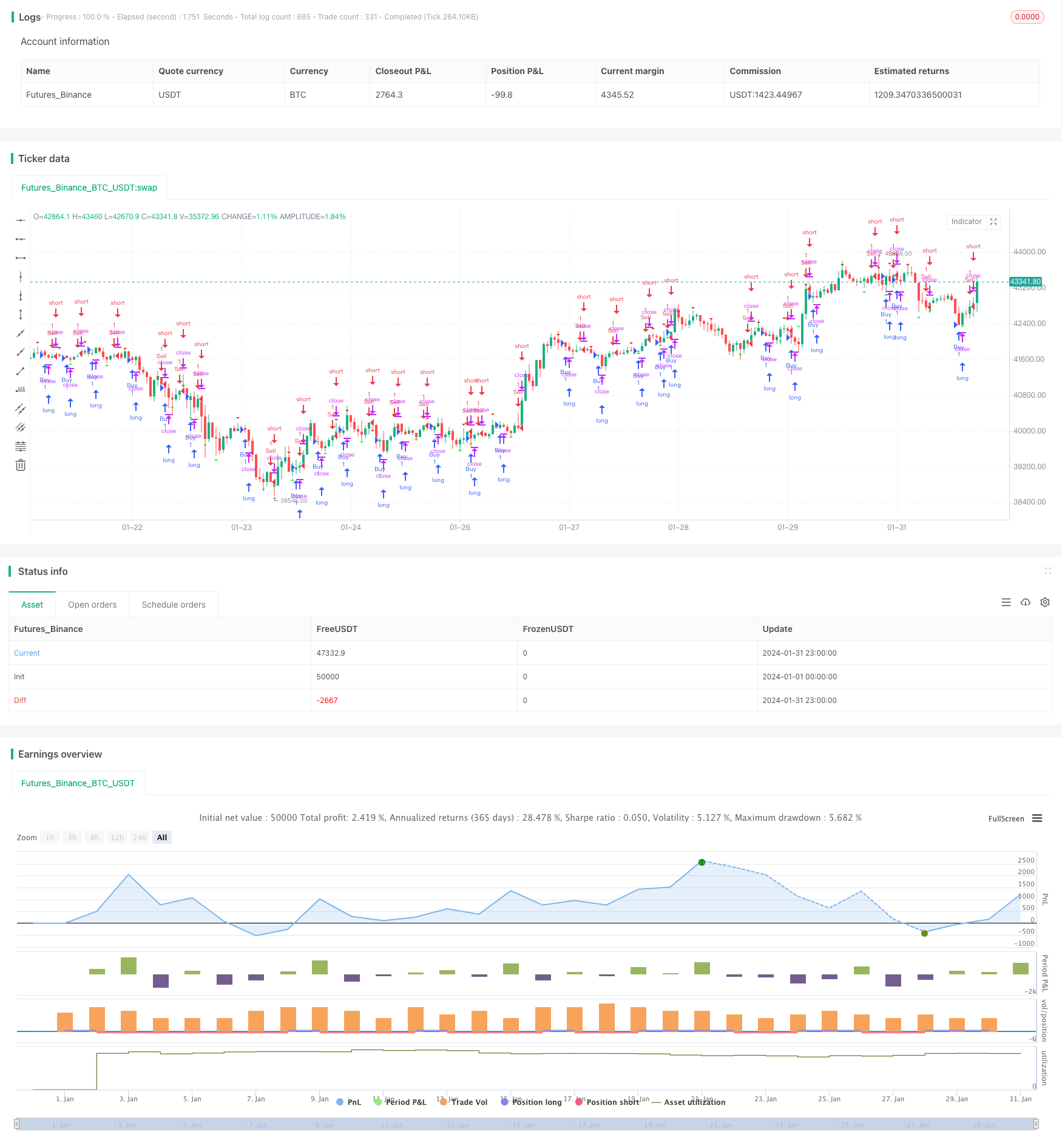
Overview
The strategy is named "Peak-to-Peak Pattern Based Trading Strategy". It mainly uses the peak-to-peak pattern in candlestick charts to determine entries and exits. This is a technical analysis based strategy.
Strategy Principle
The strategy defines rising peak (upFractal) and falling peak (downFractal) to identify the peak-to-peak pattern in candlestick charts.
Specifically, the judgment logic for rising peak is: the high of current candlestick is the highest of recent n candlesticks, and the high of subsequent candlesticks does not exceed the current one.
The judgment logic for falling peak is: the low of current candlestick is the lowest of recent n candlesticks, and the low of subsequent candlesticks does not break below the current one.
Boolean variables and loops are used here to determine the relationship between previous n and later n candlesticks' high/low and that of the current one, and eventually identify rising and falling peaks.
Therefore, the core logic of this strategy is:
- Identify rising peaks and falling peaks
- Long on rising peaks and short on falling peaks
Advantage Analysis
The advantages of this strategy include:
- Peak-to-peak pattern is easy to identify, simple to operate
- Based on technical pattern, not affected by fundamentals
- Possible smaller drawdowns
Risk Analysis
There are also some risks with this strategy:
- Inaccurate peak-to-peak pattern judgment, may miss best entry timing
- Hard to set stop loss when market moves violently
- Only relies on pattern, ignores other factors
Counter measures:
- Adjust parameters of peak-to-peak pattern to optimize the logic
- Combine with other indicators to determine stop loss position
- Use together with fundamental or other analysis
Optimization Directions
Some directions to optimize the strategy:
- Increase parameter tuning options to better identify peak-to-peak patterns
- Add stop loss logic
- Consider trading volume, volatility and other indicators
- Combine different timeframe analysis
Summary
This strategy is simple to operate with possibly smaller drawdowns based on the peak-to-peak pattern principle. But still has some risks and needs to be combined with other analysis methods to maximize its performance. Next step is to improve on accuracy of pattern judgment, stop loss, indicator optimizations etc.
Parameters
| Name | Default | What it controls |
|---|---|---|
| v_input_int_1 | 2 | Periods |
Source Pine Script
/*backtest
start: 2024-01-01 00:00:00
end: 2024-01-31 23:59:59
period: 1h
basePeriod: 15m
exchanges: [{"eid":"Futures_Binance","currency":"BTC_USDT"}]
*/

//@version=5
strategy("sanju parmar", shorttitle="sanju trading empire", overlay=true)

// Define "n" as the number of periods and keep a minimum value of 2 for error handling.
n = input.int(title="Periods", defval=2, minval=2)

// UpFractal
bool upflagDownFrontier = true
bool upflagUpFrontier0 = true
bool upflagUpFrontier1 = true
bool upflagUpFrontier2 = true
bool upflagUpFrontier3 = true
bool upflagUpFrontier4 = true

for i = 1 to n
    upflagDownFrontier := upflagDownFrontier and (high[n-i] < high[n])
    upflagUpFrontier0 := upflagUpFrontier0 and (high[n+i] < high[n])
    upflagUpFrontier1 := upflagUpFrontier1 and (high[n+1] <= high[n] and high[n+i + 1] < high[n])
    upflagUpFrontier2 := upflagUpFrontier2 and (high[n+1] <= high[n] and high[n+2] <= high[n] and high[n+i + 2] < high[n])
    upflagUpFrontier3 := upflagUpFrontier3 and (high[n+1] <= high[n] and high[n+2] <= high[n] and high[n+3] <= high[n] and high[n+i + 3] < high[n])
    upflagUpFrontier4 := upflagUpFrontier4 and (high[n+1] <= high[n] and high[n+2] <= high[n] and high[n+3] <= high[n] and high[n+4] <= high[n] and high[n+i + 4] < high[n])
flagUpFrontier = upflagUpFrontier0 or upflagUpFrontier1 or upflagUpFrontier2 or upflagUpFrontier3 or upflagUpFrontier4

upFractal = (upflagDownFrontier and flagUpFrontier)


// downFractal
bool downflagDownFrontier = true
bool downflagUpFrontier0 = true
bool downflagUpFrontier1 = true
bool downflagUpFrontier2 = true
bool downflagUpFrontier3 = true
bool downflagUpFrontier4 = true

for i = 1 to n
    downflagDownFrontier := downflagDownFrontier and (low[n-i] > low[n])
    downflagUpFrontier0 := downflagUpFrontier0 and (low[n+i] > low[n])
    downflagUpFrontier1 := downflagUpFrontier1 and (low[n+1] >= low[n] and low[n+i + 1] > low[n])
    downflagUpFrontier2 := downflagUpFrontier2 and (low[n+1] >= low[n] and low[n+2] >= low[n] and low[n+i + 2] > low[n])
    downflagUpFrontier3 := downflagUpFrontier3 and (low[n+1] >= low[n] and low[n+2] >= low[n] and low[n+3] >= low[n] and low[n+i + 3] > low[n])
    downflagUpFrontier4 := downflagUpFrontier4 and (low[n+1] >= low[n] and low[n+2] >= low[n] and low[n+3] >= low[n] and low[n+4] >= low[n] and low[n+i + 4] > low[n])
flagDownFrontier = downflagUpFrontier0 or downflagUpFrontier1 or downflagUpFrontier2 or downflagUpFrontier3 or downflagUpFrontier4

downFractal = (downflagDownFrontier and flagDownFrontier)

plotshape(downFractal, style=shape.triangleup, location=location.belowbar, offset=-n, color=#18f523, size = size.small)
plotshape(upFractal, style=shape.triangledown, location=location.abovebar, offset=-n, color=#cf3d11, size = size.small)

// Strategy Conditions
longCondition = upFractal
shortCondition = downFractal

// Strategy Entry and Exit
if (longCondition)
    strategy.entry("Buy", strategy.long)
if (shortCondition)
    strategy.entry("Sell", strategy.short)
Published by ChaoZhang on the FMZ strategy square · last modified 2024-02-20. Collected in the Quant Trading Vault. Unvalidated research: re-test with your own data and costs before trusting it.
Build this with AgenKit
A spec is not a trading system. Paste this into your coding agent and AgenKit runs a specialist team — architecture, test-first build, risk gates, review — with paper trading on by default.
/agenkit build a production-grade trading bot with a backtest engine, risk controls and paper trading by default from strategies/Peak-to-Peak-Pattern-Based-Trading-Strategy.md- npx agenkit install engineering-kit in your project
- Paste the command into your agent and approve each phase
- Get tests, backtest, risk controls and a paper-trading switch
Understand it first
Before you run this, read the lesson behind the idea and how to backtest it honestly. Specs like this one are the survivors of an unknown number of trials; deflate their results accordingly.
Related specs
- Dual Bollinger Band Volatility Tracking StrategyPine Script · Volatility · 1d
- Dual EMA Volatility Adaptive Trading Strategy with Multi Tiered Profit Optimization SystemPine Script · Volatility · 1d
- Dual Moving Average Volatility Tracking StrategyPine Script · Volatility · 1h
- Dynamic ATR Trailing Stop Trading Strategy Market Volatility Adaptive SystemPine Script · Volatility · 1d
- Multi Indicator Dynamic Volatility Alert Trading SystemPine Script · Volatility · 1m
- Multi Indicator Volatility Trading RSI EMA ATR StrategyPine Script · Volatility · 3m