Strategy vault / Mean reversion
Price based Stop Loss and Take Profit Strategy
The core idea of this strategy is to use the input stop loss and take profit amounts to set reasonable stop loss and take profit tick levels, to manage the risk and reward of each trade.
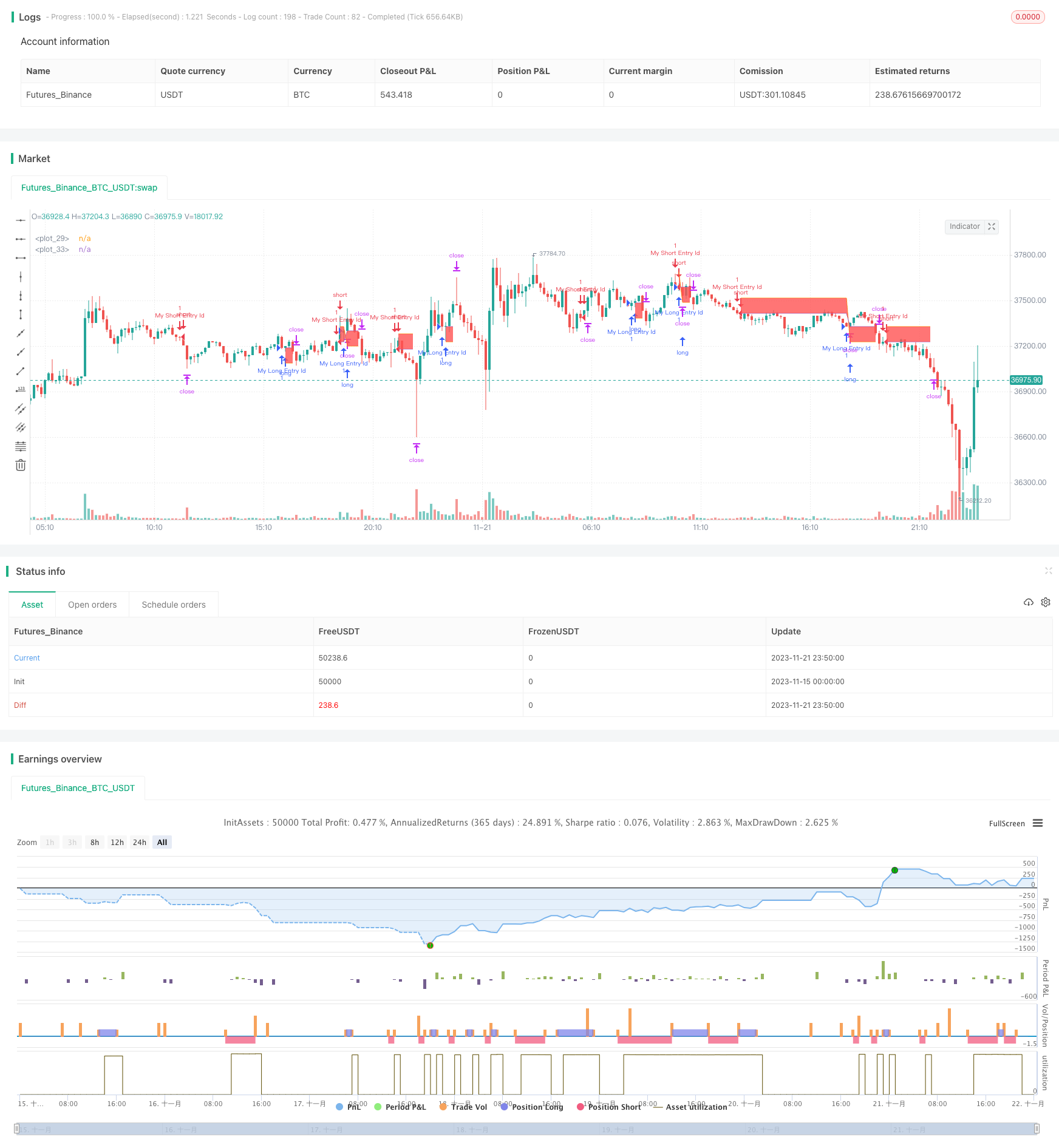
Overview
The core idea of this strategy is to use the input stop loss and take profit amounts to set reasonable stop loss and take profit tick levels, to manage the risk and reward of each trade.
Strategy Logic
The strategy first sets random entry signals, going long when SMA14 crosses over SMA28, and going short when SMA14 crosses under SMA28.
After entry, the strategy uses the moneyToSLPoints function to calculate the stop loss tick level based on the stop loss dollar amount input. Similarly, it also calculates the take profit tick level. This implements stop loss and take profit based on dollar amounts.
For example, if going long 100 contracts with each tick worth $10, and stop loss is set at $100, then the stop loss tick level would be calculated as 100/10/100 = 0.1 ticks.
Finally strategy.exit is used to set the stop loss and take profit exit points. The stop loss and take profit lines are also plotted for debugging purposes.
Advantage Analysis
The biggest advantage of this price-based stop loss and take profit strategy is that the parameters are intuitive. The relationship between risk and reward can be clearly seen to guide parameter selection.
Also, dollar-amount stops can better control actual risk exposure compared to fixed tick stops when market volatility changes.
Risk Analysis
There are some risks with this stop loss and take profit strategy:
If the stop loss is too wide, it's easy to get caught on reversals. If the stop distance is too big, short term reversals become likely and can catch the trade.
If the take profit is too close, it may be hard to reach. If the take profit distance is very small, it would be hard for normal one-sided trends to reach it, making profits unlikely.
Appropriate contracts need to be chosen. If a high tick value contract like Crude Oil is used, the same dollar stop loss would translate to very little ticks, which can easily get stopped out on noise.
Optimization Directions
Some ways this strategy can be improved on:
The entry signal can be enhanced by combining trend, volatility, seasonality etc. to time entries better.
Appropriate stop/profit percentages can be chosen based on different products. Larger stops can be used in highly volatile commodities.
Stops can adapt to volatility. Widen when volatility rises and tighten when volatility falls.
Different stop/profit approaches can be used for different trading sessions. Tighter stops can be used during US session to reduce chance of being caught in whipsaws.
Conclusion
This strategy implements intuitive stop loss and take profit based on dollar amounts. Its advantages are intuitive parameters and capital control. Drawbacks are ease of being caught in reversals and missing profits. It can be improved by enhancing entries, optimizing stops/targets, choosing better products etc. to make it more stable.
Parameters
| Name | Default | What it controls |
|---|---|---|
| v_input_1 | 200 | Take Profit $$ |
| v_input_2 | 100 | Stop Loss $$ |
Source Pine Script
/*backtest
start: 2023-11-15 00:00:00
end: 2023-11-22 00:00:00
period: 10m
basePeriod: 1m
exchanges: [{"eid":"Futures_Binance","currency":"BTC_USDT"}]
*/

// This source code is subject to the terms of the Mozilla Public License 2.0 at https://mozilla.org/MPL/2.0/
// © adolgov

// @description
//

//@version=4
strategy("Stop loss and Take Profit in $$ example", overlay=true)

// random entry condition

longCondition = crossover(sma(close, 14), sma(close, 28))
if (longCondition)
    strategy.entry("My Long Entry Id", strategy.long)

shortCondition = crossunder(sma(close, 14), sma(close, 28))
if (shortCondition)
    strategy.entry("My Short Entry Id", strategy.short)

moneyToSLPoints(money) =>
    strategy.position_size !=0 ? (money / syminfo.pointvalue / abs(strategy.position_size)) / syminfo.mintick : na

p = moneyToSLPoints(input(200, title = "Take Profit $$"))
l = moneyToSLPoints(input(100, title = "Stop Loss $$"))
strategy.exit("x", profit = p, loss = l)

// debug plots for visualize SL & TP levels
pointsToPrice(pp) =>
    na(pp) ? na : strategy.position_avg_price + pp * sign(strategy.position_size) * syminfo.mintick

pp = plot(pointsToPrice(p), style = plot.style_linebr )
lp = plot(pointsToPrice(-l), style = plot.style_linebr )
avg = plot( strategy.position_avg_price, style = plot.style_linebr )
fill(pp, avg, color = color.green)
fill(avg, lp, color = color.red)
Published by ChaoZhang on the FMZ strategy square · last modified 2023-11-23. Collected in the Quant Trading Vault. Unvalidated research: re-test with your own data and costs before trusting it.
Build this with AgenKit
A spec is not a trading system. Paste this into your coding agent and AgenKit runs a specialist team — architecture, test-first build, risk gates, review — with paper trading on by default.
/agenkit build a production-grade trading bot with a backtest engine, risk controls and paper trading by default from strategies/Price-based-Stop-Loss-and-Take-Profit-Strategy.md- npx agenkit install engineering-kit in your project
- Paste the command into your agent and approve each phase
- Get tests, backtest, risk controls and a paper-trading switch
Understand it first
Before you run this, read the lesson behind the idea and how to backtest it honestly. Specs like this one are the survivors of an unknown number of trials; deflate their results accordingly.
Related specs
- 3 10 Oscillator Profile Flagging StrategyPine Script · Mean reversion · 1d
- A Trend Reversal Strategy Based on Moving Averages Price Patterns and VolumePine Script · Mean reversion · 1d
- Adaptive Mean Reversion Trading Strategy Based on Chande Momentum OscillatorPine Script · Mean reversion · 1d
- Adaptive Trading Strategy Combining Dynamic Trend Reversal and Stochastic IndicatorPine Script · Mean reversion · 1d
- Advanced 15 Minute Chart Trading Signal StrategyPine Script · Mean reversion · 3h
- Advanced Momentum EMA Trend Following with RSI Overbought Oversold Trading StrategyPine Script · Mean reversion · 1d